. 2018 Aug 8:9:980.
doi: 10.3389/fpls.2018.00980. eCollection 2018.

Family-Four Aldehyde Dehydrogenases Play an Indispensable Role in the Pathogenesis of Magnaporthe oryzae

Affiliations

Family-Four Aldehyde Dehydrogenases Play an Indispensable Role in the Pathogenesis of Magnaporthe oryzae

Waheed Abdul et al. Front Plant Sci. .

Abstract

The oxidative degradation of lipids through lipid peroxidation processes results in the generation of free fatty acid radicals. These free radicals including reactive oxygen species (ROS) serve as a substrate for generating reactive aldehydes. The accumulation of free fatty acid radicals, ROS, and reactive aldehydes in cell compartments beyond physiological threshold levels tends to exert a damaging effect on proximal membranes and distal tissues. Living organisms deploy a wide array of efficient enzymes including superoxide dismutase (SOD), catalase (CAT), peroxidase (POD), and aldehyde dehydrogenases (ALDHs) for scavenging reactive molecules and intermediates produced from membrane lipid peroxidation events. Although the contributions of SOD, CAT, and POD to the pathogenesis of microbial plant pathogens are well known, the influence of ALDH genes on the morphological and infectious development of plant pathogenic microbes is not well understood. In this study, we deployed RNA interference (RNAi) techniques and successfully silenced two putative family-four aldehyde dehydrogenase genes potassium-activated aldehyde dehydrogenase (MoKDCDH) and delta-1-pyrrorine-5-carboxylate dehydrogenase (MoP5CDH) in the rice blast pathogen Magnaporthe oryzae. The results obtained from the phenotypic analysis of individual knock-down strains showed that the RNAi-mediated inactivation of MoKDCDH and MoP5CDH triggered a significant reduction in conidiogenesis and vegetative growth of ΔMokdcdh and ΔMop5cdh strains. We further observed that downregulating the expression of MoKDCDH and MoP5CDH severely compromised the pathogenesis of the rice blast fungus. Also, the disruption of MoKDCDH and MoP5CDH M. oryzae undermined membrane integrity and rendered the mutant strains highly sensitive to membrane stress inducing osmolytes. However, the MoKDCDH and MoP5CDH knock-down strains generated in this study displayed unaltered cell wall integrity and thus suggested that family-four ALDHs play a dispensable role in enforcing cell wall-directed stress tolerance in M. oryzae. From these results, we deduced that family-four ALDHs play a conserved role in fostering membrane integrity in M. oryzae possibly by scavenging reactive aldehydes, fatty acid radicals, and other alcohol derivatives. The observation that downregulating the expression activities of MoKDCDH had a lethal effect on potential mutants further emphasized the need for comprehensive and holistic evaluation of the numerous ALDHs amassed by the rice blast fungus for their possible engagement as suitable targets as antiblast agents.

Keywords: Magnaporthe oryzae; aldehyde dehydrogenase; aldehydes; free fatty acid radicals; lipid peroxidation.


Figures
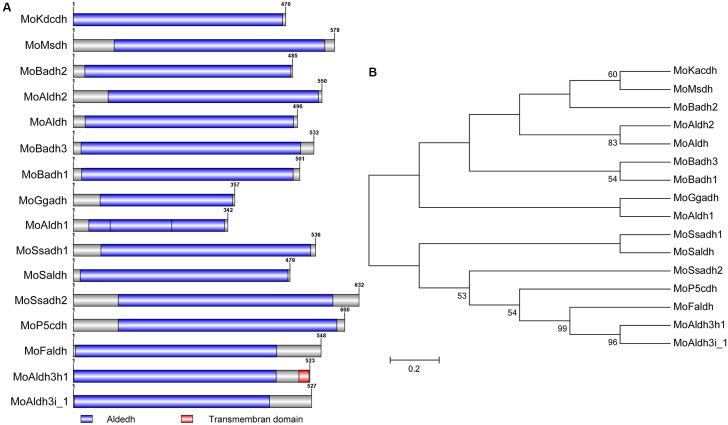
FIGURE 1
FIGURE 1
Domain architecture and domain base phylogeny of MoALDHs. (A) Structure dynamics of the conserved Aldedh-domain predicted for the 16 ALDHs identified in M. oryzae genome. (B). Domain sequence-mediated clustering and maximum-likelihood phylogeny of all the 16 M. oryzae aldehyde dehydrogenases tested with 1,000 bootstrap replicates.
FIGURE 2
FIGURE 2
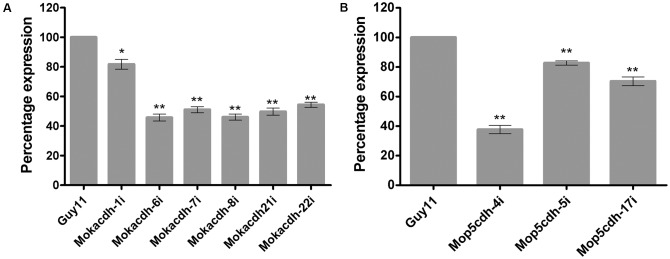
Percentage (%) fold expression of MoKDCDH and MoP5CDH in respective knock-down mutants. (A) The expression level of MoKDCDH in six different independent knock-down mutants of MoKDCDH. (B) The fold expression of MoP5CDH in the three independent MoP5CDH knock-down mutants. The quantitative real-time PCR (qRT-PCR) data were computed with Microsoft Excel spread sheet in conjuction with graphpad prism6. The error bars represent mean ± SD, whereas single and double asterisks “” represent a significant reduction in the fold expression of MoKDCDH and MoP5CDH in their respective knock-down strains. Consistent values were obtained with five independent biological replications and three technical replicates for each independent qRT-PCR experiment.
FIGURE 3
FIGURE 3
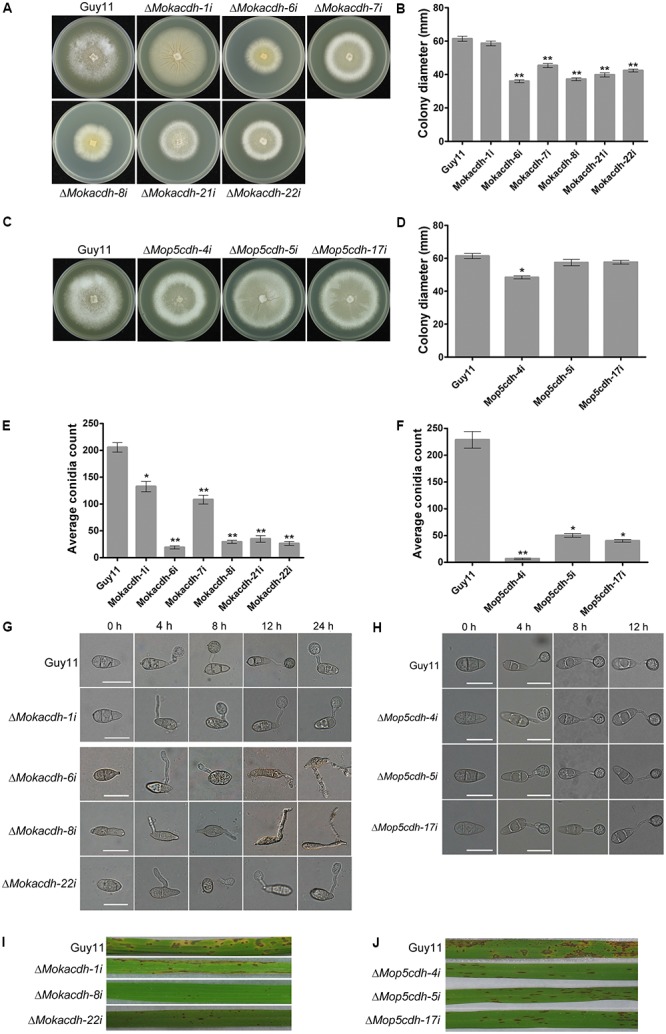
Family-four aldehyde dehydrogenases play indispensable role in survival, growth, sporulation, and pathogenesis of M. oryzae. (A) Average colony diameters of ΔMokdcdh knock-down strains and the wild-type strain cultured on CM media for 10 days. (B) Statistical evidence of growth defects exhibited by the six independent ΔMokdcdh knock-down strains compared with the wild-type strain. (C) The average colony diameters of MoP5CDH knock-down strains and the (wild-type strain cultured on CM media for 10 days. (D) The statistical evaluation of the vegetative growth level recorded in the ΔMop5cdh knock-down strains compared with the wild-type strain. (E) Conidiation abilities of the respective ΔMokdcdh knock-down strains and the wild-type strain cultured under the same growth conditions. (F) Statistical presentation of conidiation characteristics of the various ΔMop5cdh knock-down strains compared with the wild-type strains cultured under similar growth conditions. (G) The different types of conidia abnormalities as well as germination and appressorium abnormalities exhibited by the six independent ΔMokdcdh knock-down strains. (H) Morphology conidia, conidia germination, and appressorium formation characteristics exhibited by the three independent MoP5CDH knock-down mutants generated in this study. (I) Results obtained from infection assays conducted by spray inoculation susceptible CO39 rice seedlings with conidia obtained from the six independent ΔMokdcdh knock-down strains along with the wild-type conidia as control. (J) Infection capabilities of the three MoP5CDH knock-down strains. Both statistical and nonstatistical experimental data were generated from three independent biological experiments with three replicates each time with consistent results. One-way ANOVA (nonparametric) statistical analysis was carried out with graphpad prism6 and Microsoft Excel spreadsheet, and the error bars represent the standard deviation. Single and double asterisk(s) “” represent significant differences existing between Guy11 and the respective knock-down mutants (P < 0.05) and (P < 0.01).)
FIGURE 4
FIGURE 4
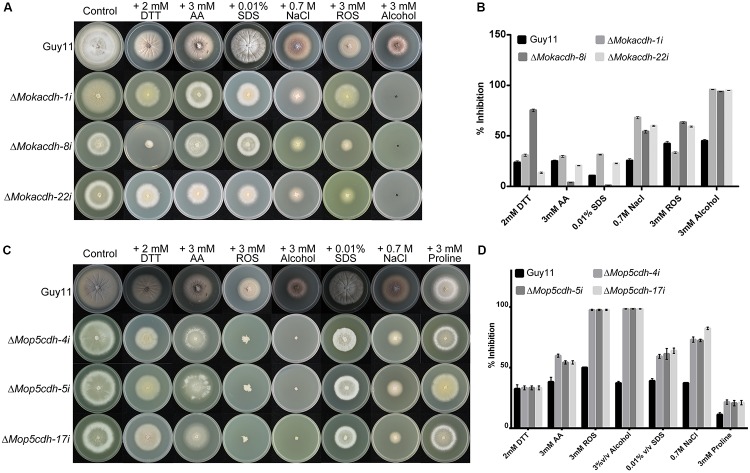
Family-four aldehyde dehydrogenases contribute oxidative and reductive stress tolerance in M. oryzae. (A) Growth response of ΔMokdcdh knock-down strains and the wild-type strain on CM supplemented with 3 mM H2O2, 3% v/v alcohol, 0.7 M NaCl, 0.01% v/v SDS, 2 mM DTT, and 3 mM acetaldehyde, as osmolytes with the aim to assess the contribution of MoKDCDH to stress tolerance of M. oryzae. (B) The percent inhibition of ΔMokdcdh knock-down strains and the wild-type strain on CM supplemented with 3 mM H2O2, 3% v/v alcohol, 0.7 M NaCl, 0.01% v/v SDS, 2 mM DTT, and 3 mM acetaldehyde. (C) Sensitivity of ΔMop5cdh knock-down strains along with the wild-type strain to 3 mM H2O2, 3% v/v alcohol, 0.7 M NaCl, 0.01% v/v SDS, 2 mM DTT, and 3 mM acetaldehyde. (D) The percent inhibition of respective ΔMop5cdh knock-down strains and the wild-type strain grown on CM supplemented with 3 mM H2O2, 3% v/v alcohol, 0.7 M NaCl, 0.01% v/v SDS, 2 mM DTT, and 3 mM acetaldehyde. One-way ANOVA (nonparametric) was used in the statistical evaluation of percent inhibition, computational analysis was performed with graphpad prism6 software and Microsoft Excel spreadsheet, and the error bars represent the standard deviation. The percent inhibition was obtained by the formula: Inhibition rate = (the diameter of untreated strain – the diameter of treated strain)/(the diameter of untreated strain × 100%)].

References

    1. Brocker C., Vasiliou M., Carpenter S., Carpenter C., Zhang Y., Wang X., et al. (2013). Aldehyde dehydrogenase (ALDH) superfamily in plants: gene nomenclature and comparative genomics. Planta 237 189–210. 10.1007/s00425-012-1749-0 - DOI - PMC - PubMed
    1. Bryan N., Ahswin H., Smart N., Bayon Y., Wohlert S., Hunt J. A. (2012). Reactive oxygen species (ROS)–a family of fate deciding molecules pivotal in constructive inflammation and wound healing. Eur. Cell Mater. 24 249–265. 10.22203/eCM.v024a18 - DOI - PubMed
    1. Buchman C. D., Hurley T. D. (2017). Inhibition of the aldehyde dehydrogenase 1/2 family by psoralen and coumarin derivatives. J. Med. Chem. 60 2439–2455. 10.1021/acs.jmedchem.6b01825 - DOI - PMC - PubMed
    1. Conrad K. A., Rodriguez R., Salcedo E. C., Rauceo J. M. (2018). The Candida albicans stress response gene stomatin-like protein 3 is implicated in ROS-induced apoptotic-like death of yeast phase cells. PLoS One 13:e0192250. 10.1371/journal.pone.0192250 - DOI - PMC - PubMed
    1. Dong Y., Liu H., Zhang Y., Hu J., Feng J., et al. (2017). Comparative genomic study of ALDH gene superfamily in Gossypium: a focus on Gossypium hirsutum under salt stress. PLoS One 12:e0176733. 10.1371/journal.pone.0176733 - DOI - PMC - PubMed