


Gamification for health and wellbeing: A systematic review of the literature
- PMID: 30135818
- PMCID: PMC6096297
- DOI: 10.1016/j.invent.2016.10.002
Gamification for health and wellbeing: A systematic review of the literature
Abstract
Background: Compared to traditional persuasive technology and health games, gamification is posited to offer several advantages for motivating behaviour change for health and well-being, and increasingly used. Yet little is known about its effectiveness.
Aims: We aimed to assess the amount and quality of empirical support for the advantages and effectiveness of gamification applied to health and well-being.
Methods: We identified seven potential advantages of gamification from existing research and conducted a systematic literature review of empirical studies on gamification for health and well-being, assessing quality of evidence, effect type, and application domain.
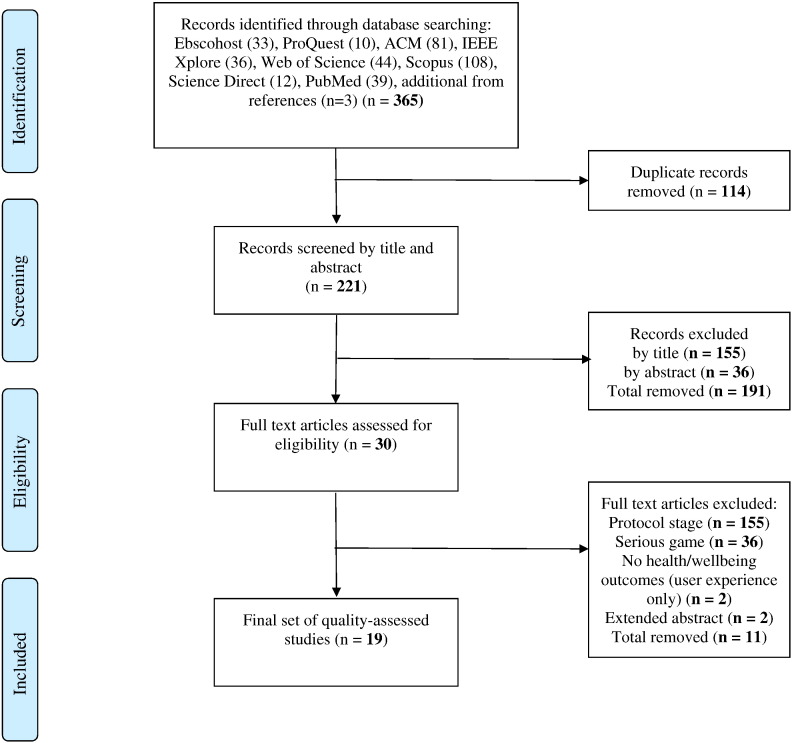
Results: We identified 19 papers that report empirical evidence on the effect of gamification on health and well-being. 59% reported positive, 41% mixed effects, with mostly moderate or lower quality of evidence provided. Results were clear for health-related behaviours, but mixed for cognitive outcomes.
Conclusions: The current state of evidence supports that gamification can have a positive impact in health and wellbeing, particularly for health behaviours. However several studies report mixed or neutral effect. Findings need to be interpreted with caution due to the relatively small number of studies and methodological limitations of many studies (e.g., a lack of comparison of gamified interventions to non-gamified versions of the intervention).
Keywords: Gamification; Health; Systematic review; Wellbeing.
Figures
References
-
- Alahäivälä T., Oinas-Kukkonen H. Understanding persuasion contexts in health gamification: a systematic analysis of gamified health behavior change support systems literature. Int. J. Med. Inform. 2016 - PubMed
-
- Boendermaker W.J., Boffo M., Wiers R.W. Exploring elements of fun to motivate youth to do cognitive bias modification. Games Health J. 2015;4(6):434–443. - PubMed
Publication types
LinkOut - more resources
Full Text Sources
Other Literature Sources
Medical
