


EarBit: Using Wearable Sensors to Detect Eating Episodes in Unconstrained Environments
- PMID: 30135957
- PMCID: PMC6101257
- DOI: 10.1145/3130902
EarBit: Using Wearable Sensors to Detect Eating Episodes in Unconstrained Environments
Abstract
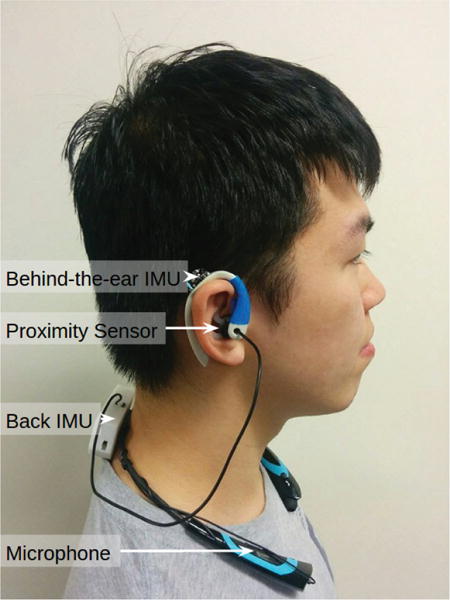
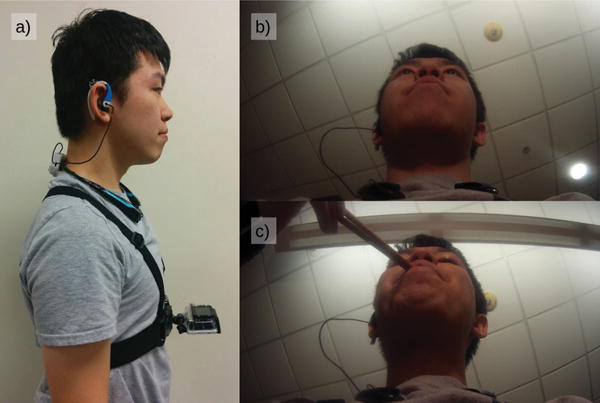
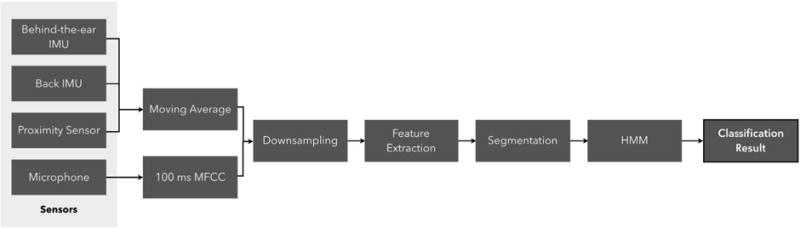
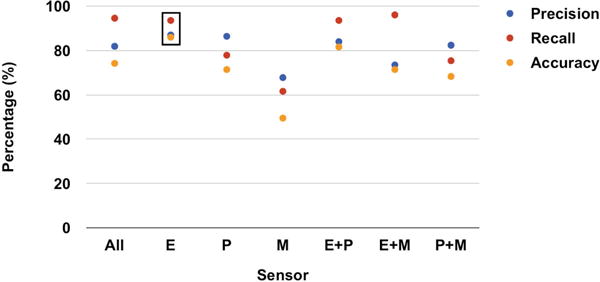
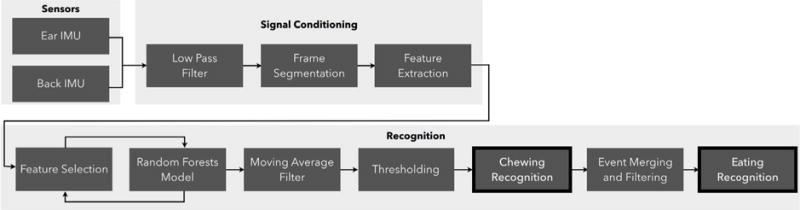
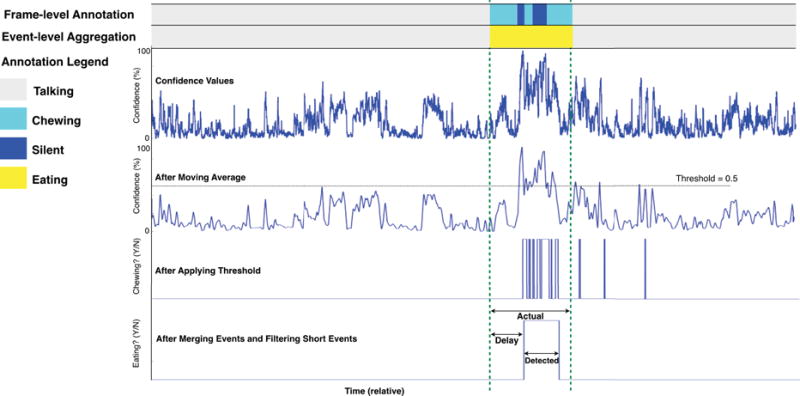
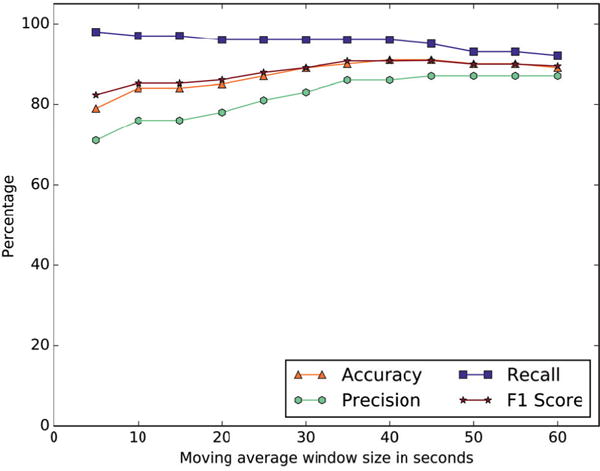
Chronic and widespread diseases such as obesity, diabetes, and hypercholesterolemia require patients to monitor their food intake, and food journaling is currently the most common method for doing so. However, food journaling is subject to self-bias and recall errors, and is poorly adhered to by patients. In this paper, we propose an alternative by introducing EarBit, a wearable system that detects eating moments. We evaluate the performance of inertial, optical, and acoustic sensing modalities and focus on inertial sensing, by virtue of its recognition and usability performance. Using data collected in a simulated home setting with minimum restrictions on participants' behavior, we build our models and evaluate them with an unconstrained outside-the-lab study. For both studies, we obtained video footage as ground truth for participants activities. Using leave-one-user-out validation, EarBit recognized all the eating episodes in the semi-controlled lab study, and achieved an accuracy of 90.1% and an F1-score of 90.9% in detecting chewing instances. In the unconstrained, outside-the-lab evaluation, EarBit obtained an accuracy of 93% and an F1-score of 80.1% in detecting chewing instances. It also accurately recognized all but one recorded eating episodes. These episodes ranged from a 2 minute snack to a 30 minute meal.
Keywords: Applied computing →Health informatics; Computing methodologies →Supervised learning by classification; Hardware →Sensor devices and platforms; Human-centered computing →Ubiquitous and mobile computing design and evaluation methods; Wearable computing; activity recognition; automatic dietary monitoring; chewing detection; earables; unconstraint environment.
Figures
References
-
- Amft Oliver, Stäger Mathias, Lukowicz Paul, Tröster Gerhard. Proceedings of the 7th International Conference on Ubiquitous Computing (UbiComp’05) Springer-Verlag; Berlin, Heidelberg: 2005. Analysis of Chewing Sounds for Dietary Monitoring; pp. 56–72. - DOI
-
- Amft O, Troster G. Methods for Detection and Classification of Normal Swallowing from Muscle Activation and Sound. 2006 Pervasive Health Conference and Workshops. 2006:1–10. doi: 10.1109/PCTHEALTH.2006.361624. - DOI
-
- Amft Oliver, Tröster Gerhard. Recognition of dietary activity events using on-body sensors. Artificial intelligence in medicine. 2008;42(2):121–136. 2008. - PubMed
-
- Bao Ling, Intille Stephen S. International Conference on Pervasive Computing. Springer; 2004. Activity recognition from user-annotated acceleration data; pp. 1–17.
-
- Bartholome Lindsay T, Peterson Roseann E, Raatz Susan K, Raymond Nancy C. A comparison of the accuracy of self-reported intake with measured intake of a laboratory overeating episode in overweight and obese women with and without binge eating disorder. European journal of nutrition. 2013;52(1):193–202. 2013. - PMC - PubMed
Grants and funding
LinkOut - more resources
Full Text Sources
Other Literature Sources
Miscellaneous