


Modeling Health Disparities and Outcomes in Disenfranchised Populations
- PMID: 30136013
- PMCID: PMC8751484
- DOI: 10.1007/s10597-018-0326-9
Modeling Health Disparities and Outcomes in Disenfranchised Populations
Abstract
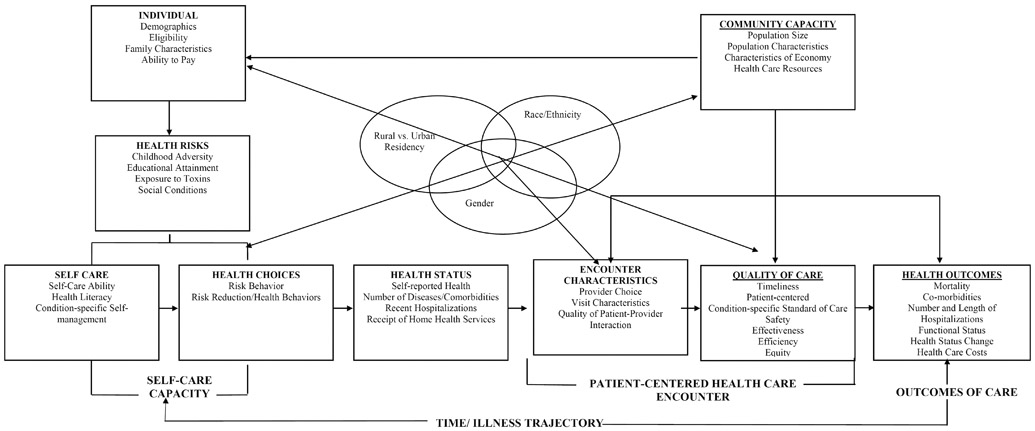
The Health Disparities and Outcomes (HDO) model originally created to explain the complexity of obtaining healthcare in rural settings has been revised and updated using emerging theoretical models of adversity and inequity and two decades of empirical work by the authors. With a strong orientation to explaining population-based health inequities, the HDO is applied to individuals with Serious Mental Illness (SMI), to explain their high rates of morbidity and mortality compared to the general population. Individual-, community-, and system-level factors that reflect an understanding of life-long risk, accrued hazards associated with multiple and intersecting disadvantages, and difficulty obtaining healthcare that meets accepted standards are described. The revised HDO can be applied to populations with disproportionate health challenges to identify multi-level factors that affect illness trajectory and overall health outcomes.
Keywords: Community characteristics; Health disparities; Health outcomes; Intersectionality; Mental illness.
Figures
References
-
- Allen ML, Cook BL, Carson N, Interian A, La Roche M, & Alegría M (2017). Patient-provider therapeutic alliance contributes to patient activation in community mental health clinics. Administration and Policy in Mental Health and Mental Health Services Research, 44(4), 431–440. doi: 10.1007/s10488-015-0655-8 - DOI - PMC - PubMed
-
- Bachrach LL (1983). Psychiatric services in rural areas: A sociological overview. Hospital and Community Psychiatry, 34(3), 215–226. - PubMed
Publication types
MeSH terms
Grants and funding
LinkOut - more resources
Full Text Sources
Other Literature Sources
Medical
