


The Prevention of Lower Urinary Tract Symptoms (PLUS) in girls and women: Developing a conceptual framework for a prevention research agenda
- PMID: 30136299
- PMCID: PMC6451314
- DOI: 10.1002/nau.23787
The Prevention of Lower Urinary Tract Symptoms (PLUS) in girls and women: Developing a conceptual framework for a prevention research agenda
Abstract
Aims: The Prevention of Lower Urinary Tract Symptoms (PLUS) Research Consortium was established by the National Institutes of Health in 2015 to expand research beyond the detection and treatment of lower urinary tract symptoms (LUTS) to the promotion and preservation of bladder health and prevention of LUTS in girls and women. While many multi-disciplinary scientific networks focus on pelvic floor dysfunction and LUTS, the PLUS Consortium stands alone in its focus on prevention. This article describes the PLUS approach to developing a conceptual framework to guide the Consortium's initial prevention research agenda.
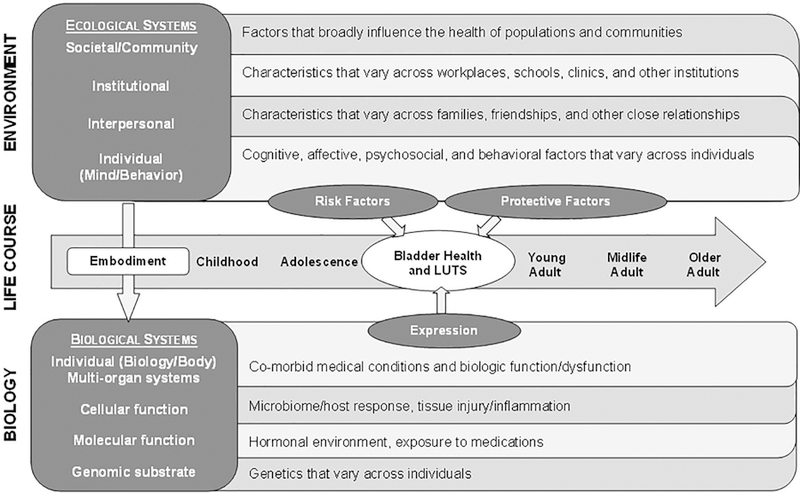
Methods: The conceptual framework was informed by traditional social ecological models of public health, biopsychosocial models of health, Glass and McAtee's Society-Behavior-Biology Nexus, and the World Health Organization's conceptual framework for action on the social determinants of health.
Results: The PLUS conceptual framework provides a foundation for developing prevention interventions that have the greatest likelihood of promoting and preserving bladder health among diverse populations.
Conclusions: PLUS Consortium work is premised on the notion that programs, practices, and policies designed to promote health will have optimal impact if the conceptual foundation upon which efforts are based is comprehensive and informed by multiple disciplines. The PLUS conceptual framework is broadly applicable to domains of health that have historically focused on the treatment of illness and symptoms rather than the promotion of health. It is also applicable to domains of health that have been examined from a predominantly biological or social ecological perspective, without integration of both perspectives.
Keywords: bladder health; conceptual framework; girls; lower urinary tract symptoms; prevention; social ecology; women.
© 2018 Wiley Periodicals, Inc.
Figures
References
-
- Schneider M Introduction to Public Health. Public Health: Sciences, Politics, and Prevention 5th ed. Burlington: Jones & Bartlett Learning; 2017.
-
- Abrams P, Andersson KE, Birder L, et al. Fourth international consultation on incontinence recommendations of the international scientific committee: Evaluation and treatment of urinary incontinence, pelvic organ prolapse, and fecal incontinence. Neurourol Urodyn 2010;29(1):213–240. doi:10.1002/nau.20870. - DOI - PubMed
Publication types
MeSH terms
Grants and funding
- U01DK106858/National Institutes of Health (NIH)/International
- U01DK106893/National Institutes of Health (NIH)/International
- U01 DK106858/DK/NIDDK NIH HHS/United States
- AG/NIA NIH HHS/United States
- U01 DK106908/DK/NIDDK NIH HHS/United States
- U01DK106908/National Institutes of Health (NIH)/International
- U01 DK106898/DK/NIDDK NIH HHS/United States
- U01 DK106786/DK/NIDDK NIH HHS/United States
- U01DK106898/National Institutes of Health (NIH)/International
- U01DK106892/National Institutes of Health (NIH)/International
- U01DK106786/National Institutes of Health (NIH)/International
- U01 DK106892/DK/NIDDK NIH HHS/United States
- NIH Office of Research on Women's Health/International
- U01 DK106853/DK/NIDDK NIH HHS/United States
- U01 DK106893/DK/NIDDK NIH HHS/United States
- U01 DK106827/DK/NIDDK NIH HHS/United States
- U01DK106853/National Institutes of Health (NIH)/International
- NIH Office of Behavioral and Social Sciences Research/International
- U01DK106827/National Institutes of Health (NIH)/International
LinkOut - more resources
Full Text Sources
Other Literature Sources
Medical
