


Associations between dimensions of anorexia nervosa and obsessive-compulsive disorder: An examination of personality and psychological factors in patients with anorexia nervosa
- PMID: 30136346
- PMCID: PMC6913175
- DOI: 10.1002/erv.2635
Associations between dimensions of anorexia nervosa and obsessive-compulsive disorder: An examination of personality and psychological factors in patients with anorexia nervosa
Abstract
Objective: Anorexia nervosa (AN) and obsessive-compulsive disorder (OCD) are highly comorbid. However, the factors that account for this comorbidity are poorly understood. We examined the core dimensions of AN and OCD and psychological and personality factors shared by both disorders.
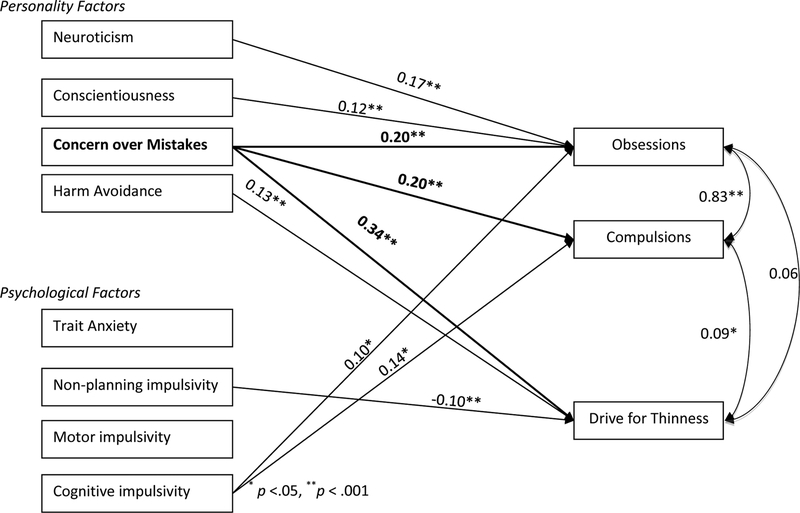
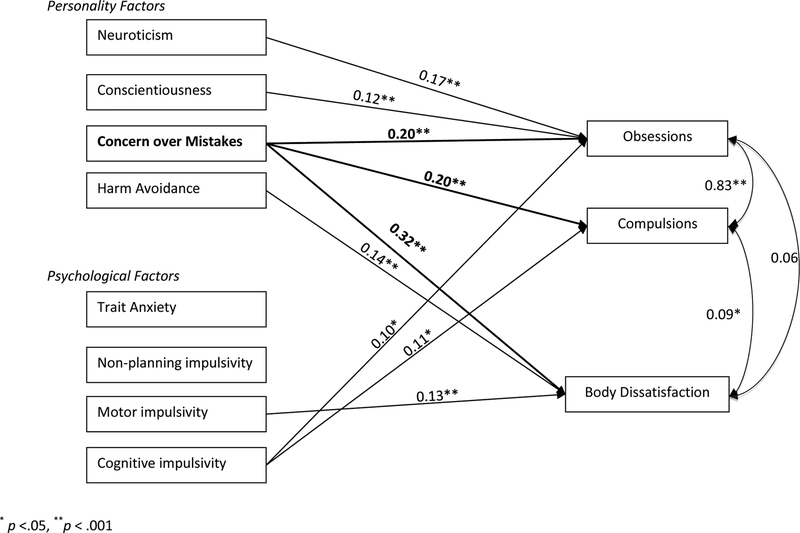
Method: In path analyses (N = 732 women with either current AN or recovered from AN), we examined which factors were uniquely and independently associated with the core dimensions of AN and OCD. We also examined recovery from AN as a moderator.
Results: When individuals with AN reported greater concern over mistakes, they endorsed more severity in both AN and OCD core dimensions. These unique associations existed above and beyond all other transdiagnostic personality and psychological factors and regardless of AN recovery status.
Conclusions: Concern over mistakes partially accounts for severity in the core dimensions of both AN and OCD. Concern over mistakes may represent an important target in the aetiology of AN and OCD.
Keywords: anorexia nervosa; comorbidity; concern over mistakes; obsessive-compulsive disorder; transdiagnostic.
© 2018 John Wiley & Sons, Ltd and Eating Disorders Association.
Conflict of interest statement
Conflicts of Interest
CM Bulik reports: Shire (grant recipient, Scientific Advisory Board member) and Pearson and Walker (author, royalty recipient). Other authors have no conflicts of interest to report.
Figures
References
-
- American Psychiatric Association. (2013). Diagnostic and statistical manual of mental disorders (5th ed.). Arlington, VA: American Psychiatric Publishing.
-
- American Psychiatric Association. (2000). Diagnostic and Statistical Manual of Mental Disorders. Fourth Edition Text Revision. Washington, DC: American Psychiatric Press.
-
- Anttila V, Bulik-Sullivan B, Finucane H, Ripke S, Malik R, & Pers T (2014). The Brainstorm project: a cross-phenotype analysis of 14 brain disorders by heritability-, constraint- and pathway-based methods, using genome-wide association data from 500,000 samples Paper presented at the American Society of Human Genetics Annual Meeting, San Diego, CA
Publication types
MeSH terms
Grants and funding
LinkOut - more resources
Full Text Sources
Other Literature Sources
Medical
