


The effect of aircraft, road, and railway traffic noise on stroke - results of a case-control study based on secondary data
- PMID: 30136675
- PMCID: PMC6122263
- DOI: 10.4103/nah.NAH_7_18
The effect of aircraft, road, and railway traffic noise on stroke - results of a case-control study based on secondary data
Abstract
Aim: To examine the stroke risks associated with aircraft, road traffic, and railway noise exposure in a large case-control study.
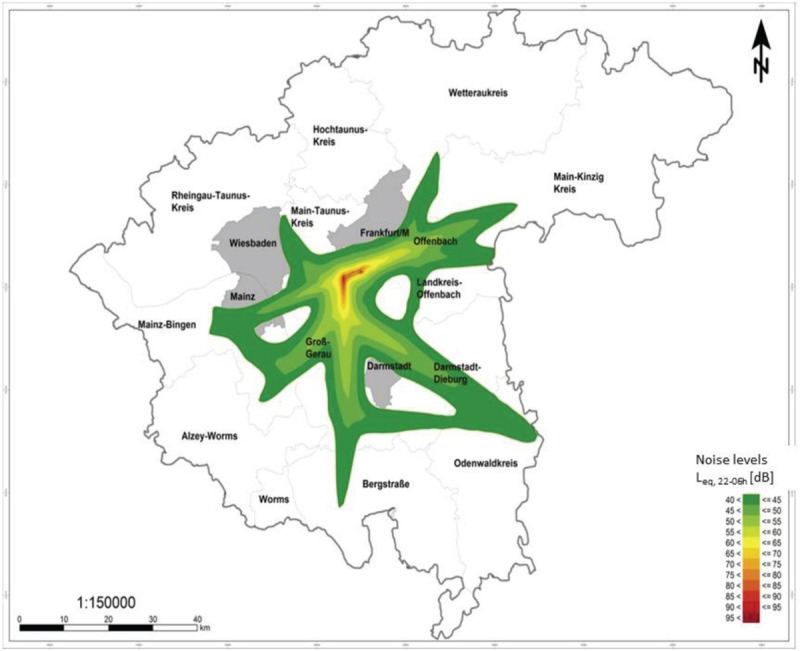
Materials and methods: All people aged ≥40 years living around the Frankfurt airport that were insured by one of three large statutory health insurance funds between 2005 and 2010 were included in the study (n = 1,026,670). Address-specific exposure to aircraft, road, and railway traffic noise was estimated for 2005. We used insurance claim data to identify 25,495 newly diagnosed cases of stroke between 2006 and 2010 and compared them with 827,601 control participants. Logistic regression analysis was used to calculate the odds ratios adjusted for age, sex, local proportion of people receiving unemployment benefits, and if available individual indicators of socioeconomic status (education, occupation).
Results: For 24-h continuous aircraft noise exposure, neither increased risk estimates nor a positive linear exposure-risk relation was found. However, stroke risk was statistically significantly increased by 7% [95% confidence intervals (95%CI): 2-13%] for people who were exposed to <40 dB of 24-h continuous aircraft noise, but ≥6 events of maximum nightly sound pressure levels ≥50 dB. For road and railway traffic noise, there was a positive linear exposure-risk relation: Per 10 dB the stroke risk increased by 1.7% (95%CI: 0.3-3.2%) for road traffic noise and by 1.8% (95%CI: 0.1-3.3%) for railway traffic noise. The maximum risk increase of 7% (95%CI: 0-14%) for road traffic noise and 18% (95%CI: 2-38%) for railway traffic noise was found in the exposure category ≥65 to <70 dB.
Conclusion: This large case-control study indicates that traffic noise exposure may lead to an increase in stroke risk. It furthermore suggests that maximum aircraft noise levels at night increase the stroke risk even when continuous noise exposure is low, and thus highlights the relevance of maximum noise levels for research and policies on noise protection.
Keywords: Case–control study; stroke; traffic noise.
Conflict of interest statement
There are no conflicts of interest
Figures
References
-
- World Health Organisation. Noncommunicable Diseases Progress Monitor. Geneva: World Health Organization; 2017.
-
- Mendis S. Global Status Report on Noncommunicable Diseases 2014. Geneva, Switzerland: The World Health Organization; 2014. - PubMed
-
- Townsend N, Wilson L, Bhatnagar P, Wickramasinghe K, Rayner M, Nichols M. Cardiovascular disease in Europe: Epidemiological update 2016. Eur Heart J. 2016;37:3232–45. - PubMed
-
- Niemann H, Hoebel J, Hammersen F, Laußmann D. Noise Annoyance − Results of the GEDA Study 2012. Berlin: Robert Koch Institute; 2014.
-
- WHO. Burden of Disease from Environmental Noise: Quantification of Healthy Life Years Lost in Europe. Bonn: WHO, European Centre for Environment and Health; 2010. [Last accessed on 2015 Oct 12]. Available from: http://www.euro.who.int/__data/assets/pdf_file/0008/136466/e94888.pdf .
MeSH terms
LinkOut - more resources
Full Text Sources
Medical
Miscellaneous