


Rest-Activity Rhythms and Cognitive Decline in Older Men: The Osteoporotic Fractures in Men Sleep Study
- PMID: 30136716
- PMCID: PMC6235690
- DOI: 10.1111/jgs.15555
Rest-Activity Rhythms and Cognitive Decline in Older Men: The Osteoporotic Fractures in Men Sleep Study
Abstract
Objective: To examine rest-activity circadian rhythm (RAR) and cognitive decline in older men.
Design: Longitudinal.
Setting: Osteoporotic Fractures in Men (MrOS) and ancillary Outcomes of Sleep Disorders in Men (MrOS Sleep) studies.
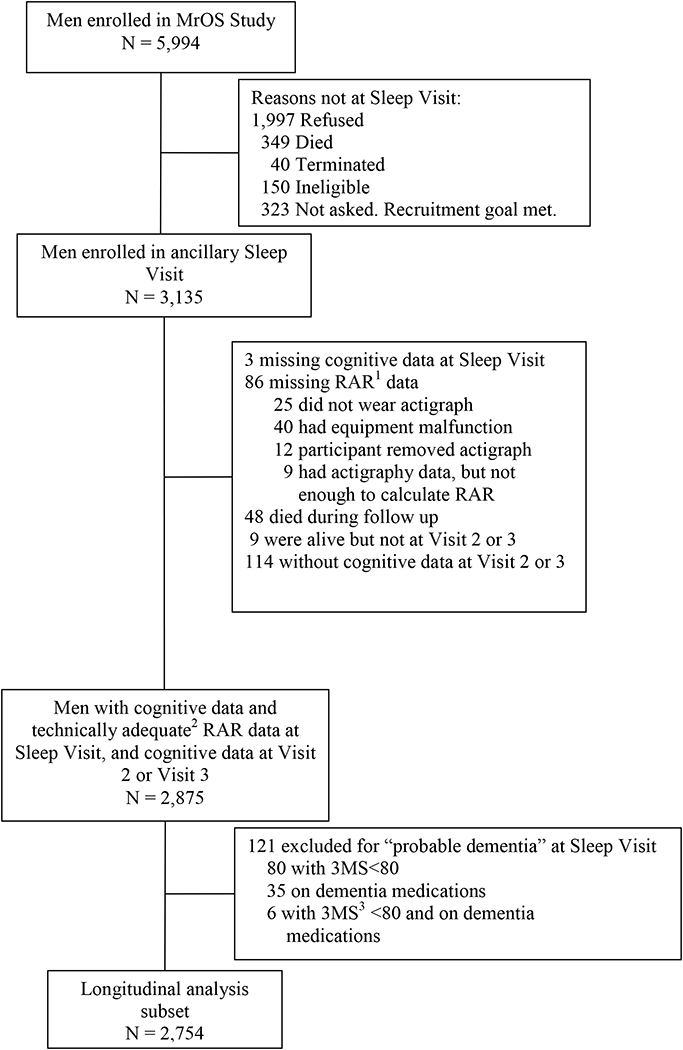
Participants: MrOS and MrOS Sleep participants (N=2,754; mean age 76.0 ± 5.3).
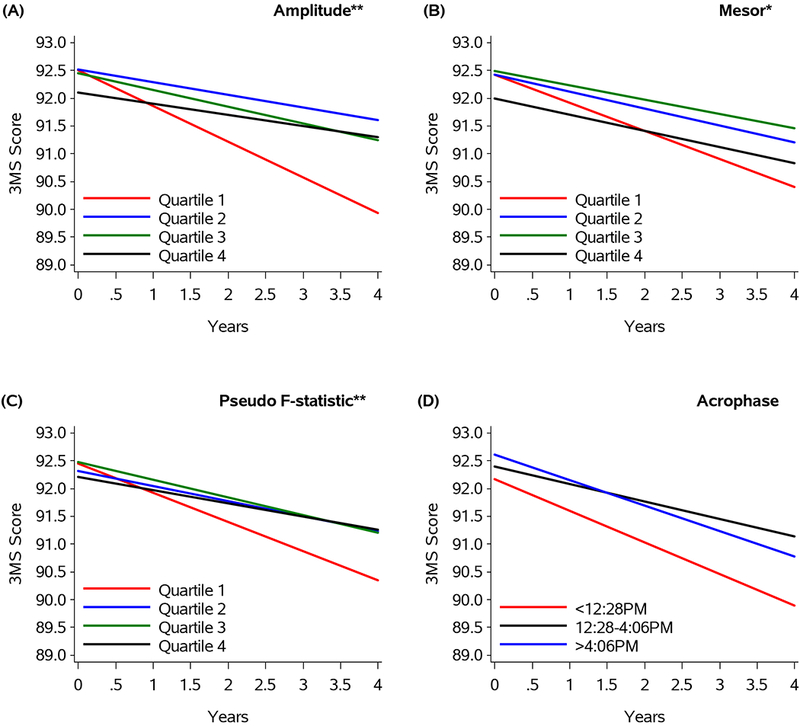
Measurements: The Modified Mini-Mental State examination (3MS) was used to assess cognition at baseline (2003-05) and follow-up examinations (2005-06 and 2007-09). Wrist actigraphy was used to measure 24-hour activity counts at baseline. RAR variables included amplitude (strength of activity rhythm), mesor (mean activity level), pseudo F-statistic (overall circadian rhythm robustness), and acrophase (time of daily peak activity).
Results: After an average of 3.4 ± 0.5 years, men with lower amplitudes, mesors, and pseudo F-statistics had greater decline in 3MS performance (amplitude: -0.7 points Q1 vs -0.5 points Q4, p<.001; mesor: -0.5 points Q1 vs -0.2 points Q4, p=.01; pseudo F-statistic: -0.5 points Q1 vs -0.3 points Q4, p<.001). Lower amplitudes and pseudo-F statistics were associated with greater odds of clinically significant cognitive decline (≥5-point decrease) (amplitude Q1 vs. Q4: odds ratio (OR)=1.4, 95% confidence interval (CI)=1.0-1.9; pseudo-F statistic Q1 vs Q4: OR=1.4, 95% CI=1.0-1.9). Men with phase-advanced acrophase had greater odds of clinically significant cognitive decline (OR=1.8, 95% CI=1.2-2.8). Results were adjusted for multiple confounders.
Conclusion: Several parameters of disrupted RAR (lower amplitude, pseudo F-statistic, mesor, phase-advanced acrophase) were associated with greater cognitive decline in older community-dwelling men. These findings contribute to a growing body of evidence suggesting that altered RARs are associated with cognitive decline in older adults. J Am Geriatr Soc 66:2136-2143, 2018.
Keywords: cognitive decline; men; rest-activity rhythm.
© 2018, Copyright the Authors Journal compilation © 2018, The American Geriatrics Society.
Conflict of interest statement
Conflicts of Interest: The authors report no conflicts of interest.
Figures
References
-
- Chaudhury D, Colwell CS. Circadian modulation of learning and memory in fear-conditioned mice. Behav Brain Res 2002;133(1):95–108. - PubMed
-
- Kripke DF, Youngstedt SD, Elliott JA et al. Circadian phase in adults of contrasting ages. Chronobiol Int 2005;22(4):695–709. - PubMed
-
- Buysse DJ, Monk TH, Carrier J et al. Circadian patterns of sleep, sleepiness, and performance in older and younger adults. Sleep 2005;28(11):1365–1376. - PubMed
-
- Czeisler CA, Dumont M, Duffy JF et al. Association of sleep-wake habits in older people with changes in output of circadian pacemaker. Lancet 1992;340(8825):933–936. - PubMed
-
- Duffy JF, Zeitzer JM, Rimmer DW et al. Peak of circadian melatonin rhythm occurs later within the sleep of older subjects. Am J Physiol Endocrinol Metab 2002;282(2):E297–303. - PubMed
Publication types
MeSH terms
Grants and funding
- R01 HL070848/HL/NHLBI NIH HHS/United States
- R01 HL071194/HL/NHLBI NIH HHS/United States
- R01 HL070847/HL/NHLBI NIH HHS/United States
- UL1 TR000128/TR/NCATS NIH HHS/United States
- U01 AG042145/AG/NIA NIH HHS/United States
- U01 AG042168/AG/NIA NIH HHS/United States
- R01 HL070841/HL/NHLBI NIH HHS/United States
- R01 HL070839/HL/NHLBI NIH HHS/United States
- U01 AG027810/AG/NIA NIH HHS/United States
- U01 AG042139/AG/NIA NIH HHS/United States
- U01 AR066160/AR/NIAMS NIH HHS/United States
- R01 HL070842/HL/NHLBI NIH HHS/United States
- U01 AG042124/AG/NIA NIH HHS/United States
- U01 AG042140/AG/NIA NIH HHS/United States
- R21 AG051380/AG/NIA NIH HHS/United States
- R01 HL070838/HL/NHLBI NIH HHS/United States
- R01 HL070837/HL/NHLBI NIH HHS/United States
- U01 AG042143/AG/NIA NIH HHS/United States
LinkOut - more resources
Full Text Sources
Other Literature Sources
Medical
