. 2018 Nov 16;46(20):10682-10696.
doi: 10.1093/nar/gky752.

Systematic discovery of uncharacterized transcription factors in Escherichia coli K-12 MG1655

Affiliations

Systematic discovery of uncharacterized transcription factors in Escherichia coli K-12 MG1655

Ye Gao et al. Nucleic Acids Res. .

Abstract

Transcriptional regulation enables cells to respond to environmental changes. Of the estimated 304 candidate transcription factors (TFs) in Escherichia coli K-12 MG1655, 185 have been experimentally identified, but ChIP methods have been used to fully characterize only a few dozen. Identifying these remaining TFs is key to improving our knowledge of the E. coli transcriptional regulatory network (TRN). Here, we developed an integrated workflow for the computational prediction and comprehensive experimental validation of TFs using a suite of genome-wide experiments. We applied this workflow to (i) identify 16 candidate TFs from over a hundred uncharacterized genes; (ii) capture a total of 255 DNA binding peaks for ten candidate TFs resulting in six high-confidence binding motifs; (iii) reconstruct the regulons of these ten TFs by determining gene expression changes upon deletion of each TF and (iv) identify the regulatory roles of three TFs (YiaJ, YdcI, and YeiE) as regulators of l-ascorbate utilization, proton transfer and acetate metabolism, and iron homeostasis under iron-limited conditions, respectively. Together, these results demonstrate how this workflow can be used to discover, characterize, and elucidate regulatory functions of uncharacterized TFs in parallel.


Figures
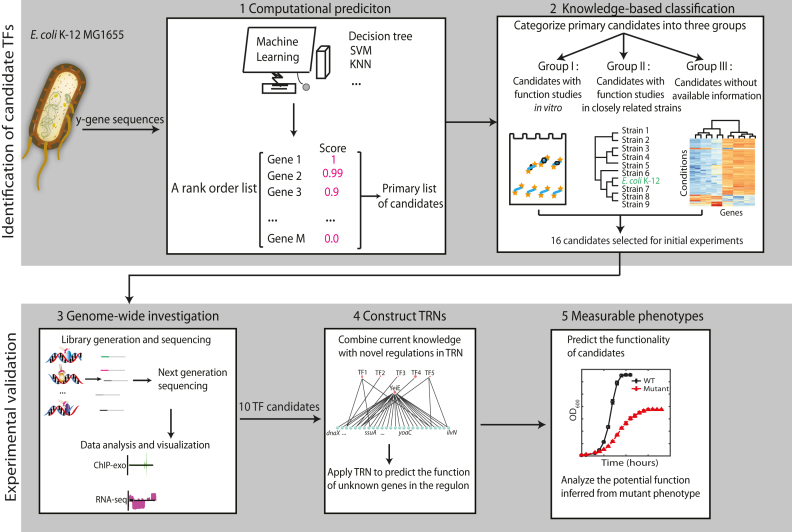
Figure 1.
Figure 1.
The scheme of the systematic workflow for discovering uncharacterized transcription factors in E. coli K-12 MG1655. This workflow consists of computational prediction, knowledge-based classification, and experimental validation. The uncharacterized gene sequences of E. coli K-12 MG1655 are the input data for TFpredict. The output is a rank order list of genes with confidence scores. The primary selection is made based on the confidence scores from TFpredict. Subsequently, the primary list of genes is categorized into three groups based on the confidence level of biochemical/biological roles. An initial subset of 16 candidates was selected for experimental validation.Next, genome-wide binding sites were identified by ChIP-exo, and differential expression of their target genes was analyzed by RNA-seq. Finally, hypothesized functions of selected candidate TFs were inferred by comparing phenotypes between wild type and TF knockout mutants.
Figure 2.
Figure 2.
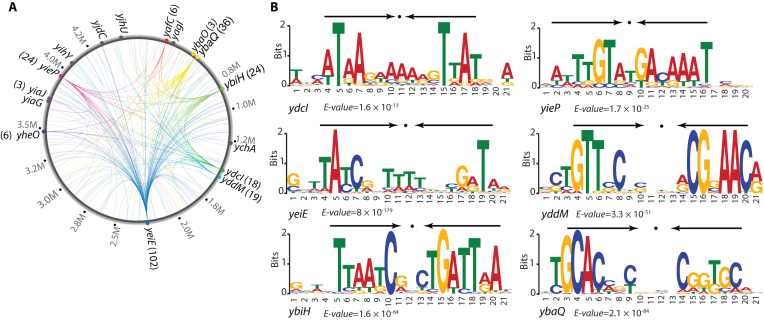
A global landscape of DNA binding events for uncharacterized TFs during growth at active conditions. (A) Binding sites identified by ChIP-exo. Verified uncharacterized TFs were labeled with colored circles. The numbers in the parentheses represent the number of identified binding sites for individual uncharacterized TFs. Gray circles represent uncharacterized TFs without binding peaks under the growth conditions used, which include YjhU, YjdC, YihY, YiaG, YagI, and YchA. (B) The sequence motifs for six uncharacterized TFs. The height of the letters (in bits on the y-axis) represents the degree of conservation at a given position within the aligned sequence set, with perfect conservation being 2 bits. Arrows above motif indicate the presence of palindromic sequences.
Figure 3.
Figure 3.
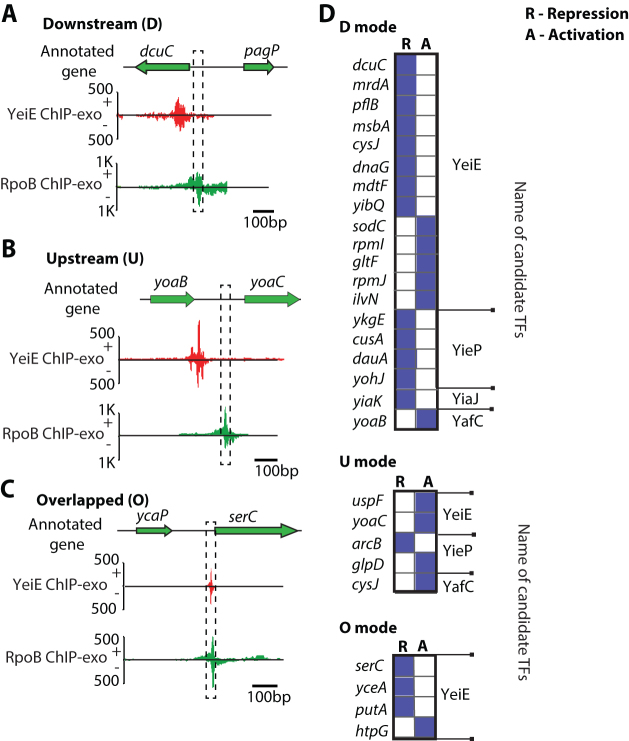
Transcriptional regulation by the position of uncharacterized TFs relative to the binding of RNA polymerase (RNAP), using binding sites from YeiE, YieP, YiaJ, and YafC as representatives. (A) In the case of dcuC, YeiE-binding is located downstream of the promoter. (B) YeiE binds to the upstream site of the yoaC. (C) YeiE-binding region upstream of serC overlaps with the promoter occupied by RNAP. (D) The binding positions of YeiE, YieP, YiaJ, and YafC from the promoter are categorized according to the gene regulation. The abbreviations, D, U, and O indicate the downstream, upstream, and overlapped position, respectively. R and A indicate the regulation modes: repression and activation, respectively.
Figure 4.
Figure 4.
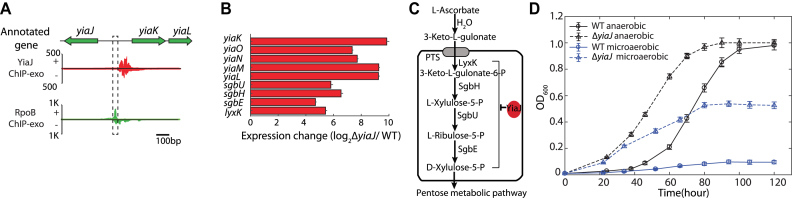
The regulatory role of the uncharacterized TF YiaJ is involved in the utilization of l-ascorbate in E. coli K-12 MG1655. (A) YiaJ binding sites at the promoter region between yiaJ and the yiaKLMNO-lyxK-sgbH-sgbU-sgbE operon. (B) Expression changes for genes in the yiaJ deletion strain in the yiaKLMNO-lyxK-sgbH-sgbU-sgbE operon compared to the wild type strain. (C) The proposed function of YiaJ is to repress the ascorbate utilization pathway, therefore regulating the level of d-xylulose-5-P that feeds into the pentose phosphate pathway. (D) Growth curve of wild type and yiaJ deletion strains at ascorbate as the carbon source under anaerobic and microaerobic conditions, respectively.
Figure 5.
Figure 5.
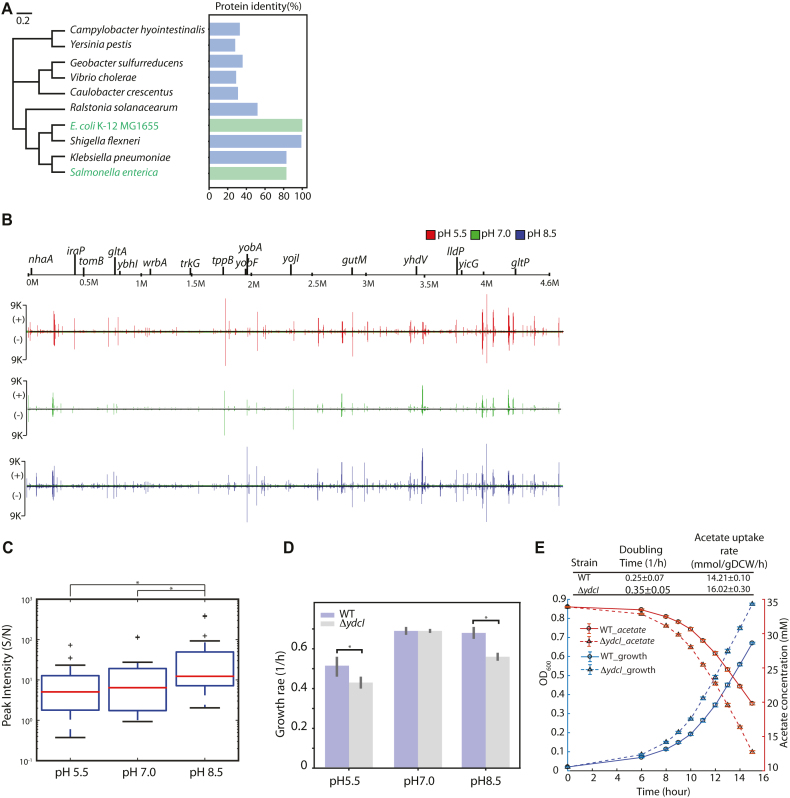
The regulatory role of the uncharacterized TF YdcI is involved in proton and acetate metabolism in E. coli K-12 MG1655. (A) Phylogenetic trees displaying the relatedness of YdcI from E. coli K-12 MG1655 and from Salmonella enterica. (B) Genome-wide YdcI DNA binding. YdcI binding across the genome was compared under different pH conditions in E. coli K-12 MG1655 by ChIP-exo. (C) Peak intensity (Signal/Noise) of YdcI ChIP-exo binding sites at pH 5.5, pH 7.0, and pH 8.5. Among the three different pH conditions, peak intensity was most active at pH 8.5 (* indicates rank sum test P-value < 0.05). (D) The growth rate of wild type and ydcI deletion strain at low pH, neutral pH, and high pH media. (E) Growth and acetate uptake rates of wild type and ydcI deletion strains in acetate growth medium.
Figure 6.
Figure 6.
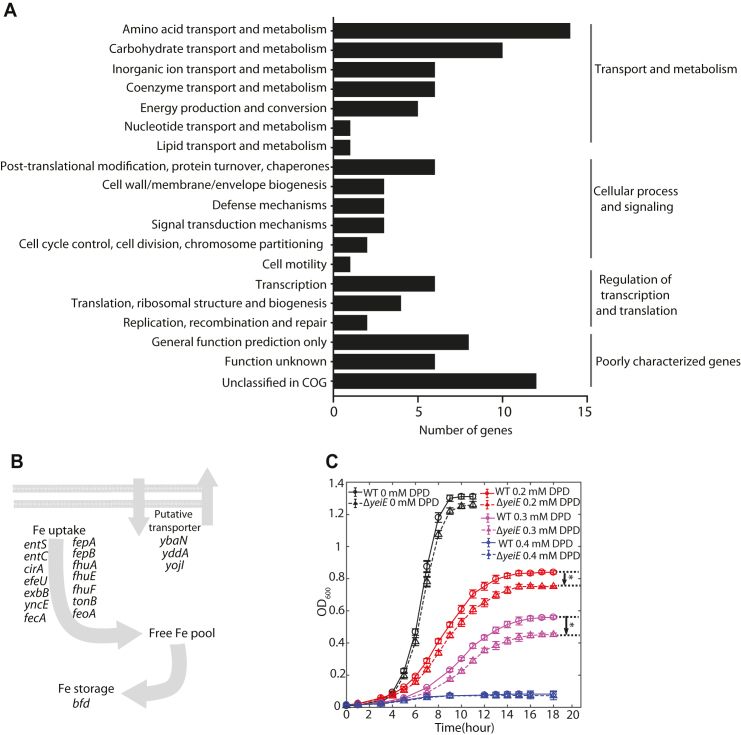
The regulatory role of the uncharacterized TF YeiE is involved in maintaining iron homeostasis under iron-limited conditions in E. coli K-12 MG1655. (A) Functional classification of target genes from YeiE genome-wide bindings. The enriched functions are in three groups: amino acid transport/metabolism, carbohydrate transport/metabolism, and inorganic ion transport/metabolism. (B) The proposed regulatory roles of genes down-regulated in the yeiE deletion strain. (C) Growth profile of wild-type and yeiE deletion strain in iron-free M9 minimal medium supplemented with 0, 0.2 mM, 0.3 mM, 0.4 mM of 2,2′-dipyridyl (DPD) (an iron chelator), respectively. The growth curves were determined from at least six independent cultures and significant differences in the stationary phase between wild type and yeiE deletion strain were determined by the Student's t test, P < 0.01.
Figure 7.
Figure 7.
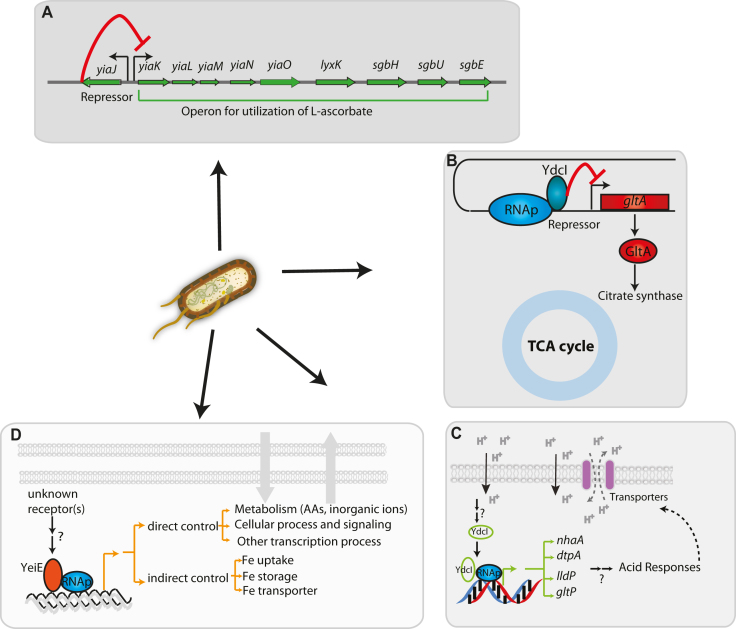
The model for the regulatory network integrating three candidate TFs (YiaJ, YdcI, and YeiE) and their biological functions in E. coli K-12 MG1655. (A) YiaJ is a regulator that controls the operon yiaK-yiaL-yiaM-yiaN-yiaO-lyxK-sgbH-sgbU-sgbE in the catabolism pathway. (B) YdcI inhibits the transcription of target gene gltA, resulting in the down-regulation of citrate synthase that is required in the TCA cycle. (C) YdcI binds to genomic DNA and activates target genes nhaA, dtpA, lldP, and gltP that are responsible for proton transfer. (D) YeiE affects multiple transporters (amino acids, inorganic ions, lipids) and metabolic processes, maintaining iron homeostasis at iron-limited conditions.

References

    1. Cannon W., Claverie-Martin F., Austin S., Buck M.. Core RNA polymerase assists binding of the transcription factor σ; 54 to promoter DNA. Mol. Microbiol. 1993; 8:287–298. - PubMed
    1. Alkema W.B.L., Lenhard B., Wasserman W.W.. Regulog analysis: detection of conserved regulatory networks across bacteria: application to Staphylococcus aureus. Genome Res. 2004; 14:1362–1373. - PMC - PubMed
    1. Keseler I.M., Mackie A., Santos-Zavaleta A., Billington R., Bonavides-Martínez C., Caspi R., Fulcher C., Gama-Castro S., Kothari A., Krummenacker M. et al. The EcoCyc database: reflecting new knowledge about Escherichia coli K-12. Nucleic Acids Res. 2017; 45:D543–D550. - PMC - PubMed
    1. Keseler I.M., Collado-Vides J., Santos-Zavaleta A., Peralta-Gil M., Gama-Castro S., Muñiz-Rascado L., Bonavides-Martinez C., Paley S., Krummenacker M., Altman T. et al. EcoCyc: a comprehensive database of Escherichia coli biology. Nucleic Acids Res. 2011; 39:D583–D590. - PMC - PubMed
    1. Gama-Castro S., Salgado H., Santos-Zavaleta A., Ledezma-Tejeida D., Muñiz-Rascado L., García-Sotelo J.S., Alquicira-Hernández K., Martínez-Flores I., Pannier L., Castro-Mondragón J.A. et al. RegulonDB version 9.0: high-level integration of gene regulation, coexpression, motif clustering and beyond. Nucleic Acids Res. 2015; 44:D133–D143. - PMC - PubMed

Publication types

MeSH terms

Substances