


Arterial spin labelling MRI to measure renal perfusion: a systematic review and statement paper
- PMID: 30137581
- PMCID: PMC6106644
- DOI: 10.1093/ndt/gfy180
Arterial spin labelling MRI to measure renal perfusion: a systematic review and statement paper
Abstract
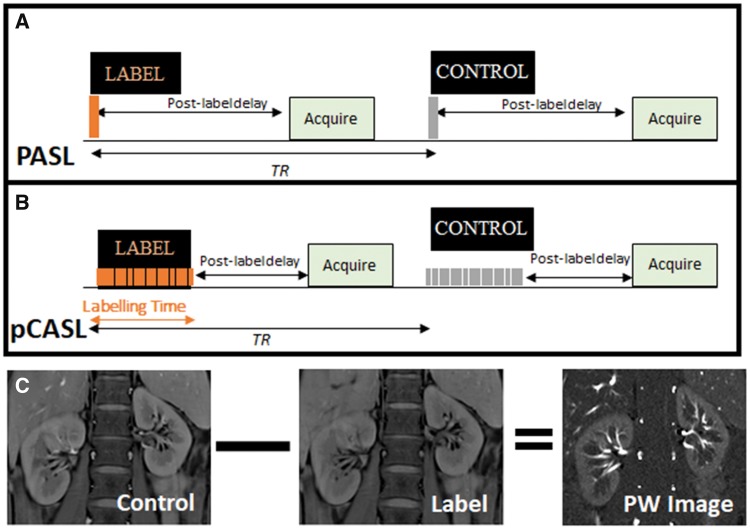
Renal perfusion provides the driving pressure for glomerular filtration and delivers the oxygen and nutrients to fuel solute reabsorption. Renal ischaemia is a major mechanism in acute kidney injury and may promote the progression of chronic kidney disease. Thus, quantifying renal tissue perfusion is critically important for both clinicians and physiologists. Current reference techniques for assessing renal tissue perfusion have significant limitations. Arterial spin labelling (ASL) is a magnetic resonance imaging (MRI) technique that uses magnetic labelling of water in arterial blood as an endogenous tracer to generate maps of absolute regional perfusion without requiring exogenous contrast. The technique holds enormous potential for clinical use but remains restricted to research settings. This statement paper from the PARENCHIMA network briefly outlines the ASL technique and reviews renal perfusion data in 53 studies published in English through January 2018. Renal perfusion by ASL has been validated against reference methods and has good reproducibility. Renal perfusion by ASL reduces with age and excretory function. Technical advancements mean that a renal ASL study can acquire a whole kidney perfusion measurement in less than 5-10 min. The short acquisition time permits combination with other MRI techniques that might inform drug mechanisms and renal physiology. The flexibility of renal ASL has yielded several variants of the technique, but there are limited data comparing these approaches. We make recommendations for acquiring and reporting renal ASL data and outline the knowledge gaps that future research should address.
Figures
References
-
- Evans RG, Gardiner BS, Smith DW. et al. Intrarenal oxygenation: unique challenges and the biophysical basis of homeostasis. Am J Physiol Renal Physiol 2008; 295: F1259–F1270 - PubMed
-
- Evans RG, Ince C, Joles JA. et al. Haemodynamic influences on kidney oxygenation: clinical implications of integrative physiology. Clin Exp Pharmacol Physiol 2013; 40: 106–122 - PubMed
-
- Pallone TL, Edwards A, Mattson DL.. Renal medullary circulation. Compr Physiol 2012; 2: 97–140 - PubMed
-
- Ow CPC, Ngo JP, Ullah MM. et al. Renal hypoxia in kidney disease: cause or consequence? Acta Physiol (Oxf) 2018; 222: e12999. - PubMed
-
- Beierwaltes WH, Harrison-Bernard LM, Sullivan JC. et al. Assessment of renal function; clearance, the renal microcirculation, renal blood flow, and metabolic balance. Compr Physiol 2013; 3: 165–200 - PubMed
Publication types
MeSH terms
Substances
Grants and funding
LinkOut - more resources
Full Text Sources
Other Literature Sources
Medical
