


National, Regional, State, and Selected Local Area Vaccination Coverage Among Adolescents Aged 13-17 Years - United States, 2017
- PMID: 30138305
- PMCID: PMC6107323
- DOI: 10.15585/mmwr.mm6733a1
National, Regional, State, and Selected Local Area Vaccination Coverage Among Adolescents Aged 13-17 Years - United States, 2017
Erratum in
-
Erratum: Vol. 67, No. 33.MMWR Morb Mortal Wkly Rep. 2018 Oct 19;67(41):1164. doi: 10.15585/mmwr.mm6741a8. MMWR Morb Mortal Wkly Rep. 2018. PMID: 30335735 Free PMC article. No abstract available.
Abstract
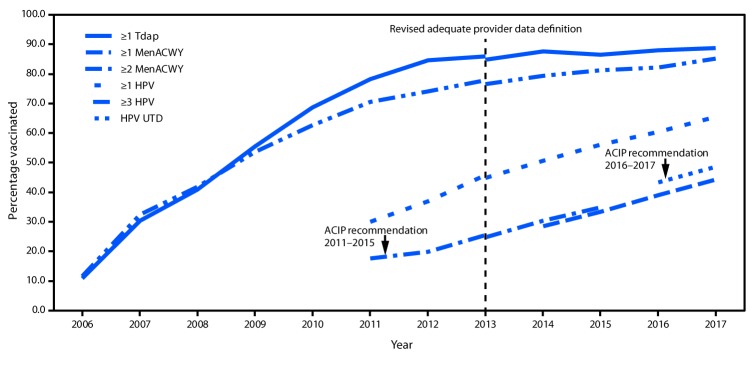
The Advisory Committee on Immunization Practices (ACIP) recommends routine vaccination of persons aged 11-12 years with human papillomavirus (HPV) vaccine, quadrivalent meningococcal conjugate vaccine (MenACWY), and tetanus and reduced diphtheria toxoids and acellular pertussis vaccine (Tdap). A booster dose of MenACWY is recommended at age 16 years (1), and catch-up vaccination is recommended for hepatitis B vaccine (HepB), measles, mumps, and rubella vaccine (MMR), and varicella vaccine (VAR) for adolescents whose childhood vaccinations are not up to date (UTD) (1). ACIP also recommends that clinicians may administer a serogroup B meningococcal vaccine (MenB) series to adolescents and young adults aged 16-23 years, with a preferred age of 16-18 years (2). To estimate U.S. adolescent vaccination coverage, CDC analyzed data from the 2017 National Immunization Survey-Teen (NIS-Teen) for 20,949 adolescents aged 13-17 years.* During 2016-2017, coverage increased for ≥1 dose of HPV vaccine (from 60.4% to 65.5%), ≥1 dose of MenACWY (82.2% to 85.1%), and ≥2 doses of MenACWY (39.1% to 44.3%). Coverage with Tdap remained stable at 88.7%. In 2017, 48.6% of adolescents were UTD with the HPV vaccine series (HPV UTD) compared with 43.4% in 2016.† On-time vaccination (receipt of ≥2 or ≥3 doses of HPV vaccine by age 13 years) also increased. As in 2016, ≥1-dose HPV vaccination coverage was lower among adolescents living in nonmetropolitan statistical areas (MSAs) (59.3%) than among those living in MSA principal cities (70.1%).§ Although HPV vaccination initiation remains lower than coverage with MenACWY and Tdap, HPV vaccination coverage has increased an average of 5.1 percentage points annually since 2013, indicating that continued efforts to target unvaccinated teens and eliminate missed vaccination opportunities might lead to HPV vaccination coverage levels comparable to those of other routinely recommended adolescent vaccines.
Conflict of interest statement
All authors have completed and submitted the ICMJE form for disclosure of potential conflicts of interest. No potential conflicts of interest were disclosed.
Figures
References
-
- Robinson CL, Romero JR, Kempe A, Pellegrini C; Advisory Committee on Immunization Practices (ACIP) Child/Adolescent Immunization Work Group. Advisory Committee on Immunization Practices recommended immunization schedule for children and adolescents aged 18 years or younger—United States, 2017. MMWR Morb Mortal Wkly Rep 2017;66:134–5. 10.15585/mmwr.mm6605e1 - DOI - PMC - PubMed
-
- MacNeil JR, Rubin L, Folaranmi T, Ortega-Sanchez IR, Patel M, Martin SW. Use of serogroup B meningococcal vaccines in adolescents and young adults: recommendations of the Advisory Committee on Immunization Practices, 2015. MMWR Morb Mortal Wkly Rep 2015;64:1171–6. 10.15585/mmwr.mm6441a3 - DOI - PubMed
-
- CDC. National Immunization Survey: a user’s guide for the 2016 public-use data file. Atlanta, GA: US Department of Health and Human Services, CDC; 2017. https://www.cdc.gov/vaccines/imz-managers/nis/downloads/NIS-TEEN-PUF16-D...
MeSH terms
Substances
LinkOut - more resources
Full Text Sources
Other Literature Sources
Medical
Research Materials
