


Assessing capacity and readiness to manage NCDs in primary care setting: Gaps and opportunities based on adapted WHO PEN tool in Zambia
- PMID: 30138318
- PMCID: PMC6107121
- DOI: 10.1371/journal.pone.0200994
Assessing capacity and readiness to manage NCDs in primary care setting: Gaps and opportunities based on adapted WHO PEN tool in Zambia
Abstract
Introduction: Sub-Saharan Africa is experiencing an epidemiological transition as the burden of NCDs overtake communicable diseases. However, it is unknown what capacity and gaps exist at primary care level to address the growing burden of NCDs. This study aimed to assess the Zambian health system's capacity to address in NCDs, using an adapted WHO Essential Non Communicable Disease Interventions (WHO PEN) tool.
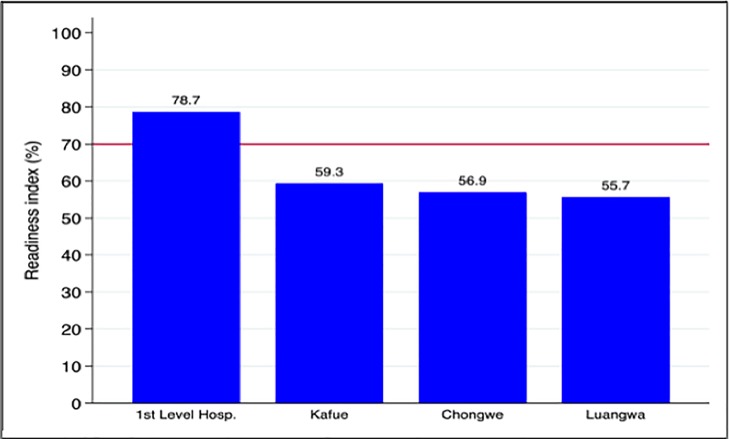
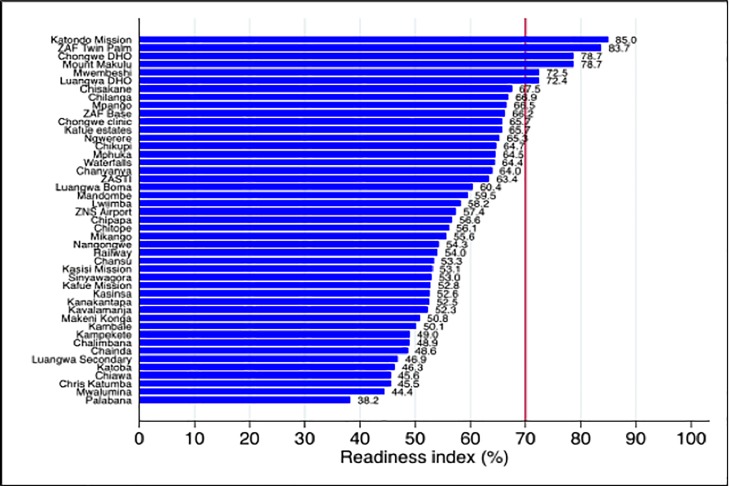
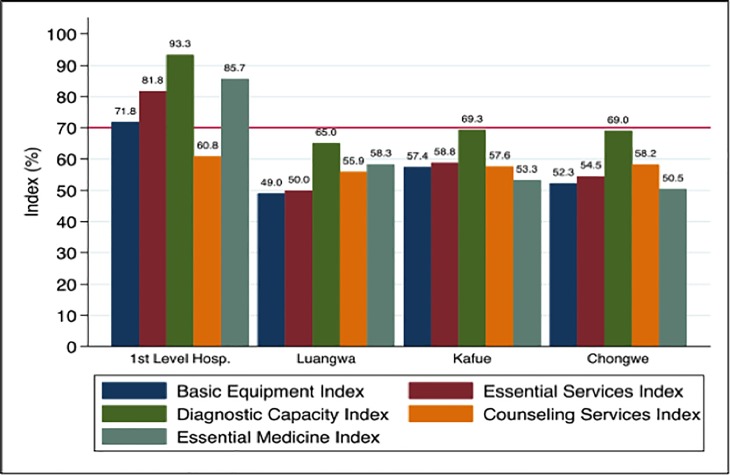
Methodology: This was a cross-sectional facility survey in the three districts conducted from September 2017 to October 2017. We defined facility readiness along five domains: basic equipment, essential services, diagnostic capacity, counseling services, and essential medicines. For each domain, we calculated an index as the mean score of items expressed as percentage. These indices were compared to an agreed cutoff at 70%, meaning that a facility index or district index below 70% off was considered as 'not ready' to manage NCDs at that level. All analysis were performed using Stata 15 MP.
Results: There appeared to be wide heterogeneity between facilities in respect of readiness to manage NCDs. Only 6 (including the three 1st level hospitals) out of the 46 facilities were deemed ready to manage NCDs. Only the first level hospitals scored a mean index higher than the 70% cut off; With regard to medications needed to manage NCDs, urban and rural health facilities were comparably equipped. However, there was evidence that calcium channel blockers (p = 0.013) and insulin (p = 0.022) were more likely to be available in urban and semi-urban health facilities compared to rural facilities.
Conclusion: Our study revealed gaps in primary health care capacity to manage NCDs in Zambia, with almost all health facilities failing to reach the minimum threshold. These results could be generalized to other similar districts in Zambia and the sub-region, where health systems remain focused on infectious rather than non-communicable Disease. These results should attract policy attention and potentially form the basis to review current approach to NCD care at the primary care level in Zambia and Sub-Saharan Africa.
Conflict of interest statement
The authors have declared that no competing interests exist.
Figures
References
-
- Habib SH, Saha S. Burden of non-communicable disease: Global overview. Diabetes & Metabolic Syndrome: Clinical Research & Reviews, Elsevier 2010;4:41–7.
-
- WHO. Global status report on non-communicable diseases 2010. Geneva, Switzerland: World Health Organization; 2011.
Publication types
MeSH terms
Grants and funding
LinkOut - more resources
Full Text Sources
Other Literature Sources
