


Total and cause-specific standardized mortality ratios in patients with schizophrenia and/or substance use disorder
- PMID: 30138449
- PMCID: PMC6107156
- DOI: 10.1371/journal.pone.0202028
Total and cause-specific standardized mortality ratios in patients with schizophrenia and/or substance use disorder
Abstract
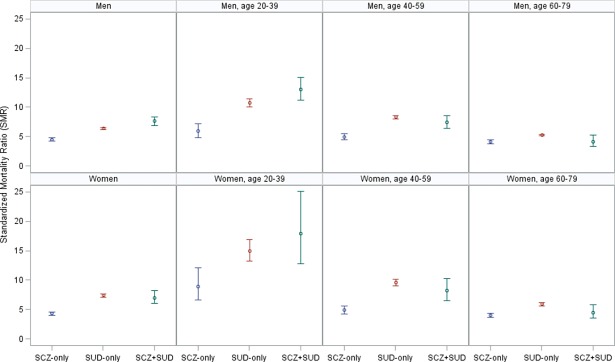
Individuals with schizophrenia or substance use disorder have a substantially increased mortality compared to the general population. Despite a high and probably increasing prevalence of comorbid substance use disorder in people with schizophrenia, the mortality in the comorbid group has been less studied and with contrasting results. We performed a nationwide open cohort study from 2009 to 2015, including all Norwegians aged 20-79 with schizophrenia and/or substance use disorder registered in any specialized health care setting in Norway, a total of 125,744 individuals. There were 12,318 deaths in the cohort, and total, sex-, age- and cause-specific standardized mortality ratios (SMRs) were calculated, comparing the number of deaths in patients with schizophrenia, schizophrenia only, substance use disorder only or a co-occurring diagnosis of schizophrenia and substance use disorder to the number expected if the patients had the age-, sex- and calendar-year specific death rates of the general population. The SMRs were 4.9 (95% CI 4.7-5.1) for all schizophrenia patients, 4.4 (95% CI 4.2-4.6) in patients with schizophrenia without substance use disorder, 6.6 (95% CI 6.5-6.8) in patients with substance use disorder only, and 7.4 (95% CI 7.0-8.2) in patients with both schizophrenia and substance use disorder. The SMRs were elevated in both genders, in all age groups and for all considered causes of death, and most so in the youngest. Approximately 27% of the excess mortality in all patients with schizophrenia was due to the raised mortality in the subgroup with comorbid SUD. The increased mortality in patients with schizophrenia and/or substance use disorder corresponded to more than 10,000 premature deaths, which constituted 84% of all deaths in the cohort. The persistent mortality gap highlights the importance of securing systematic screening and proper access to somatic health care, and a more effective prevention of premature death from external causes in this group.
Conflict of interest statement
The authors have declared that no competing interests exist.
Figures
References
-
- Nordentoft M, Wahlbeck K, Hällgren J, Westman J, Ösby U, Alinaghizadeh H, et al. Excess mortality, causes of death and life expectancy in 270,770 patients with recent onset of mental disorders in Denmark, Finland and Sweden. PLoS One. 2013;8(1):e55176 Epub 2013/02/02. 10.1371/journal.pone.0055176 ; PubMed Central PMCID: PMCPmc3555866. - DOI - PMC - PubMed
-
- Chang CK, Hayes RD, Perera G, Broadbent MT, Fernandes AC, Lee WE, et al. Life expectancy at birth for people with serious mental illness and other major disorders from a secondary mental health care case register in London. PLoS One. 2011;6(5):e19590 Epub 2011/05/26. 10.1371/journal.pone.0019590 ; PubMed Central PMCID: PMCPmc3097201. - DOI - PMC - PubMed
Publication types
MeSH terms
LinkOut - more resources
Full Text Sources
Other Literature Sources
Medical
Miscellaneous
