


Individual- and community-level determinants of child immunization in the Democratic Republic of Congo: A multilevel analysis
- PMID: 30138459
- PMCID: PMC6107214
- DOI: 10.1371/journal.pone.0202742
Individual- and community-level determinants of child immunization in the Democratic Republic of Congo: A multilevel analysis
Erratum in
-
Correction: Individual- and community-level determinants of child immunization in the Democratic Republic of Congo: A multilevel analysis.PLoS One. 2019 Jan 17;14(1):e0211299. doi: 10.1371/journal.pone.0211299. eCollection 2019. PLoS One. 2019. PMID: 30653601 Free PMC article.
Abstract
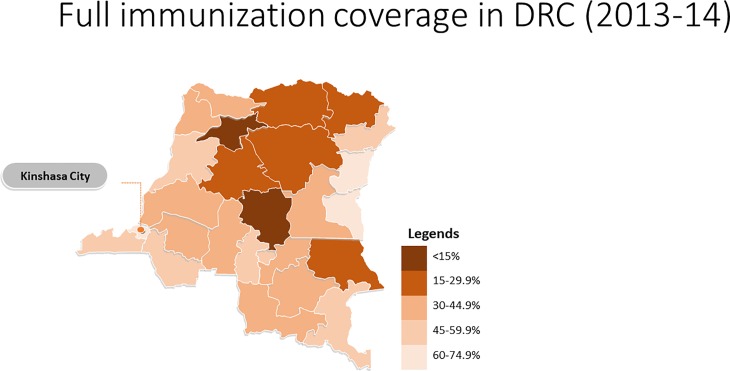
Understanding modifiable determinants of full immunization of children provide a valuable contribution to immunization programs and help reduce disease, disability, and death. This study is aimed to assess the individual and community-level determinants of full immunization coverage among children in the Democratic Republic of Congo. This study used data from the Demographic and Health Survey 2013-14 from the Democratic Republic of Congo. Data regarding total 3,366 children between 12 and 23 months of age were used in this study. Children who were immunized with one dose of BCG, three doses of polio, three doses of DPT, and a dose of measles vaccine was considered fully immunized. Descriptive statistics were calculated for the prevalence and distribution of full immunization coverage. Two-level multilevel logistic regression analysis, with individual-level (level 1) characteristics nested within community-level (level 2) characteristics, was used to assess the individual- and community-level determinants of full immunization coverage. This study found that about 45.3% [95%CI: 42.02, 48.52] of children aged 12-23 months were fully immunized in the DRC. The results confirmed immunization coverage varied and ranged between 5.8% in Mongala province to 70.6% in Nord-Kivu province. Results from multilevel analysis revealed that, four Antenatal Care (ANC) visits [AOR: 1.64; 95%CI: 1.23, 2.18], institutional delivery [AOR: 2.37; 95%CI: 1.52, 3.72], and Postnatal Care (PNC) service utilization [AOR: 1.43; 95%CI: 1.04, 1.95] were statistically significantly associated with the full immunization coverage. Similarly, children of mothers with secondary or higher education [AOR: 1.32; 95%CI: 1.00, 1.81] and from the richest wealth quintile [AOR: 1.96; 95%CI: 1.18, 3.27] had significantly higher odds of being fully immunized compared to their counterparts whose mothers were relatively poorer and less educated. Among the community-level characteristics, residents of the community with a higher rate of institutional delivery [AOR: 2.36; 95%CI: 1.59, 3.51] were found to be positively associated with the full immunization coverage. Also, the random effect result found about 35% of the variation in immunization coverage among the communities was attributed to community-level factors.The Democratic Republic of Congo has a noteworthy gap in full immunization coverage. Modifiable factors-particularly health service utilization including four ANC visits, institutional delivery, and postnatal visits-had a strong positive effect on full immunization coverage. The study underlines the importance of promoting immunization programs tailored to the poor and women with little education.
Conflict of interest statement
The authors have declared that no competing interests exist.
Figures
References
-
- You D, Hug L, Ejdemyr S, Beise J. Levels and trends in child mortality. Report 2015. Estimates developed by the UN Inter-agency Group for Child Mortality Estimation. 2015.
-
- United Nations Inter-agency Group for Child Mortality Estimation (UN IGME). Levels & Trends in Child Mortality: Report 2017. United Nations Children’s Fund, New York, 2017., 2017 2017. Report No.
-
- UNICEF, WHO, World Bank, UN DESA Population Division. Child Mortality Estimates: UN Inter-agency Group for Child Mortality Estimation; 2015 [updated 10/16/2017]. Available from: http://www.childmortality.org/index.php?r=site/graph#ID=COD.
-
- Institute of Health Metrics and Evaluation (IHME). The Democratic Republic of the Congo. Available at http://www.healthdata.org/democratic-republic-congo. Accessed on 15 October 2018. [cited 2018 January 31]. Available from: http://www.healthdata.org/democratic-republic-congo.
MeSH terms
Substances
LinkOut - more resources
Full Text Sources
Other Literature Sources
Medical
Miscellaneous
