


Maternal and perinatal adverse outcomes in women with pre-eclampsia cared for at facility-level in South Africa: a prospective cohort study
- PMID: 30140431
- PMCID: PMC6076583
- DOI: 10.7189/jogh.08.020401
Maternal and perinatal adverse outcomes in women with pre-eclampsia cared for at facility-level in South Africa: a prospective cohort study
Abstract
Background: Hypertensive disorders of pregnancy contribute to 14% of all maternal deaths, the majority of which occur in low- and middle-income countries. The aim of the study was to describe the maternal and perinatal clinical outcomes of women with pre-eclampsia living in middle- and low-income countries.
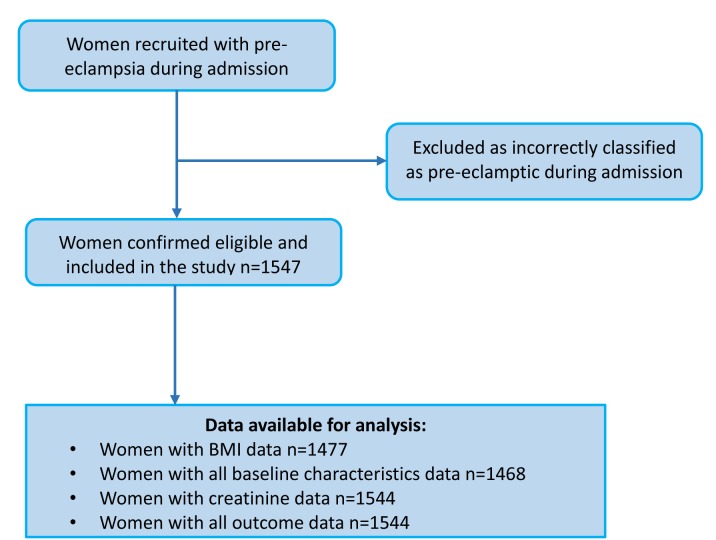
Methods: The study was a prospective observational study of women with pre-eclampsia (n = 1547, 42 twin pregnancies) at three South African tertiary facilities. Using stepwise logistic regression model area under the receiver operating characteristic curve (AUROC) values, the association between maternal baseline and admission characteristics and risk of adverse outcomes was evaluated. Main outcome measures were eclampsia, kidney injury and perinatal death.
Results: In 1547 women with pre-eclampsia, 16 (1%) died, 147 (9.5%) had eclampsia, four (0.3%) had a stroke and 272 (17.6%) had kidney injury. Of the 1589 births, there were 332 (21.0%) perinatal deaths; of these, 281 (84.5%) were stillbirths. Of 1308 live births, 913 (70.0%) delivered <37 completed weeks and 544 (41.7%) delivered <34 weeks' gestation. Young maternal age (AUROC = 0.76, 95% confidence interval (CI) = 0.71-0.80) and low Body Mass Index BMI (AUROC 0.65, 95% CI = 0.59-0.69) were significant predictors of eclampsia. Highest systolic blood pressure had the strongest association with kidney injury, (AUROC = 0.64, 95% CI = 0.60-0.68). Early gestation at admission was most strongly associated with perinatal death (AUROC = 0.81, 95% CI = 0.77-0.84).
Conclusions: The incidence of pre-eclampsia complications, perinatal death and preterm delivery in women referred to tertiary care in South Africa was much higher than reported in other low- and middle-income studies and despite access to tertiary care interventions. Teenage mothers and those with low BMI were at highest risk of eclampsia. This information could be used to inform guidelines, the research agenda and policy.
Conflict of interest statement
Competing interests: No conflict of interest is declared. No financial relationships with any organisation that might have interest in the submitted work in the previous 3 years are declared. No other relationships or activities that could appear to have influenced the submitted work are declared. All authors had full access to all of the data in the study and can take full responsibility for the integrity of the data and the accuracy of the data analysis. King’s College London is the guarantor for the study. The authors have completed the Unified Competing Interest form at www.icmje.org/coi_disclosure.pdfb(availableonrequestfromthecorrespondingauthor), and declare no conflict of interest.
References
-
- Kassebaum NJ, Bertozzi-Villa A, Coggeshall MS, Shackelford KA, Steiner C, Heuton KR, et al. Global, regional, and national levels and causes of maternal mortality during 1990–2013: a systematic analysis for the Global Burden of Disease Study 2013. Lancet. 2014;384:980–1004. doi: 10.1016/S0140-6736(14)60696-6. - DOI - PMC - PubMed
-
- von Dadelszen P, Sawchuck D, Hofmeyr GJ, Magee LA, Bracken H, Mathai M, et al. PRE-EMPT (PRE-eclampsia-Eclampsia Monitoring, Prevention and Treatment): A low and middle income country initiative to reduce the global burden of maternal, fetal and infant death and disease related to pre-eclampsia. Pregnancy Hypertens. 2013;3:199–202. doi: 10.1016/j.preghy.2013.06.002. - DOI - PubMed
-
- De Wet N. Pregnancy and death: An examination of pregnancy-related deaths among adolescents in South Africa. South African Journal of Child Health. 2016;10:151–5. doi: 10.7196/SAJCH.2016.v10i3.978. - DOI
MeSH terms
Grants and funding
LinkOut - more resources
Full Text Sources