Association of Residential Mobility Over the Life Course With Nonaffective Psychosis in 1.4 Million Young People in Sweden
- PMID: 30140915
- PMCID: PMC6248097
- DOI: 10.1001/jamapsychiatry.2018.2233
Association of Residential Mobility Over the Life Course With Nonaffective Psychosis in 1.4 Million Young People in Sweden
Abstract
Importance: Residential mobility (changing residence) during childhood and early adolescence is a possible risk factor for several adverse health outcomes, including psychotic disorders. However, it is unclear whether sensitive periods to residential mobility exist over the life course, including in adulthood, or if greater moving distances, which might disrupt social networks, are associated with a greater psychosis risk.
Objective: To examine the association between residential mobility over the life course and the risk of nonaffective psychosis.
Design, setting, and participants: This prospective cohort study included all people born in Sweden between January 1, 1982, and December 31, 1995, who were alive and resided in Sweden on their 16th birthday who were followed up until up to age 29 years (ending December 2011). Participants were followed until receiving a first diagnosis of an International Statistical Classification of Diseases and Related Health Problems, Tenth Revision (ICD-10) nonaffective psychotic disorder (F20-29), emigration, death, or the end of 2011, whichever was sooner. National register linkage provided exposure, outcome, and covariate data (complete data were available for 1 440 383 participants [97.8%]).
Exposures: The exposures to distance moved and the number of residential moves were examined for participants at the following periods over the life course: 0 to 6 years, 7 to 15 years, 16 to 19 years, and 20 years and older.
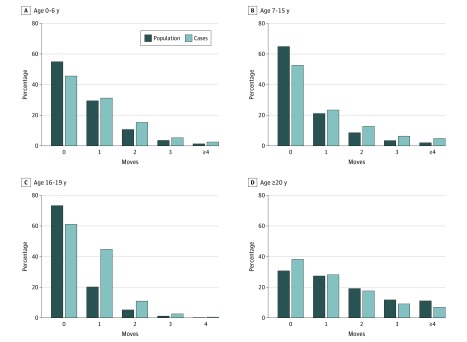
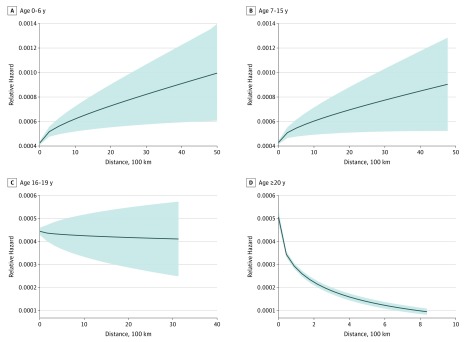
Results: This study included 1 440 383 participants, of whom 4537 (0.31%) had nonaffective psychotic disorder (median age, 20.9 [interquartile range, 19.0-23.3]). More frequent moves during childhood and adolescence were associated with an increased risk of nonaffective psychosis that showed dose-response associations independent of covariates. The most sensitive period of risk occurred during late adolescence; those who moved during each year between age 16 to 19 years had an increased adjusted hazard ratio (HR) of 1.99 (95% CI, 1.30-3.05) compared with those who never moved. One move during adulthood was not associated with psychosis risk (adjusted HR, 1.04; 95% CI, 0.94-1.14), but moving 4 or more times during adulthood was associated with increased risk (adjusted hazard ratio, 1.82; 95% CI, 1.51-2.23). Independently, moving greater distances before age 16 years was associated with an increased risk (adjusted HR, 1.11; 95% CI, 1.05-1.19), with evidence of a nonlinear threshold effect for moves longer than 30 km. The distance moved after age 20 years was associated with a decreased risk (adjusted HR, 0.67; 95% CI, 0.63-0.71).
Conclusions and relevance: Children and adolescents with less disruption in their residential environments are less likely to experience psychotic disorders in early adulthood. Moves that may necessitate changes in school and social networks were most strongly associated with future risk.
Conflict of interest statement
Figures
References
Publication types
MeSH terms
Grants and funding
LinkOut - more resources
Full Text Sources
Other Literature Sources
Medical