Ultrasound Evolution of Pediatric Urinary Schistosomiasis after Treatment with Praziquantel in a Highly Endemic Area
- PMID: 30141396
- PMCID: PMC6159568
- DOI: 10.4269/ajtmh.18-0343
Ultrasound Evolution of Pediatric Urinary Schistosomiasis after Treatment with Praziquantel in a Highly Endemic Area
Abstract
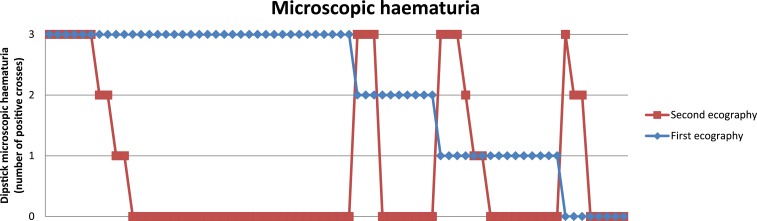
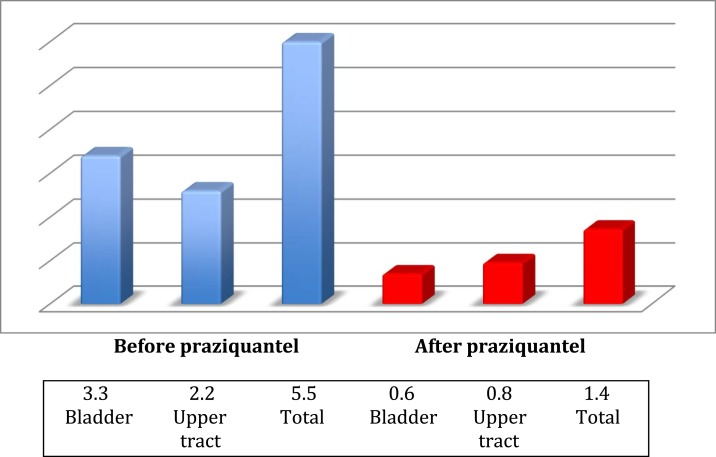
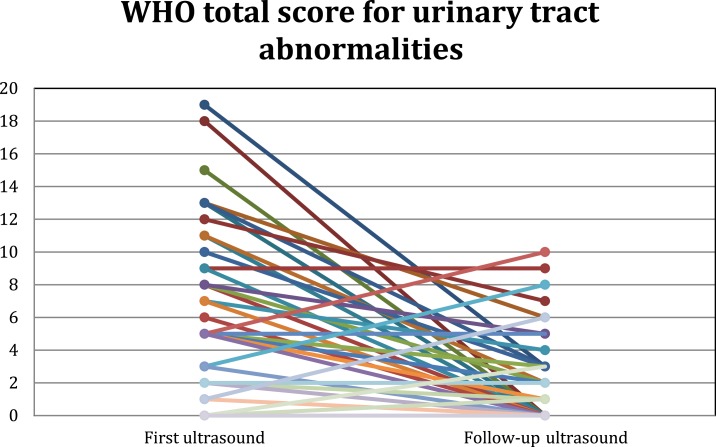
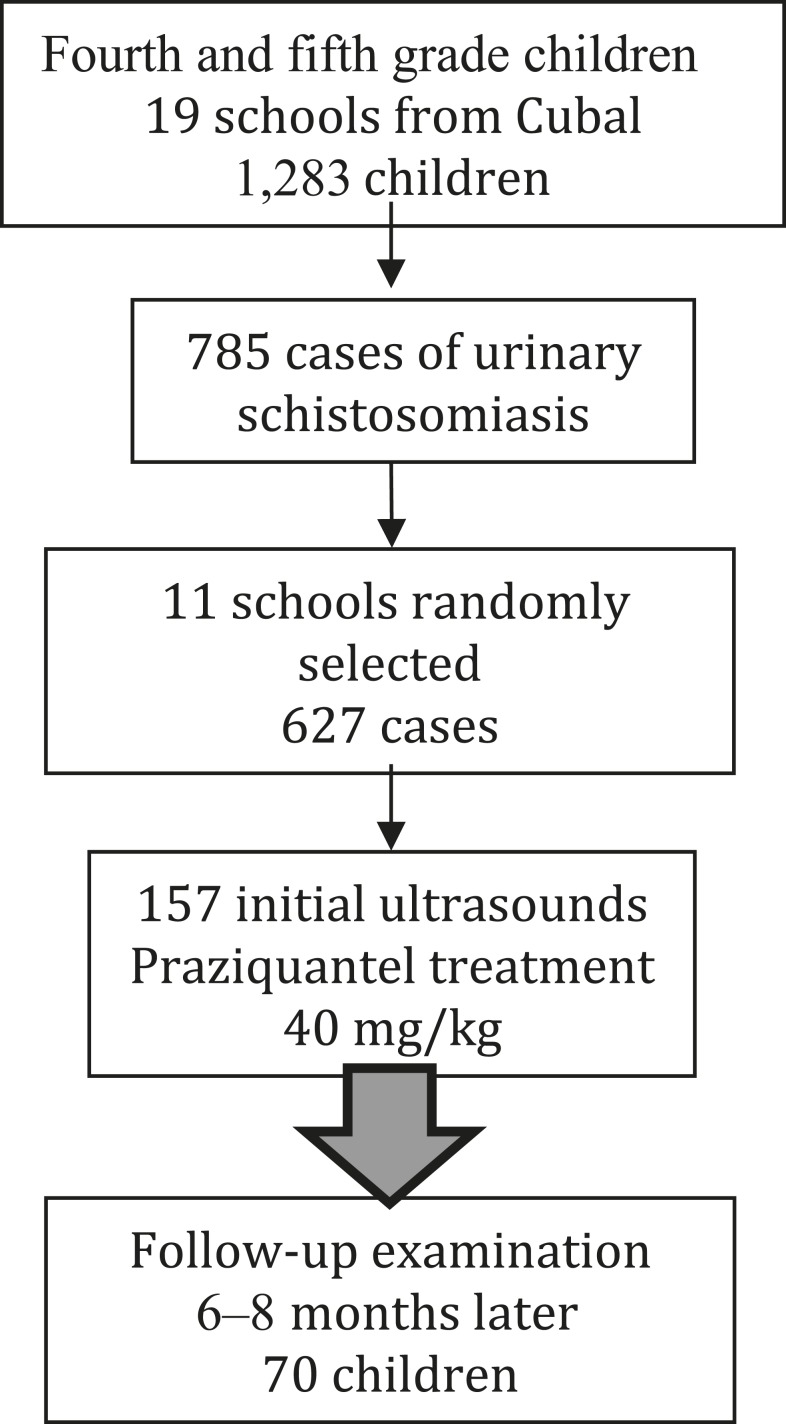
Urinary schistosomiasis causes damage to the urological system. Ultrasound is a method that detects the burden of secondary disease, individually and in epidemiological studies. In this study, the Schistosoma haematobium-associated urinary tract pathology is analyzed before and after treatment in a short period of time. Seventy children who had previously participated in an epidemiological study on schistosomiasis in the city of Cubal, Angola, and had also performed urinary ultrasound between August 2013 and February 2014 were cited 6-8 months later to assess the possible reinfection and repeat new urinary ultrasound, analyzing changes at the level of urinary pathology. The presence of hematuria and proteinuria was also analyzed. Of the 70 children analyzed, 29 (41.4%) were girls, with an average age of 10.4 years (standard deviation 2.3). Fifty-three (75.7%) had an improvement in their bladder and/or kidney scores, whereas 12 (17.1%) had no change and five (7.1%) had progression of the disease. None of the parameters analyzed completely disappeared. After one single course of treatment with praziquantel, all the analyzed parameters showed regression. Improvement was greater in the urinary bladder than in the upper urinary tract, though these lesions also reversed; the reversion of all parameters was greater among children older than 10 years old than the younger ones. Proteinuria was the parameter with a smaller reduction. Ultrasound should be a usual tool for diagnosis and follow-up in urinary schistosomiasis, particularly in children; more accurate recommendations about follow-up in the case of children whose lesions do not reverse should be established.
Figures
Similar articles
-
Evolution of Schistosoma haematobium-related pathology over 24 months after treatment with praziquantel among school children in southeastern Tanzania.Am J Trop Med Hyg. 1998 Nov;59(5):775-81. doi: 10.4269/ajtmh.1998.59.775. Am J Trop Med Hyg. 1998. PMID: 9840596
-
Inflammation dynamics after praziquantel treatment of Schistosoma haematobium reflected by urinary eosinophil cationic protein.Trans R Soc Trop Med Hyg. 2017 Jul 1;111(7):316-324. doi: 10.1093/trstmh/trx057. Trans R Soc Trop Med Hyg. 2017. PMID: 29165707
-
Ultrasonographic evaluation of urinary tract morbidity in school-aged and preschool-aged children infected with Schistosoma haematobium and its evolution after praziquantel treatment: A randomized controlled trial.PLoS Negl Trop Dis. 2017 Feb 21;11(2):e0005400. doi: 10.1371/journal.pntd.0005400. eCollection 2017 Feb. PLoS Negl Trop Dis. 2017. PMID: 28222149 Free PMC article. Clinical Trial.
-
Evolution of schistosomiasis-induced pathology after therapy and interruption of exposure to schistosomes: a review of ultrasonographic studies.Acta Trop. 2000 Oct 23;77(1):111-31. doi: 10.1016/s0001-706x(00)00125-x. Acta Trop. 2000. PMID: 10996127 Review.
-
Ultrasound aspects and risk factors associated with urogenital schistosomiasis among primary school children in Mali.Infect Dis Poverty. 2023 Apr 20;12(1):40. doi: 10.1186/s40249-023-01071-6. Infect Dis Poverty. 2023. PMID: 37081494 Free PMC article.
Cited by
-
Urogenital schistosomiasis burden in school-aged children in Tiko, Cameroon: a cross-sectional study on prevalence, intensity, knowledge and risk factors.Trop Med Health. 2021 Sep 16;49(1):75. doi: 10.1186/s41182-021-00362-8. Trop Med Health. 2021. PMID: 34530935 Free PMC article.
-
Associations between infection intensity categories and morbidity prevalence in school-age children are much stronger for Schistosoma haematobium than for S. mansoni.PLoS Negl Trop Dis. 2021 May 25;15(5):e0009444. doi: 10.1371/journal.pntd.0009444. eCollection 2021 May. PLoS Negl Trop Dis. 2021. PMID: 34033646 Free PMC article.
-
Point-of-care ultrasound reveals extensive pathology in Gabonese preschool-age children with urogenital schistosomiasis.PLoS Negl Trop Dis. 2025 Apr 10;19(4):e0012991. doi: 10.1371/journal.pntd.0012991. eCollection 2025 Apr. PLoS Negl Trop Dis. 2025. PMID: 40208908 Free PMC article.
-
Parasitic helminth infections in humans modulate Trefoil Factor levels in a manner dependent on the species of parasite and age of the host.PLoS Negl Trop Dis. 2021 Oct 18;15(10):e0009550. doi: 10.1371/journal.pntd.0009550. eCollection 2021 Oct. PLoS Negl Trop Dis. 2021. PMID: 34662329 Free PMC article.
-
Review of Recent Prevalence of Urogenital Schistosomiasis in Sub-Saharan Africa and Diagnostic Challenges in the Field Setting.Life (Basel). 2023 Jul 31;13(8):1670. doi: 10.3390/life13081670. Life (Basel). 2023. PMID: 37629527 Free PMC article. Review.
References
-
- King CH, Dickman K, Tisch D, 2005. Reassessment of the cost of chronic helmintic infection: a meta-analysis of disability related outcomes in endemic schistosomiasis. Lancet 365: 1561–1569. - PubMed
-
- Gryseels B, Polman K, Clerinx J, Kestens L, 2006. Human schistosomiasis. Lancet 368: 1106–1118. - PubMed
-
- Steinmann P, Keiser J, Bos R, Tanner M, Utzinger J, 2006. Schistosomiasis and water resources development: systematic review, meta-analysis, and estimates of people at risk. Lancet Infect Dis 6: 411–425. - PubMed
-
- Murray CJ, et al. 2013. Disability-adjusted life years (DALYs) for 291 diseases and injuries in 21 regions, 1990–2010: a systematic analysis for the global burden of disease study 2010. Lancet 380: 2197–2223. - PubMed
MeSH terms
Substances
LinkOut - more resources
Full Text Sources
Other Literature Sources