


Comment
doi: 10.7554/eLife.40271.
Cider vinegar rules
Affiliations
- PMID: 30141408
- PMCID: PMC6108824
- DOI: 10.7554/eLife.40271
Item in Clipboard
Comment
Cider vinegar rules
Elife.
.
Abstract
Experiments in wind tunnels have shed light on the rules that govern how flies respond when they detect odors.
Keywords: D. melanogaster; behavior; chemotaxis; computation; navigation; neuroscience; olfaction.
© 2018, Calabrese.
Conflict of interest statement
RC No competing interests declared
Figures
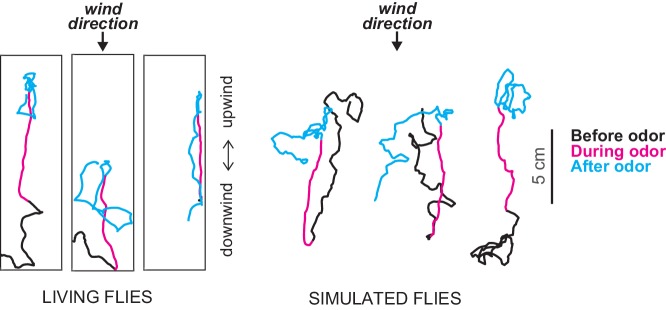
Álvarez-Salvado et al. performed experiments in which they tracked the movement of flies in small-scale wind tunnels when pulses of an odor (apple cider vinegar) were released from a point source (not shown) and were carried by the wind through the tunnel: in the figure the wind is blowing from top to bottom. Left: tracks of three genetically blinded flies before (black), during (magenta) and after (cyan) a 10 second odor pulse. At the onset of the pulse the flies turn rapidly toward the source of the odor and increase their upwind velocity. When the pulse ends the flies start to change direction in an effort to locate the odor. Right: based on these findings Álvarez-Salvado et al. built a model to simulate the movement of flies in the wind tunnels. The model does a good job of capturing the responses of the flies to various odor pulses.
Comment on
-
Elementary sensory-motor transformations underlying olfactory navigation in walking fruit-flies.Elife. 2018 Aug 21;7:e37815. doi: 10.7554/eLife.37815. Elife. 2018. PMID: 30129438 Free PMC article.
References
-
- Baker T. Upwind flight and casting flight: Complementary phasic and tonic systems used for location of sex pheromone sources by male moth. Proceedings of the 10th International Symposium on Olfaction and Taste (Oslo); 1990. pp. 18–25.
-
- Berg HC. E. coli in Motion. New York: Springer-Verlag; 2004.
Publication types
MeSH terms
Substances
LinkOut - more resources
Full Text Sources
Other Literature Sources
Molecular Biology Databases
