


DNA Methylation Changes in Lung Immune Cells Are Associated with Granulomatous Lung Disease
- PMID: 30141971
- PMCID: PMC6348713
- DOI: 10.1165/rcmb.2018-0177OC
DNA Methylation Changes in Lung Immune Cells Are Associated with Granulomatous Lung Disease
Abstract
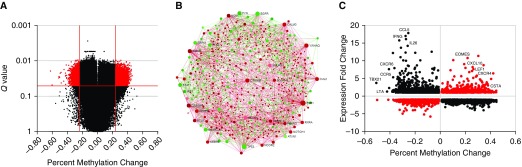
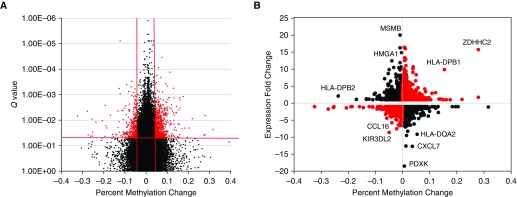
Epigenetic marks are likely to explain variability of response to antigen in granulomatous lung disease. The objective of this study was to identify DNA methylation and gene expression changes associated with chronic beryllium disease (CBD) and sarcoidosis in lung cells obtained by BAL. BAL cells from CBD (n = 8), beryllium-sensitized (n = 8), sarcoidosis (n = 8), and additional progressive sarcoidosis (n = 9) and remitting (n = 15) sarcoidosis were profiled on the Illumina 450k methylation and Affymetrix/Agilent gene expression microarrays. Statistical analyses were performed to identify DNA methylation and gene expression changes associated with CBD, sarcoidosis, and disease progression in sarcoidosis. DNA methylation array findings were validated by pyrosequencing. We identified 52,860 significant (P < 0.005 and q < 0.05) CpGs associated with CBD; 2,726 CpGs near 1,944 unique genes have greater than 25% methylation change. A total of 69% of differentially methylated genes are significantly (q < 0.05) differentially expressed in CBD, with many canonical inverse relationships of methylation and expression in genes critical to T-helper cell type 1 differentiation, chemokines and their receptors, and other genes involved in immunity. Testing of these CBD-associated CpGs in sarcoidosis reveals that methylation changes only approach significance, but are methylated in the same direction, suggesting similarities between the two diseases with more heterogeneity in sarcoidosis that limits power with the current sample size. Analysis of progressive versus remitting sarcoidosis identified 15,215 CpGs (P < 0.005 and q < 0.05), but only 801 of them have greater than 5% methylation change, demonstrating that DNA methylation marks of disease progression changes are more subtle. Our study highlights the significance of epigenetic marks in lung immune response in granulomatous lung disease.
Keywords: berylliosis; epigenetics; genomics; immunology; sarcoidosis.
Figures


Comment in
-
Environment, Epigenetics, and Differential Responses to Beryllium Exposure: Are We There Yet?Am J Respir Cell Mol Biol. 2019 Jan;60(1):11-12. doi: 10.1165/rcmb.2018-0306ED. Am J Respir Cell Mol Biol. 2019. PMID: 30321053 Free PMC article. No abstract available.
References
-
- Mayer AS, Hamzeh N, Maier LA. Sarcoidosis and chronic beryllium disease: similarities and differences. Semin Respir Crit Care Med. 2014;35:316–329. - PubMed
-
- Rybicki BA, Major M, Popovich J, Jr, Maliarik MJ, Iannuzzi MC. Racial differences in sarcoidosis incidence: a 5-year study in a health maintenance organization. Am J Epidemiol. 1997;145:234–241. - PubMed
-
- Infante PF, Newman LS. Beryllium exposure and chronic beryllium disease. Lancet. 2004;363:415–416. - PubMed
-
- Newman LS, Mroz MM, Balkissoon R, Maier LA. Beryllium sensitization progresses to chronic beryllium disease: a longitudinal study of disease risk. Am J Respir Crit Care Med. 2005;171:54–60. - PubMed
-
- Erdal BS, Clymer BD, Yildiz VO, Julian MW, Crouser ED. Unexpectedly high prevalence of sarcoidosis in a representative U.S. metropolitan population. Respir Med. 2012;106:893–899. - PubMed
Publication types
MeSH terms
Substances
Grants and funding
LinkOut - more resources
Full Text Sources
Other Literature Sources
Molecular Biology Databases
