


Role of extracellular matrix in the pathogenesis of pulmonary arterial hypertension
- PMID: 30141981
- PMCID: PMC6297810
- DOI: 10.1152/ajpheart.00136.2018
Role of extracellular matrix in the pathogenesis of pulmonary arterial hypertension
Abstract
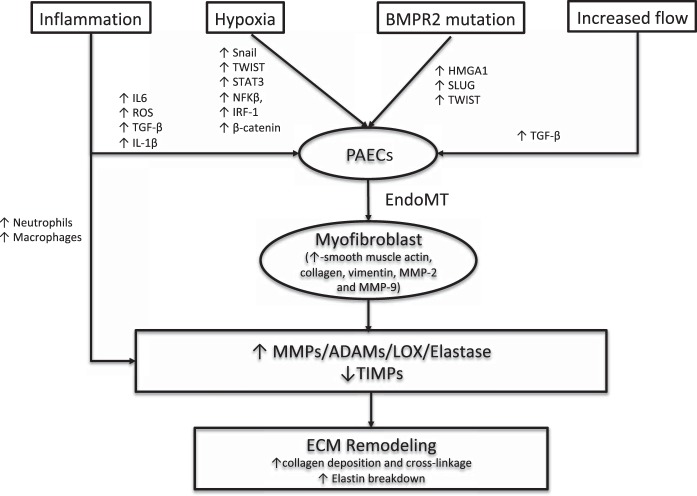
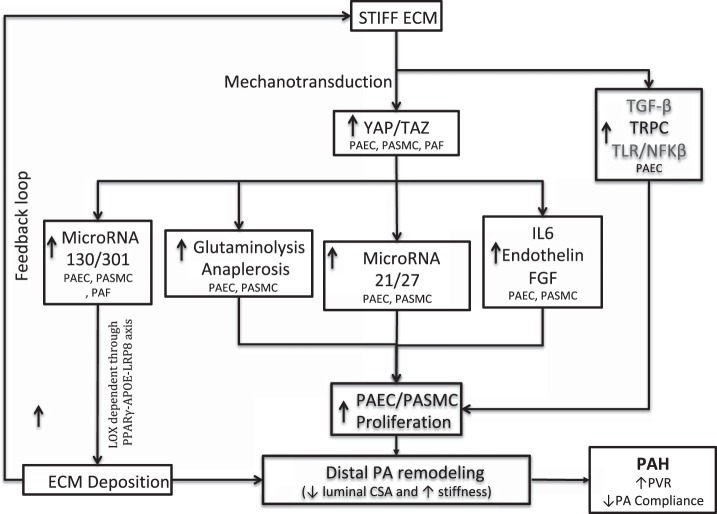
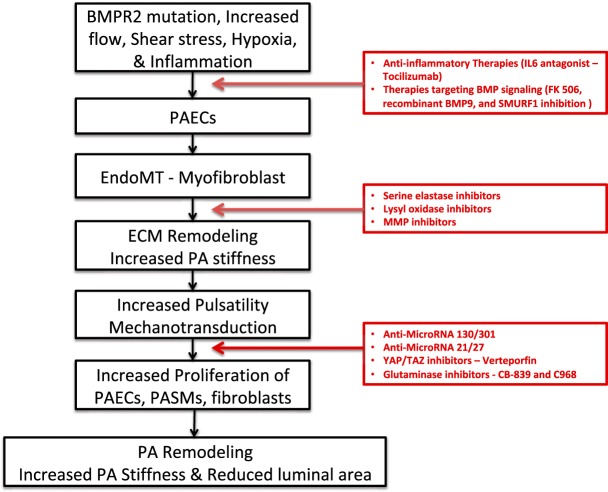
Pulmonary arterial hypertension (PAH) is characterized by remodeling of the extracellular matrix (ECM) of the pulmonary arteries with increased collagen deposition, cross-linkage of collagen, and breakdown of elastic laminae. Extracellular matrix remodeling occurs due to an imbalance in the proteolytic enzymes, such as matrix metalloproteinases, elastases, and lysyl oxidases, and tissue inhibitor of matrix metalloproteinases, which, in turn, results from endothelial cell dysfunction, endothelial-to-mesenchymal transition, and inflammation. ECM remodeling and pulmonary vascular stiffness occur early in the disease process, before the onset of the increase in the intimal and medial thickness and pulmonary artery pressure, suggesting that the ECM is a cause rather than a consequence of distal pulmonary vascular remodeling. ECM remodeling and increased pulmonary arterial stiffness promote proliferation of pulmonary vascular cells (endothelial cells, smooth muscle cells, and adventitial fibroblasts) through mechanoactivation of various signaling pathways, including transcriptional cofactors YAP/TAZ, transforming growth factor-β, transient receptor potential channels, Toll-like receptor, and NF-κB. Inhibition of ECM remodeling and mechanotransduction prevents and reverses experimental pulmonary hypertension. These data support a central role for ECM remodeling in the pathogenesis of the PAH, making it an attractive novel therapeutic target.
Keywords: collagen; compliance; mechanotransduction; right ventricle; stiffness.
Figures
Comment in
-
The extracellular matrix in early and advanced pulmonary arterial hypertension.Am J Physiol Heart Circ Physiol. 2018 Dec 1;315(6):H1684-H1686. doi: 10.1152/ajpheart.00620.2018. Epub 2018 Sep 28. Am J Physiol Heart Circ Physiol. 2018. PMID: 30265148 No abstract available.
References
-
- Anand V, Roy SS, Archer SL, Weir EK, Garg SK, Duval S, Thenappan T. Trends and outcomes of pulmonary arterial hypertension-related hospitalizations in the United States: analysis of the nationwide inpatient sample database from 2001 through 2012. JAMA Cardiol 1: 1021–1029, 2016. doi: 10.1001/jamacardio.2016.3591. - DOI - PMC - PubMed
-
- Anwar A, Li M, Frid MG, Kumar B, Gerasimovskaya EV, Riddle SR, McKeon BA, Thukaram R, Meyrick BO, Fini MA, Stenmark KR. Osteopontin is an endogenous modulator of the constitutively activated phenotype of pulmonary adventitial fibroblasts in hypoxic pulmonary hypertension. Am J Physiol Lung Cell Mol Physiol 303: L1–L11, 2012. doi: 10.1152/ajplung.00050.2012. - DOI - PMC - PubMed
-
- Benza RL, Miller DP, Gomberg-Maitland M, Frantz RP, Foreman AJ, Coffey CS, Frost A, Barst RJ, Badesch DB, Elliott CG, Liou TG, McGoon MD. Predicting survival in pulmonary arterial hypertension: insights from the Registry to Evaluate Early and Long-Term Pulmonary Arterial Hypertension Disease Management (REVEAL). Circulation 122: 164–172, 2010. doi: 10.1161/CIRCULATIONAHA.109.898122. - DOI - PubMed
Publication types
MeSH terms
Substances
Grants and funding
LinkOut - more resources
Full Text Sources
Other Literature Sources
Medical
