. 2018 Aug 23;10(9):1154.
doi: 10.3390/nu10091154.

A High Salt Diet Modulates the Gut Microbiota and Short Chain Fatty Acids Production in a Salt-Sensitive Hypertension Rat Model

Affiliations

A High Salt Diet Modulates the Gut Microbiota and Short Chain Fatty Acids Production in a Salt-Sensitive Hypertension Rat Model

Ariel Bier et al. Nutrients. .

Abstract

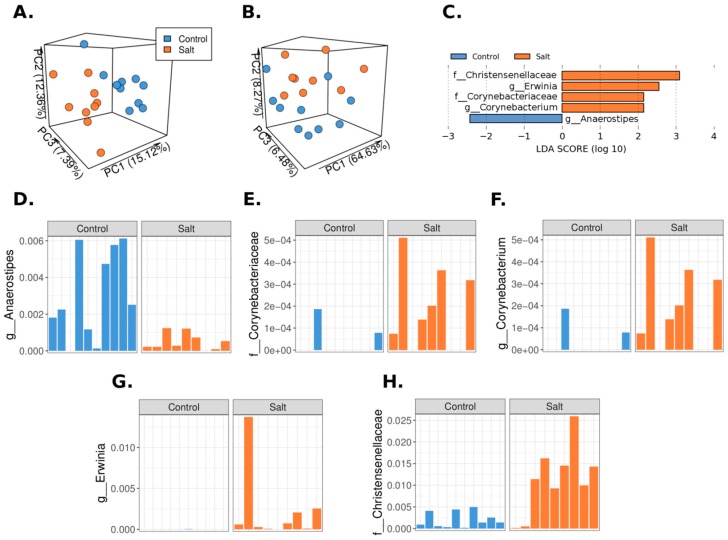
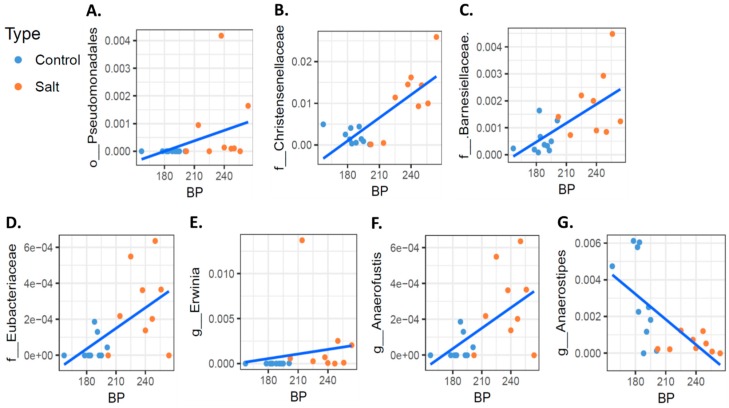
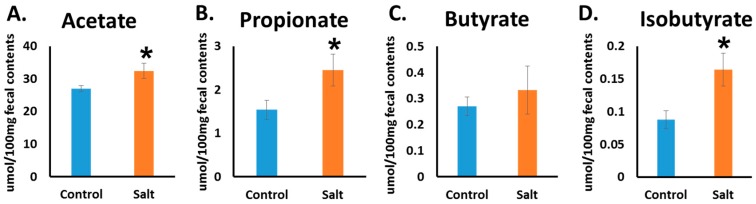
Emerging data indicate a correlation between gut microbial composition and cardiovascular disease including hypertension. The host's diet greatly affects microbial composition and metabolite production. Short chain fatty acids (SCFAs) are products of microbial fermentation, which can be utilized by the host. It has been suggested that SCFAs play a pivotal role as mediators in a microbiome host: microbial interactions occur in health and disease. The aim of this study was to evaluate the effect of a high salt diet (HSD) on microbial variation and to determine whether this effect is accompanied by an alteration in fecal SCFAs. To this end, Dahl salt-sensitive rats were divided into two groups (n = 10 each): (A) Control: fed regular chow; and (B) Fed HSD. High-throughput pyrosequencing of the 16S rRNA amplicon sequencing was used for microbiome characterizing. Chromatography-mass spectrometry was used to measure the levels of SCFAs: acetic acid, propionic acid, butyric acid, and isobutyric acid in fecal samples. Differences in microbial composition were noted between groups. Principal Coordinate Analysis (PCoA) principal coordinate 1 (PC1) primarily separated controls from the HSD. Four taxa displayed significant differences between HSD and controls. Taxa from the Erwinia genus, the Christensenellaceae and Corynebacteriaceae families, displayed an increased abundance in HSD versus control. In contrast, taxa from the Anaerostipes genus displayed a decreased abundance in HSD. We were able to identify seven unique taxa that were significantly associated with blood pressure. There was a significant difference in fecal acetic acid, as well as propionic and isobutyric acid, but not in the butyric acid composition between groups. Adding salt to a diet impacts the gut's microbial composition, which may alter fecal SCFA production.

Keywords: blood pressure; microbiome; salt; short chain fatty acids.


Conflict of interest statement

The authors declare no conflict of interest.

Figures
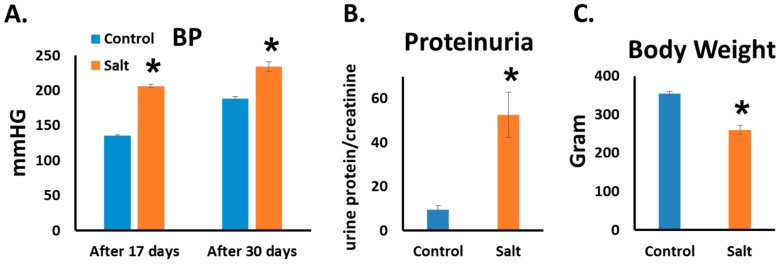
Figure 1
Figure 1
High salt diet (HSD)-fed rats developed hypertension accompanied by kidney injury. Blood pressure (BP) was measured using tail cuff. (The results of the 2nd and 5th weeks are shown.) (A) Proteinuria was measured in rat’s urine at the end of the 8th week; (B) Body weight was measured at the end of the experiment (the 8th week); (C) n = 8–10, * p ≤ 0.05.
Figure 2
Figure 2
Microbial composition in high salt diet (HSD) differs from the control. Fecal pellets from HSD and control rats were analyzed using 16S rRNA-Amplicon Sequencing. Unweighted (A) and weighted (B) UniFrac-based Principal Coordinates Analysis (PCoA) analysis of the cohort was performed to visually explore the similarity and variations between the samples’ microbial composition. PCoA indicated that a visual separation exists between HSD and control samples; (C) Five different microbial taxa displayed significant abundance differences (Linear discriminant analysis (LDA) score > 2) between HSD and control, using the LDA Effect Size analytic approach; (DH) The relative abundance of the 5 significant microbial taxa in the LDA Effect Size analysis is shown for each sample.
Figure 3
Figure 3
Correlation between blood pressure (BP) and bacterial taxa. Rat’s BP values after 30 days were analyzed for their correlation with specific bacterial taxa; 7 microbial taxa displayed a significant correlation (q value ≤ 0.1) with BP (AG) using the Multivariate Association with Linear Models (Maaslin) package. Blue dots and red dots depict fecal samples from the high salt diet and controls, respectively.
Figure 4
Figure 4
High salt diet elevated the SCFA level. The level of acetate (A); propionate (B); butyrate (C), and isobutyrate (D) were measured by GC-MS from fecal pellets at the end of the experiment. n = 8–10, * p ≤ 0.05.

References

    1. Oparil S., Acelajado M.C., Bakris G.L., Berlowitz D.R., Cifkova R., Dominiczak A.F., Grassi G., Jordan J., Poulter N.R., Rodgers A., et al. Hypertension. Nat. Rev. Dis. Prim. 2018;4:18014. doi: 10.1038/nrdp.2018.14. - DOI - PMC - PubMed
    1. Rucker A.J., Rudemiller N.P., Crowley S.D. Salt, Hypertension, and Immunity. Annu. Rev. Physiol. 2018;80:283–307. doi: 10.1146/annurev-physiol-021317-121134. - DOI - PMC - PubMed
    1. O’Donnell M., Mente A., Yusuf S. Sodium intake and cardiovascular health. Circ. Res. 2015;116:1046–1057. doi: 10.1161/CIRCRESAHA.116.303771. - DOI - PubMed
    1. David L.A., Maurice C.F., Carmody R.N., Gootenberg D.B., Button J.E., Wolfe B.E., Ling A.V., Devlin A.S., Varma Y., Fischbach M.A., Biddinger S.B., et al. Diet rapidly and reproducibly alters the human gut microbiome. Nature. 2014;505:559–563. doi: 10.1038/nature12820. - DOI - PMC - PubMed
    1. Schroeder B.O., Bäckhed F. Signals from the gut microbiota to distant organs in physiology and disease. Nat. Med. 2016;22:1079–1089. doi: 10.1038/nm.4185. - DOI - PubMed

MeSH terms