


Knee extensor muscles strength indicates global lower-limb strength in individuals who have suffered a stroke: A cross-sectional study
- PMID: 30143356
- PMCID: PMC6531629
- DOI: 10.1016/j.bjpt.2018.08.001
Knee extensor muscles strength indicates global lower-limb strength in individuals who have suffered a stroke: A cross-sectional study
Abstract
Objectives: This study had three aims: (1) to evaluate the relationships between the paretic knee extensor muscle strength and global lower-limb strength in individuals who had suffered a sub-acute/chronic stroke, (2) to determine whether global lower-limb strength, sex, body mass index, or age could predict knee extensor muscle strength, and 3) to investigate whether the results obtained via a Modified Sphygmomanometer Test (MST) would be similar to those obtained using a hand-held dynamometer.
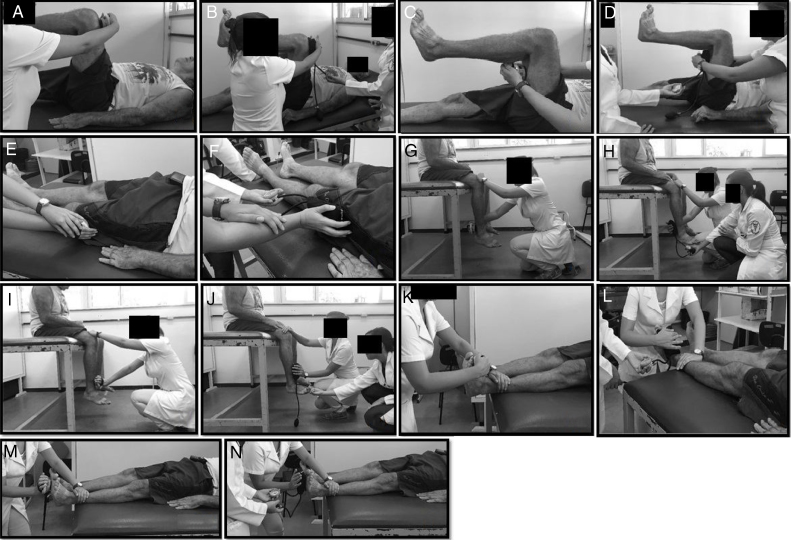
Methods: This was a cross-sectional study, performed at a research laboratory, at participants' homes, or at outpatient clinics. Forty-two individuals with a sub-acute stroke and 45 individuals with a chronic stroke participated. Maximum isometric strength of the paretic lower-limb muscles (i.e. hip, knee, and ankle flexors/extensors, hip abductors) was measured using the MST and a hand-held dynamometer.
Results: Significant and high correlation coefficients were found between knee extensor muscle strength and global lower-limb strength as measured by the combined strength values of 6 lower limb muscle groups in individuals with sub-acute (0.81≤r≤0.88; p<0.05) and chronic (0.82≤r≤0.85; p<0.05) stroke. Step-wise multiple regression analysis revealed that only global lower-limb strength was retained in the model and accounted for 66-78% and 67-72% (p<0.001) of the variance in knee extensor muscle strength at the sub-acute and chronic phases post-stroke, respectively. The results obtained via the MST were similar to those obtained using the hand-held dynamometer.
Conclusion: Paretic knee extensor muscles strength, assessed using a MST or a hand-held dynamometer, indicates global lower-limb strength in individuals with a sub-acute or chronic stroke.
Keywords: Knee; Lower extremity; Muscle strength; Physical therapy; Rehabilitation; Stroke.
Copyright © 2018 Associação Brasileira de Pesquisa e Pós-Graduação em Fisioterapia. Publicado por Elsevier Editora Ltda. All rights reserved.
Figures
References
-
- Feigin V.L., Norrving B., Mensah G.A. Global burden of stroke. Circ Res. 2017;120:439–448. - PubMed
-
- Dorsch S., Ada L., Canning C.G. Lower limb strength is significantly impaired in all muscle groups in ambulatory people with chronic stroke: a cross-sectional study. Arch Phys Med Rehabil. 2016;97:522–527. - PubMed
-
- Mentiplay B.F., Adair B., Bower K.J., Williams G., Tole G., Clark R.A. Associations between lower limb strength and gait velocity following stroke: a systematic review. Brain Inj. 2015;29:409–422. - PubMed
MeSH terms
LinkOut - more resources
Full Text Sources
Other Literature Sources
Medical
