. 2018 Oct 17;84(21):e01113-18.
doi: 10.1128/AEM.01113-18. Print 2018 Nov 1.

A Putative Acetylation System in Vibrio cholerae Modulates Virulence in Arthropod Hosts

Affiliations

A Putative Acetylation System in Vibrio cholerae Modulates Virulence in Arthropod Hosts

Kalle Liimatta et al. Appl Environ Microbiol. .

Abstract

Acetylation is a broadly conserved mechanism of covalently modifying the proteome to precisely control protein activity. In bacteria, central metabolic enzymes and regulatory proteins, including those involved in virulence, can be targeted for acetylation. In this study, we directly link a putative acetylation system to metabolite-dependent virulence in the pathogen Vibrio cholerae We demonstrate that the cobB and yfiQ genes, which encode homologs of a deacetylase and an acetyltransferase, respectively, modulate V. cholerae metabolism of acetate, a bacterially derived short-chain fatty acid with important physiological roles in a diversity of host organisms. In Drosophila melanogaster, a model arthropod host for V. cholerae infection, the pathogen consumes acetate within the gastrointestinal tract, which contributes to fly mortality. We show that deletion of cobB impairs growth on acetate minimal medium, delays the consumption of acetate from rich medium, and reduces virulence of V. cholerae toward Drosophila These impacts can be reversed by complementing cobB or by introducing a deletion of yfiQ into the ΔcobB background. We further show that cobB controls the accumulation of triglycerides in the Drosophila midgut, which suggests that cobB directly modulates metabolite levels in vivo In Escherichia coli K-12, yfiQ is upregulated by cAMP-cAMP receptor protein (CRP), and we identified a similar pattern of regulation in V. cholerae, arguing that the system is activated in response to similar environmental cues. In summary, we demonstrate that proteins likely involved in acetylation can modulate the outcome of infection by regulating metabolite exchange between pathogens and their colonized hosts.IMPORTANCE The bacterium Vibrio cholerae causes severe disease in humans, and strains can persist in the environment in association with a wide diversity of host species. By investigating the molecular mechanisms that underlie these interactions, we can better understand constraints affecting the ecology and evolution of this global pathogen. The Drosophila model of Vibrio cholerae infection has revealed that bacterial regulation of acetate and other small metabolites from within the fly gastrointestinal tract is crucial for its virulence. Here, we demonstrate that genes that may modify the proteome of V. cholerae affect virulence toward Drosophila, most likely by modulating central metabolic pathways that control the consumption of acetate as well as other small molecules. These findings further highlight the many layers of regulation that tune bacterial metabolism to alter the trajectory of interactions between bacteria and their hosts.

Keywords: Drosophila melanogaster; Vibrio cholerae; acetate; acetyl-CoA; acetyl-CoA synthetase; acetylation; carbon metabolism; cholera; posttranslational modification.


Figures

FIG 1
FIG 1
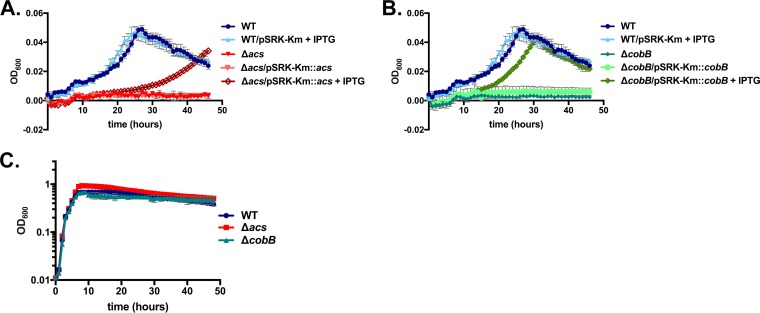
Deletion of V. cholerae SIO cobB prevents growth on acetate minimal medium but not on LB broth. (A and B) V. cholerae SIO Δacs (A) and ΔcobB (B) strains cannot grow on M63 minimal medium supplemented with 10 mM acetate as a sole carbon source, but the addition of the pSRK-Km complementation plasmids carrying the acs and cobB genes, respectively, together with induction with 1 mM IPTG, restores growth. Optical densities were measured once every hour over 46.5 h, and values from triplicate wells of a single experiment are plotted. (C) In LB broth, V. cholerae SIO Δacs and ΔcobB grow at similar rates, and to similar optical densities, relative to the wild-type (WT) strain. Optical densities were measured once every hour over 48 h, and values from duplicate wells of a single experiment in a 96-well plate are plotted. In each panel, error bars depict standard deviations. At some time points, the symbols fully obscure the error bars and therefore are not shown.
FIG 2
FIG 2
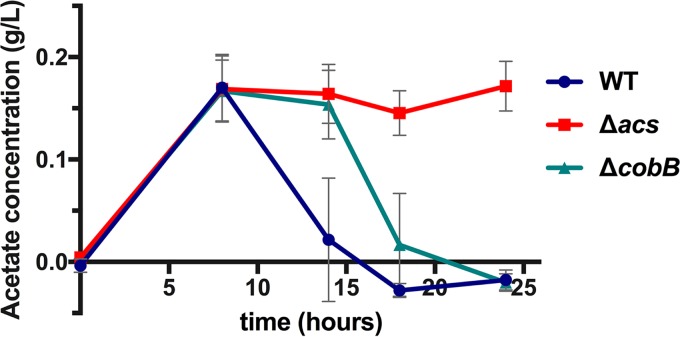
Deletion of V. cholerae SIO cobB delays, but does not halt, acetate consumption. Acetate concentrations relative to those in uninoculated LB broth were measured over time. Here, results from three biological replicates, each performed in duplicate, are depicted. Acetate concentrations in cultures of wild-type SIO and SIO ΔcobB strains are significantly different from one another after 14 h (P = 0.0022) and 18 h (P = 0.0087) of growth (by a Mann-Whitney test). Error bars depict standard deviations.
FIG 3
FIG 3
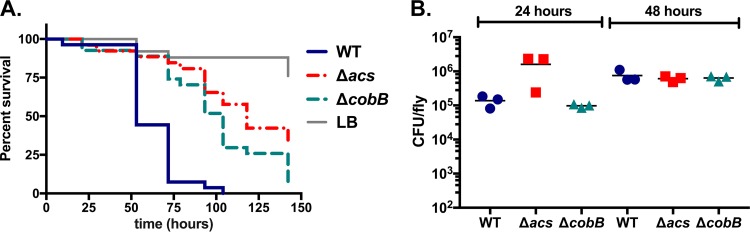
Deletion of V. cholerae SIO cobB significantly improves survival of Drosophila without appreciably affecting colonization. (A) Survival of flies fed the V. cholerae wild-type SIO, SIO ΔcobB, or SIO Δacs strain, or uninoculated LB broth as a control, was monitored over 143 h. This assay was performed with V. cholerae strains added to triplicate vials, with 8 to 10 flies per vial. This result is representative of data from five separate trials. Flies fed the SIO ΔcobB or SIO Δacs strain survived significantly longer than did flies fed the wild-type strain (P < 0.0001 by a log rank test). (B) Colonization of flies infected with the V. cholerae SIO wild-type, SIO ΔcobB, or SIO Δacs strain. The assay was performed in triplicate vials, and all surviving flies were collected after 24 and 48 h of infection, homogenized, and plated on selective medium. The bacterial loads of flies infected with the mutant strains were not significantly different from bacterial loads of those infected with the wild-type strain (P > 0.05 by a Mann-Whitney test).
FIG 4
FIG 4
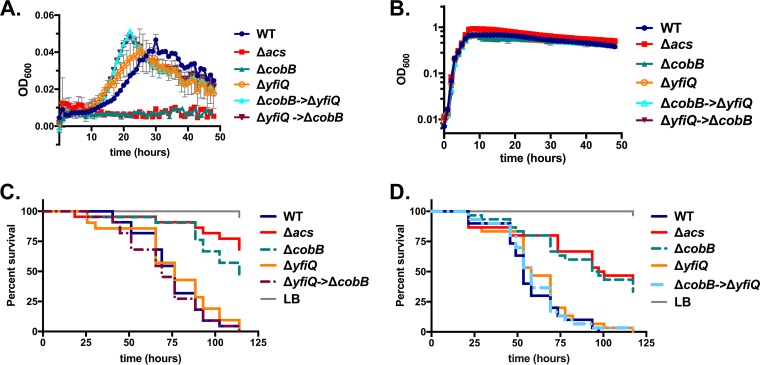
Introduction of the complete deletion of yfiQ restores both virulence in Drosophila and growth on acetate minimal medium to the V. cholerae ΔcobB strain. (A) Deletion of yfiQ does not impact growth on minimal medium supplemented with acetate (10 mM), with growth being similar to that of the wild-type strain. Introduction of the ΔyfiQ mutation restores growth to the strain carrying the deletion in ΔcobB, as both the ΔyfiQ→ΔcobB and the ΔcobB→ΔyfiQ strains grow similarly to the wild-type strain in acetate minimal medium. (B) In LB broth, all strains grow similarly to the wild type. (C) YfiQ does not significantly alter virulence of Drosophila (P > 0.05). In seven independent trials, deletion of yfiQ significantly increased virulence in one assay (P = 0.0003), reduced virulence in a second assay (P = 0.0143), and did not alter virulence in the remaining five assays, including the representative assay presented here. When infected with the ΔyfiQ→ΔcobB strain, fly mortality is increased significantly relative to the strain carrying the ΔcobB deletion alone (P < 0.0001 by a log rank test). This result was reproducible in five independent trials. (D) When flies were infected with the ΔcobB→ΔyfiQ strain, virulence was similarly restored relative to the strain carrying the single cobB deletion (P < 0.0001 by a log rank test).
FIG 5
FIG 5
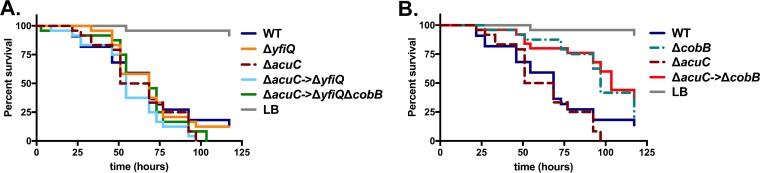
Deletion of the putative deacetylase AcuC does not alter virulence in Drosophila. (A) Survival of flies fed the wild-type, ΔyfiQ, ΔacuC, ΔacuC ΔyfiQ, or ΔacuC ΔyfiQ ΔcobB strain. Deletion of acuC did not alter fly survival relative to the wild type in each of two separate assays, one of which is represented here (P > 0.05 by a log rank test). (B) Survival of flies fed the wild-type, ΔcobB, ΔacuC, or ΔacuC ΔcobB strain. Deletion of acuC in the ΔcobB strain did not alter survival relative to the ΔcobB deletion alone in each of two separate assays (P > 0.05 by a log rank test).
FIG 6
FIG 6
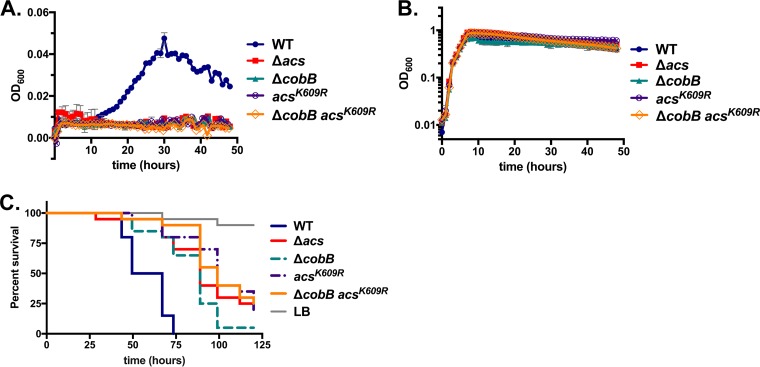
Mutation of lysine 609 abrogates Acs activity. (A) Mutation of the putative catalytic residue of Acs, K609, to arginine entirely halts growth on M63 minimal medium supplemented with 10 mM acetate. The introduction of this mutation has no effect on the growth of the ΔcobB strain. (B) Mutations of acs have no effect on growth on LB broth, consistent with previous findings. (C) Introduction of the acsK609R mutation into the wild-type strain reduces fly mortality (P < 0.0001 by a log rank test). The introduction of the same mutation into the ΔcobB strain does not restore virulence but rather further reduces virulence (P = 0.018 by a log rank test). These results are representative of data from three independent trials.
FIG 7
FIG 7
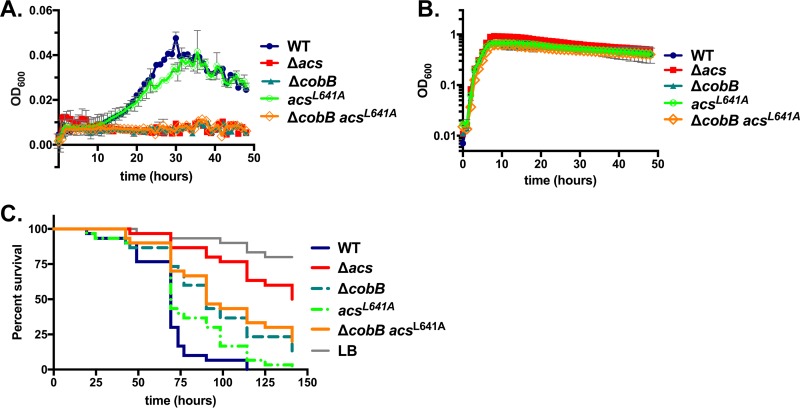
Mutation of Leu641 to Ala does not restore acetate metabolism in the ΔcobB strain. (A) Mutation of Leu641 does not severely impede growth on M63 minimal medium supplemented with 10 mM acetate. The introduction of this mutation has no effect on the growth of the ΔcobB strain. (B) Mutations of acs have no effect on growth on LB broth, consistent with previous findings. (C) Introduction of the acsL641A mutation into the wild-type strain slightly reduces fly mortality (P = 0.0260 by a log rank test), consistent with findings in four of five independent trials. The introduction of the same mutation into the ΔcobB strain does not affect the virulence of the ΔcobB mutant (P > 0.05 by a log rank test), which was again observed in four of five independent trials.
FIG 8
FIG 8
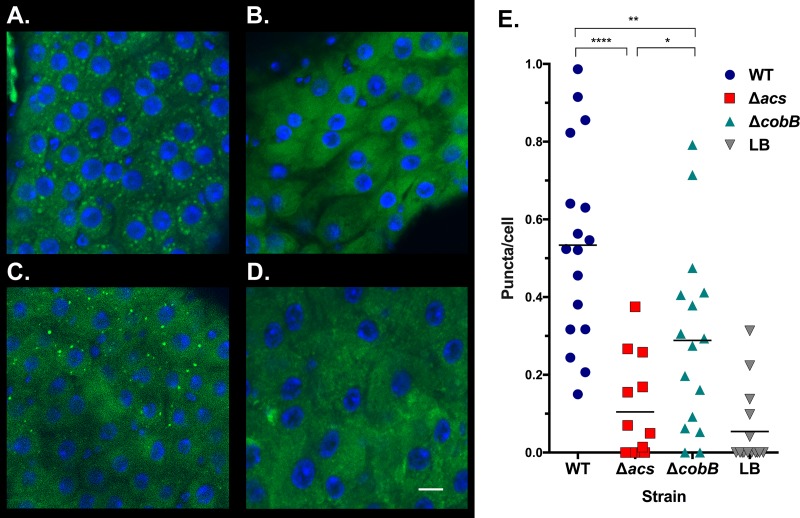
CobB alters accumulation of triglycerides in the Drosophila gastrointestinal tract. (A to D) Representative images of Drosophila GI tracts infected with the V. cholerae wild-type (A), Δacs (B), or ΔcobB (D) strain or provided sterile LB broth (D); visualized by confocal microscopy; and stained with DAPI and BODIPY. Bar, 10 μm. (E) Quantification of triglyceride puncta stained with BODIPY 493/503 in midguts of Drosophila flies infected with the V. cholerae wild-type, Δacs, or ΔcobB strain or sterile LB broth, with the levels of significance indicated (****, P < 0.0001; **, P = 0.0060; *, P = 0.0127). These results were representative of data from three trials comparing the wild-type and ΔcobB strains, two of which included the Δacs strain.
FIG 9
FIG 9
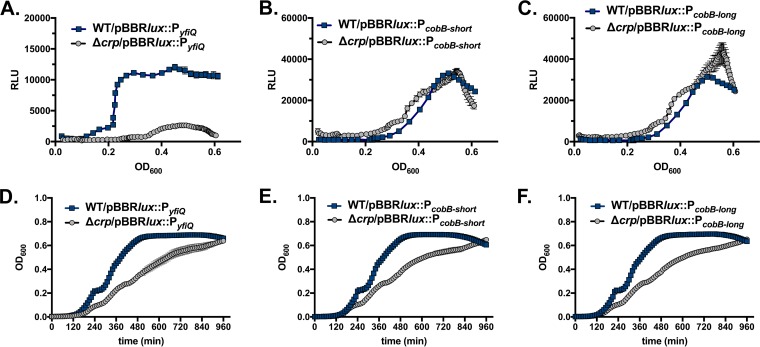
CRP regulates transcription of yfiQ but not cobB. (A to C) The promoter of yfiQ (A) and both a short region (B) and a longer region (C) of the cobB promoter were cloned into the pBBRlux plasmid and conjugated into V. cholerae wild-type and V. cholerae Δcrp bacteria. Bioluminescence was monitored in a multimode plate reader over 1,000 min and is depicted as relative light units (RLU), defined as luminescence normalized to the OD600. Due to the growth defect of the crp mutants, the y axis depicts the OD600, and RLU are shown over the time period during which the cultures were at an OD600 of 0.02 to 0.60. The yfiQ promoter is strongly induced, but the deletion of crp prevents the expression of yfiQ. In contrast, the deletion of crp does not affect expression from the cobB promoter fragments. (D to F) The Δcrp strain exhibits a growth defect as cells approach stationary phase. Growth of the WT and Δcrp strains carrying the designated promoters was monitored in the multimode plate reader by measurement of OD600.

References

    1. Wolfe AJ. 2005. The acetate switch. Microbiol Mol Biol Rev 69:12–50. doi:10.1128/MMBR.69.1.12-50.2005. - DOI - PMC - PubMed
    1. Nakayasu ES, Burnet MC, Walukiewicz HE, Wilkins CS, Shukla AK, Brooks S, Plutz MJ, Lee BD, Schilling B, Wolfe AJ, Müller S, Kirby JR, Rao CV, Cort JR, Payne SH. 2017. Ancient regulatory role of lysine acetylation in central metabolism. mBio 8:e01894-. doi:10.1128/mBio.01894-17. - DOI - PMC - PubMed
    1. Wang Q, Zhang Y, Yang C, Xiong H, Lin Y, Yao J, Li H, Xie L, Zhao W, Yao Y, Ning Z-B, Zeng R, Xiong Y, Guan K-L, Zhao S, Zhao G-P. 2010. Acetylation of metabolic enzymes coordinates carbon source utilization and metabolic flux. Science 327:1004–1007. doi:10.1126/science.1179687. - DOI - PMC - PubMed
    1. Xie L, Wang X, Zeng J, Zhou M, Duan X, Li Q, Zhang Z, Luo H, Pang L, Li W, Liao G, Yu X, Li Y, Huang H, Xie J. 2015. Proteome-wide lysine acetylation profiling of the human pathogen Mycobacterium tuberculosis. Int J Biochem Cell Biol 59:193–202. doi:10.1016/j.biocel.2014.11.010. - DOI - PubMed
    1. Weinert BT, Iesmantavicius V, Wagner SA, Schölz C, Gummesson B, Beli P, Nyström T, Choudhary C. 2013. Acetyl-phosphate is a critical determinant of lysine acetylation in E. coli. Mol Cell 51:265–272. doi:10.1016/j.molcel.2013.06.003. - DOI - PubMed

Publication types

MeSH terms

LinkOut - more resources