. 2018 Oct 3;38(40):8666-8679.
doi: 10.1523/JNEUROSCI.1702-17.2018. Epub 2018 Aug 24.

The Lifespan Trajectory of the Encoding-Retrieval Flip: A Multimodal Examination of Medial Parietal Cortex Contributions to Episodic Memory

Affiliations

The Lifespan Trajectory of the Encoding-Retrieval Flip: A Multimodal Examination of Medial Parietal Cortex Contributions to Episodic Memory

Inge K Amlien et al. J Neurosci. .

Abstract

The formation of episodic memories is associated with deactivation during encoding and activation during retrieval in the posteromedial cortex (PMC). We hypothesized that the encoding/retrieval (E/R) flip is a critical component of episodic memory across the lifespan because structural and metabolic changes in the PMC coincide with the fine tuning of the episodic memory system in development and the reductions of memory performance in aging. The aims of the present study were, first, to describe lifespan trajectories of PMC encoding and retrieval activity in 270 human participants (167 females) from 6 to 80 years of age. Our second goal was to construct a model for episodic memory development in which contributions from brain activity, cortical thickness (CT), and structural connectivity are accounted for. We found that modulation of neural activity in response to memory encoding and retrieval demands was not fully developed until adolescence and decreased from adulthood through old age. The magnitude of the E/R flip was related to source memory and 55% of the age-related variance in source memory performance during childhood and adolescence could be accounted for by the E/R flip, CT, and mean diffusivity together. However, only CT and the E/R flip provided unique contributions with which to explain memory performance. The results suggest that neural dynamics in the PMC is related to the development of episodic memory during childhood and adolescence. The similar trajectories of the E/R flip and episodic memory emergence and decline through development and aging further suggests that a lifelong relationship exists.SIGNIFICANCE STATEMENT Modulation of neural activity in the posteromedial cortex (PMC) in response to memory encoding/retrieval (E/R) demands (E/R flip) does not reach its peak until adolescence and decreases from adulthood through old age. The magnitude of the E/R flip is related to source memory and 55% of the age-related variance in source memory performance during childhood and adolescence can be accounted for by the E/R flip and brain structure together. The results suggest that neural dynamics in the PMC is related to the development of episodic memory function during childhood and adolescence and the similar trajectories of the E/R flip and episodic memory performance through development and aging suggests that a lifelong relationship exists.

Keywords: E/R flip; development; episodic memory; fMRI; lifespan; posteromedial cortex.


Figures

Figure 1.
Figure 1.
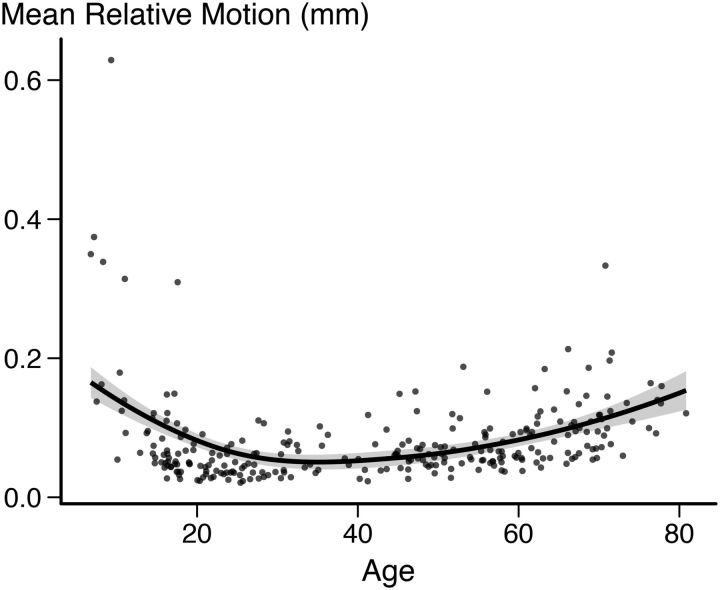
Estimated relative motion across all runs for all included participants. Fit line used R's LOESS function with 1.3 span and SE is marked as a shaded area.
Figure 2.
Figure 2.
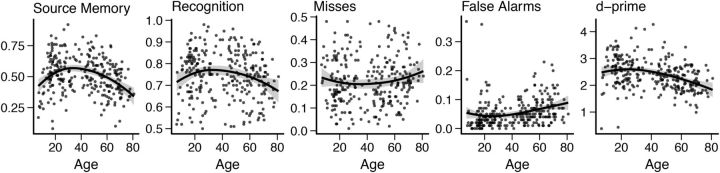
Scatterplots showing the relationships between age and (left to right): Source memory, recognition memory, recognition misses, false alarms, and d′ score, from 6 to 80 years. Fit line used R's LOESS function with 1.3 span and SE is marked as a shaded area.
Figure 3.
Figure 3.
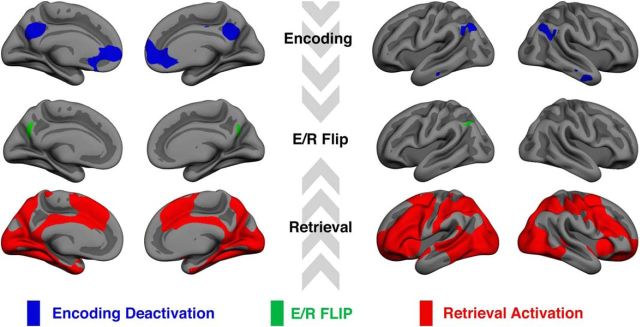
Conjunction analysis results based on 55 young adult participants (18.6–30.4 years of age). Top row, Blue areas are significantly deactivated during successful source memory encoding. Bottom row, red areas are significantly activated during successful source memory retrieval. Middle row: Green areas represent the area of overlap: the E/R Flip. Significant areas are FDR corrected at p < 0.05.
Figure 4.
Figure 4.
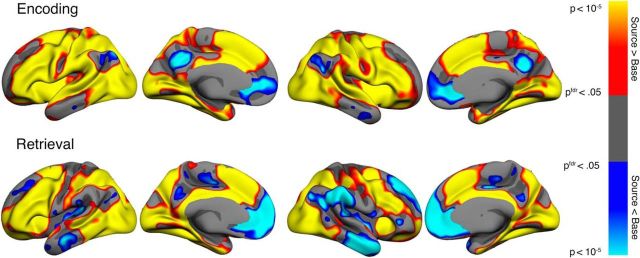
Areas showing significant source memory success activation contrasted with baseline are shown in warm colors and deactivations in cool colors during encoding (top) and retrieval (bottom). Only vertices significant after FDR correction at the p < 0.05 level are shown.
Figure 5.
Figure 5.
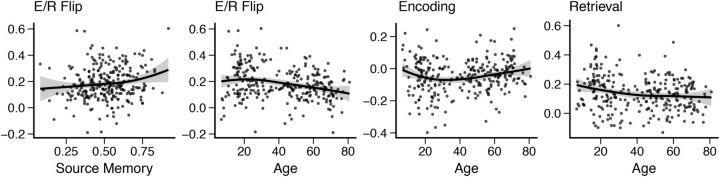
Left to right, E/R flip by source memory, E/R flip by age, encoding activity in the E/R flip ROI by age, retrieval activity in the E/R flip ROI by age. Fit line used R's LOESS function with 1.3 span and SE is marked as a shaded area.
Figure 6.
Figure 6.
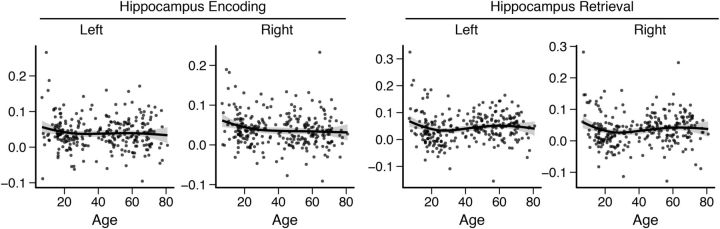
Hippocampus BOLD activity (parameter estimates) during encoding and retrieval. Fit line used R's LOESS function with 1.3 span and SE is marked as a shaded area.
Figure 7.
Figure 7.
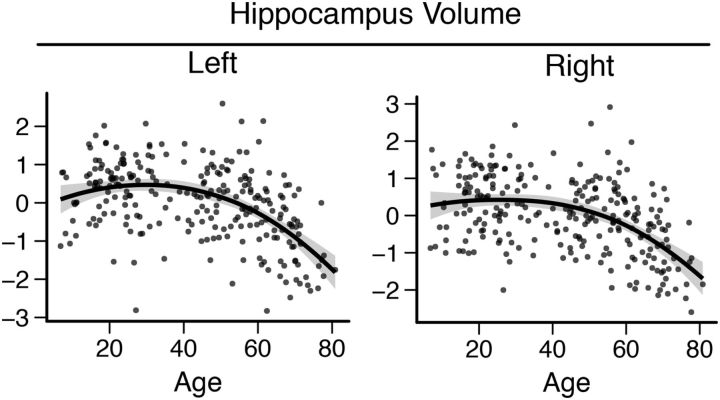
Hippocampus volume lifespan trajectories for bilateral hippocampi. Fit line used R's LOESS function with 1.3 span and SE is marked as a shaded area.
Figure 8.
Figure 8.
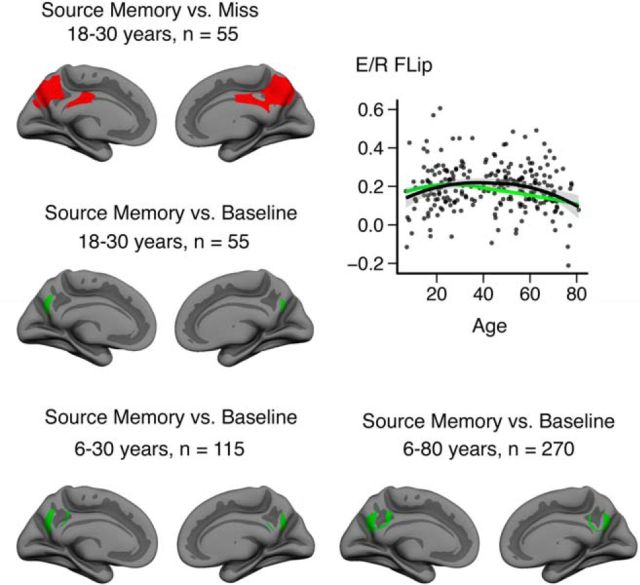
Comparison of different approaches used for defining the E/R flip. Top left, ER/Flip ROI defined using the DM contrast in the young adult sample. Middle left, E/R flip ROI defined using the baseline contrast in the young adult sample (ROI used in the main analyses). Top right, Scatterplot showing individual data points extracted from the E/R flip ROI defined using the DM approach. The black line is fitted to the E/R flip defined using the DM approach, whereas the green lines posted for reference represent the E/R flip defined using the baseline approach. Lines are fitted using R (ggplot2, LOESS span = 1.3). Bottom row, E/R flip ROI defined using different samples. Bottom left, Complete development sample (6–30 years of age, n = 105). Bottom right: Complete lifespan sample (6–80 years of age, n = 270).
Figure 9.
Figure 9.
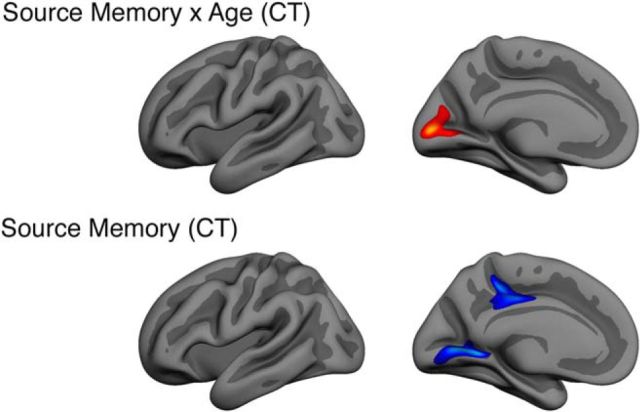
Multiple-comparisons-corrected results showing clusters with a significant source memory–CT relation (top) and source memory–age interactions (bottom). Analyses are based on the developmental subsample with complete multimodal data.
Figure 10.
Figure 10.
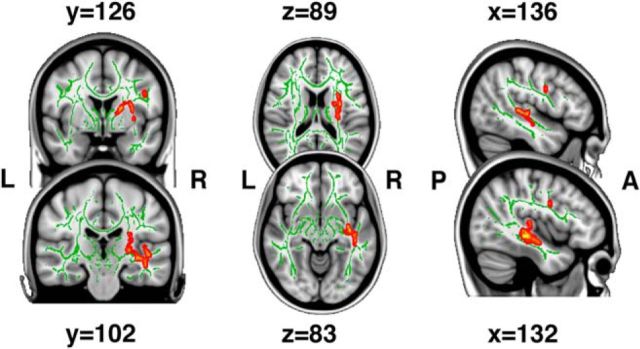
Threshold-free cluster enhancement-corrected (p < 0.05) results showing voxels where the source memory–MD relationship differs with age. Effects are filled for readability using tbss_fill. Analyses are based on the developmental subsample with complete multimodal data.
Figure 11.
Figure 11.
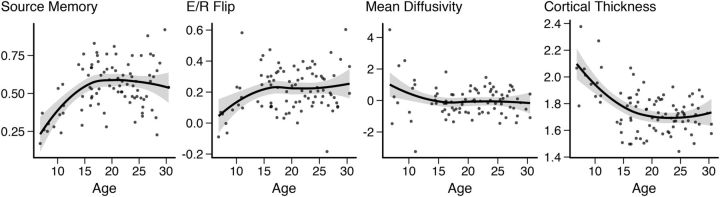
Scatterplots showing the data entered in the structural equation model for source memory development from 6–30 years of age. Left to right, Source memory, E/R flip, MD, and CT. Lines are fitted to the data using R's LOESS function with 1.3 span and SE is marked as a shaded area.
Figure 12.
Figure 12.
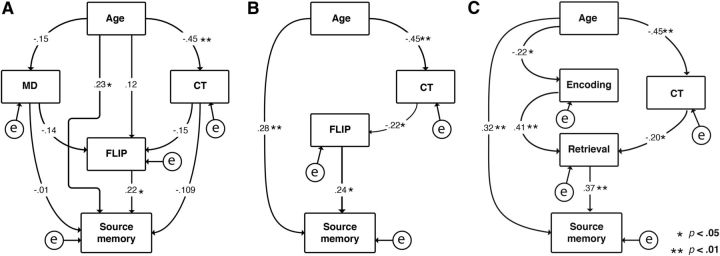
Structural equation models. A, Initial model. B, Final model. C, Final model with encoding and retrieval entered separately. Numbers on paths represent standardized partial regression weights. Analyses are based on the developmental subsample with complete multimodal data.

References

    1. Amlien IK, Fjell AM, Tamnes CK, Grydeland H, Krogsrud SK, Chaplin TA, Rosa MGP, Walhovd KB (2016) Organizing principles of human cortical development-thickness and area from 4 to 30 years: insights from comparative primate neuroanatomy. Cereb Cortex 26:257–267. 10.1093/cercor/bhu214 - DOI - PubMed
    1. Andersson JLR, Jenkinson M (2007) Non-linear optimisation. FMRIB Technical Report TR07JA1. Available at: http://fsl.fmrib.ox.ac.uk/analysis/techrep/tr07ja1/tr07ja1.pdf. Accessed December 12, 2016.
    1. Andersson JLR, Sotiropoulos SN (2016) An integrated approach to correction for off-resonance effects and subject movement in diffusion MR imaging. Neuroimage 125:1063–1078. 10.1016/j.neuroimage.2015.10.019 - DOI - PMC - PubMed
    1. Andersson JL, Skare S, Ashburner J (2003) How to correct susceptibility distortions in spin-echo echo-planar images: application to diffusion tensor imaging. Neuroimage 20:870–888. 10.1016/S1053-8119(03)00336-7 - DOI - PubMed
    1. Andersson JLR, Jenkinson M, Smith S (2007) Non-linear registration, aka Spatial normalisation FMRIB Technical Report TR07JA2. Available at: https://www.fmrib.ox.ac.uk/analysis/techrep/tr07ja2/tr07ja2.pdf. Accessed December 12, 2016.

Publication types

LinkOut - more resources