. 2018 Aug 24;9(1):3438.
doi: 10.1038/s41467-018-06011-9.

In-built thermo-mechanical cooperative feedback mechanism for self-propelled multimodal locomotion and electricity generation

Affiliations

In-built thermo-mechanical cooperative feedback mechanism for self-propelled multimodal locomotion and electricity generation

Xiao-Qiao Wang et al. Nat Commun. .

Abstract

Utilization of ubiquitous low-grade waste heat constitutes a possible avenue towards soft matter actuation and energy recovery opportunities. While most soft materials are not all that smart relying on power input of some kind for continuous response, we conceptualize a self-locked thermo-mechano feedback for autonomous motility and energy generation functions. Here, the low-grade heat usually dismissed as 'not useful' is used to fuel a soft thermo-mechano-electrical system to perform perpetual and untethered multimodal locomotions. The innately resilient locomotion synchronizes self-governed and auto-sustained temperature fluctuations and mechanical mobility without external stimulus change, enabling simultaneous harvesting of thermo-mechanical energy at the pyro/piezoelectric mechanistic intersection. The untethered soft material showcases deterministic motions (translational oscillation, directional rolling, and clockwise/anticlockwise rotation), rapid transitions and dynamic responses without needing power input, on the contrary extracting power from ambient. This work may open opportunities for thermo-mechano-electrical transduction, multigait soft energy robotics and waste heat harvesting technologies.


Conflict of interest statement

The authors declare no competing interests.

Figures
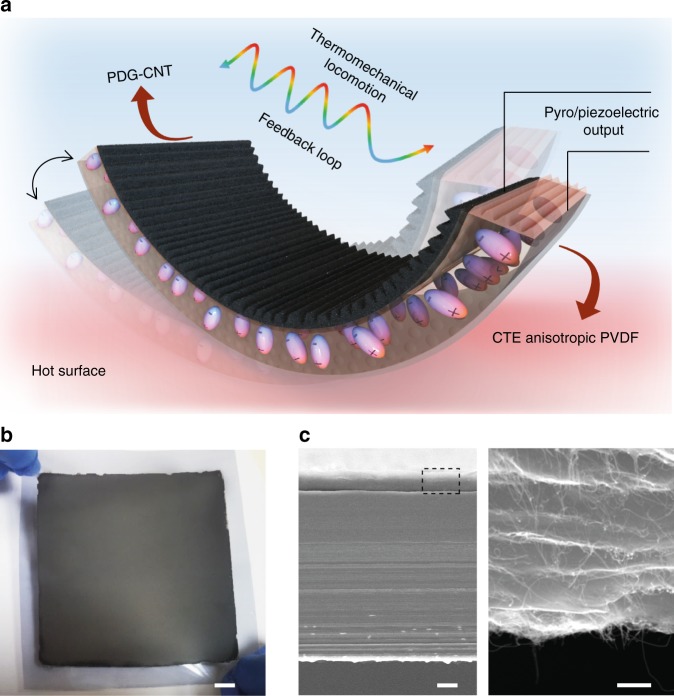
Fig. 1
Fig. 1
The structure design and system concept of TMES. a Schematic illustration of the design concept of thermo-mechano-electrical conversion based on a bimorph actuator. b Photograph of a large-area TMES sample. c Cross-sectional scanning electron microscopy (SEM) image of PVDF/PDG-CNT bimorph (left) and magnification of PDG-CNT nanocomposite layer (right). The scale in b, left and right of c are 1 cm, 10 μm, and 200 nm, respectively
Fig. 2
Fig. 2
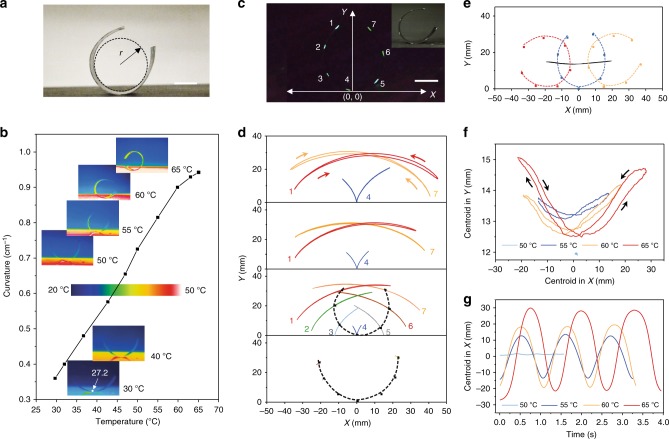
Autonomous thermo-mechanical oscillation, kinematic tracking, and mechanical analysis. a Photograph of TMES on a hot surface at 60 °C. b Infrared images and curvature change of TMES on the hot surface with different temperatures. c Fluorescent image of marked TMES in UV light and its 2D coordinate system. The inset is a photograph of marked TMES in visible light. d The 2D trajectory of marked points on the cross-section of TMES during a complete oscillation cycle from the leftmost to rightmost and then back to the leftmost position, at four different temperatures, 50, 55, 60, and 65 °C (from bottom to top). e Plot of center of gravity during a complete oscillation cycle based on trajectory of the marked points. f The 2D trajectory of center of gravity at different temperatures. g Time-dependent center of gravity in the x-axis during three consecutive oscillation cycles at different temperatures. All scale bars correspond to 1 cm
Fig. 3
Fig. 3
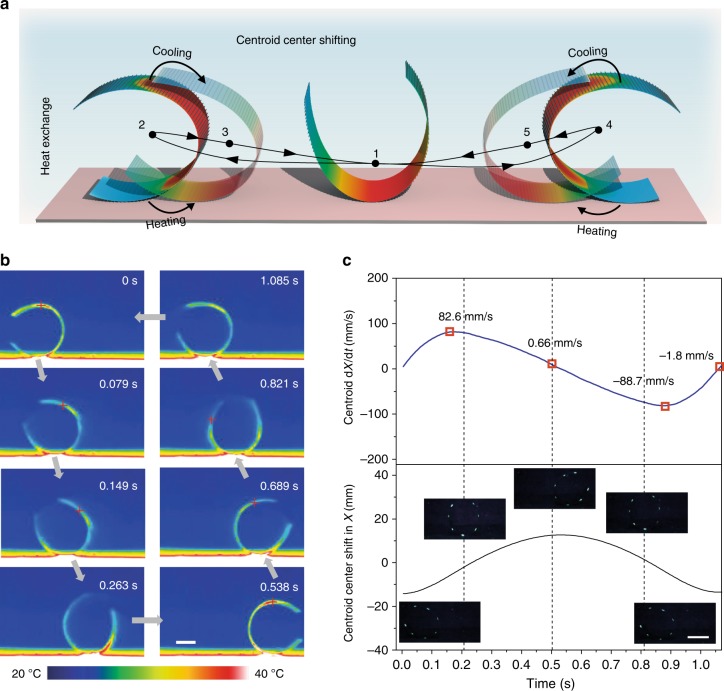
Thermo-mechanical feedback mechanism for the autonomous oscillation. a Schematic illustration of the heat exchange followed by center of gravity shifting of TMES during the oscillation process. b Time-dependent infrared images. c Centroid and rate of change of centroid of TMES in the x-axis during a complete oscillation cycle at 60 °C. Insets of c are fluorescent images of marked TMES corresponding to the oscillation positions. All scale bars correspond to 1 cm
Fig. 4
Fig. 4
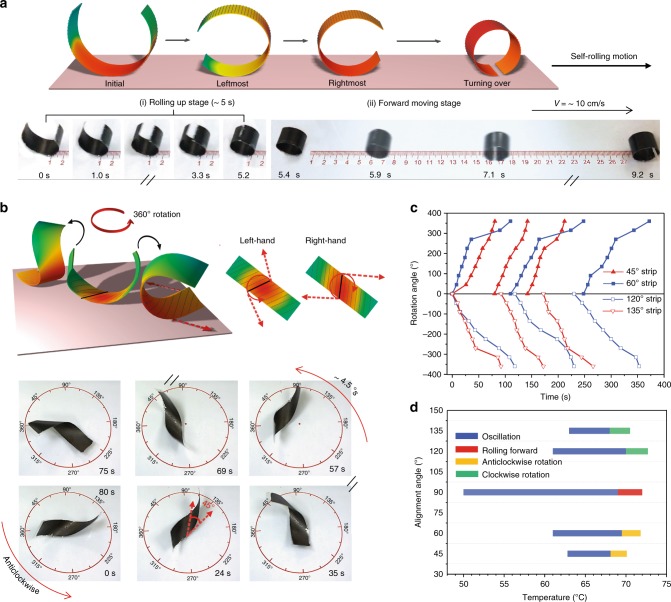
Realization of self-propelled multimodal locomotions. a Schematic representation and snapshots of a self-rolling motion of TMES at α = 90° on a hot surface at 70 °C. b Schematic illustration of self-rotation movement with direction determined by the alignment angle of PVDF in TMES, and snapshots of TMES at α = 45° during an anticlockwise rotation process. c Time-dependent rotation angle of TMES at four different alignment angles during three consecutive 360-degree rotation cycles. d The locomotion modes of TMES strips at different alignment angles on the hot surface with temperatures ranging from 50 to 75 °C
Fig. 5
Fig. 5
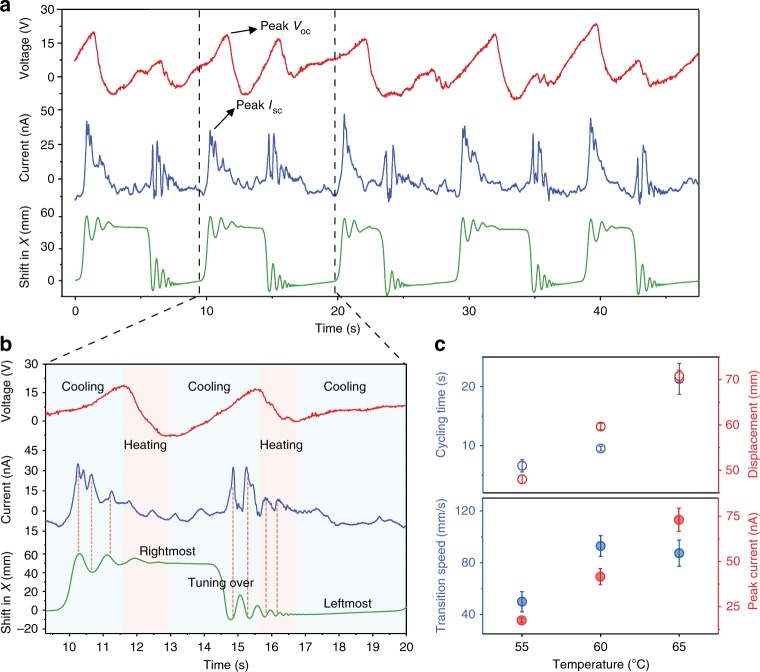
Thermomechanical locomotion energy harvesting utilizing the pyro/piezoelectric effect. a Time-dependent shifting in the x-axis, short circuit current and open circuit voltage of TMES (α = 90°) during five consecutive oscillation cycles on the hot surface at 60 °C and b magnification in one oscillation cycle. c Average cycling time, maximum displacement, transition speed, and peak Isc at 55, 60, and 65 °C. Error bars represent SD
Fig. 6
Fig. 6
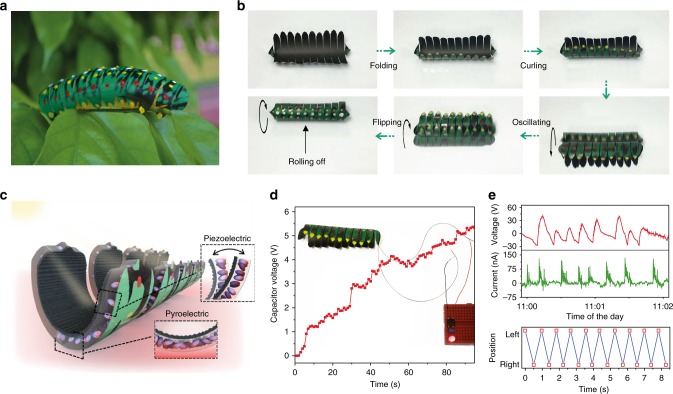
Power-generating soft TMES-bot imitating self-defensive living organism behaviors. a Photograph of the fabricated TMES-bot. b Active locomotive evolution of TMES-bot for self-defense purpose. c Schematic showing pyro/piezoelectric effects of the power-generating TMES-bot. d Charging characteristic of TMES-bot and an inset photograph of a lighted LED using a charged capacitor. e Open circuit voltage/short circuit current generated by locomotion of TMES on a tiled pavement under an ambient outdoor environment (top) and photothermal-directed cyclic oscillations of the TMES (bottom)

References

    1. Chu S, Majumdar A. Opportunities and challenges for a sustainable energy future. Nature. 2012;488:294. doi: 10.1038/nature11475. - DOI - PubMed
    1. Chen H, Goswami DY, Stefanakos EK. A review of thermodynamic cycles and working fluids for the conversion of low-grade heat. Renew. Sustain. Energy Rev. 2010;14:3059–3067. doi: 10.1016/j.rser.2010.07.006. - DOI
    1. Phillip WA. Thermal-energy conversion: under pressure. Nat. Energy. 2016;1:16101. doi: 10.1038/nenergy.2016.101. - DOI
    1. Chu S, Cui Y, Liu N. The path towards sustainable energy. Nat. Mater. 2016;16:16. doi: 10.1038/nmat4834. - DOI - PubMed
    1. Straub AP, Yip NY, Lin S, Lee J, Elimelech M. Harvesting low-grade heat energy using thermo-osmotic vapour transport through nanoporous membranes. Nat. Energy. 2016;1:16090. doi: 10.1038/nenergy.2016.90. - DOI

Publication types