. 2018 Aug 24;9(1):3426.
doi: 10.1038/s41467-018-05819-9.

Peritectic titanium alloys for 3D printing

Affiliations

Peritectic titanium alloys for 3D printing

Pere Barriobero-Vila et al. Nat Commun. .

Abstract

Metal-based additive manufacturing (AM) permits layer-by-layer fabrication of near net-shaped metallic components with complex geometries not achievable using the design constraints of traditional manufacturing. Production savings of titanium-based components by AM are estimated up to 50% owing to the current exorbitant loss of material during machining. Nowadays, most of the titanium alloys for AM are based on conventional compositions still tailored to conventional manufacturing not considering the directional thermal gradient that provokes epitaxial growth during AM. This results in severely textured microstructures associated with anisotropic structural properties usually remaining upon post-AM processing. The present investigations reveal a promising solidification and cooling path for α formation not yet exploited, in which α does not inherit the usual crystallographic orientation relationship with the parent β phase. The associated decrease in anisotropy, accompanied by the formation of equiaxed microstructures represents a step forward toward a next generation of titanium alloys for AM.


Conflict of interest statement

The authors declare no competing interests.

Figures
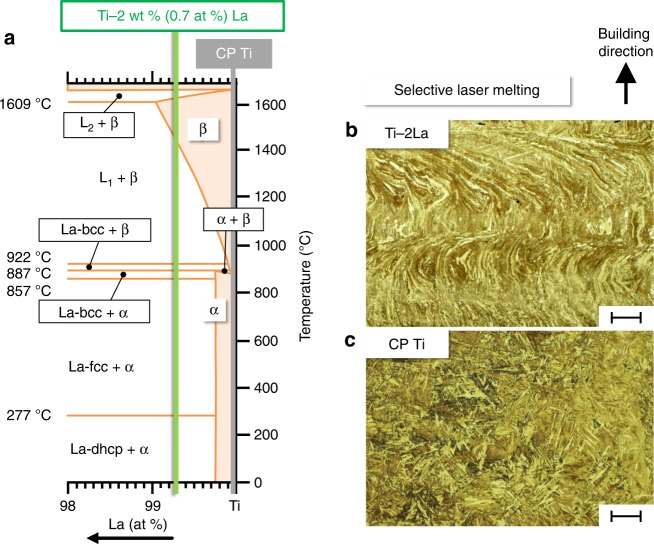
Fig. 1
Fig. 1
Additive manufacturing of the Ti–La system. The approach of selecting a composition Ti-2wt.% La permits to explore an uncommon path of α formation in titanium alloys, by altering the regular Burgers-related β → α transformation. a Portion of the Ti–La phase diagram adapted from,, indicating the compositions used for selective laser melting. b, c Overview of the as-built microstructures for these compositions, namely commercially pure titanium grade 1 (CP Ti) taken as reference, and the Ti-2wt.% La alloy (Ti-2La), respectively. Scale bars, 100 μm
Fig. 2
Fig. 2
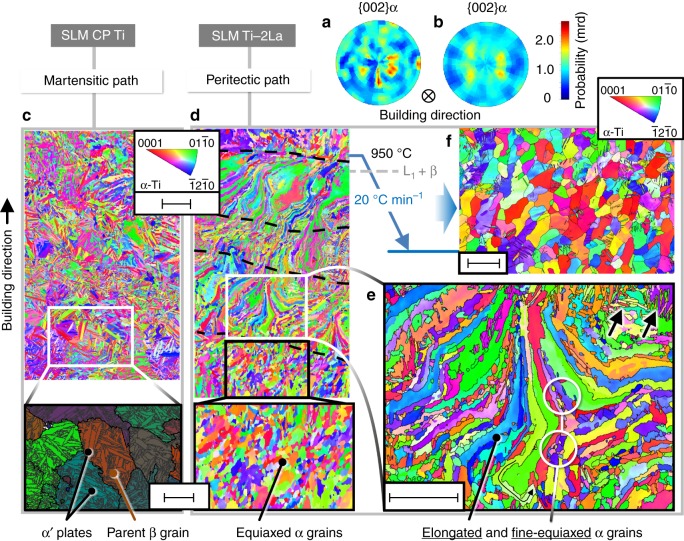
Texture modification during selective laser melting (SLM) of Ti-2wt.% La (Ti-2La). The addition of 2wt.% La to commercially pure titanium grade 1 (CP Ti) leads to an attenuation of the preferential orientation of α phase along the building direction as shown in a, b: normalized pole figures of {002}α reconstructed from a gauge volume of 1 × 1 × 5 mm3 for CP Ti and Ti-2La, respectively. c The martensitic microstructure of CP Ti consists of α′ plates extending within parent β grains according to the Burgers OR. Texture attenuation occurs as a consequence of arrangements of small equiaxed α grains with multiple orientations, nucleated in Ti-2La as shown in d and e (e.g., see encircled grains). f Post- thermal treatment of the SLM as-built condition via slow cooling with 20 °C min−1 from 950 °C passing through the peritectic line (i.e., from L1 + β field down to room temperature) provokes the formation of new α grains and extensive globularization, leading to a recrystallized-like microstructure. Black lines in e, f indicate high-angle grain boundaries (misorientation >10°). The scale bars in c, d and in its magnified regions (at the bottom) are 100 μm and 50 μm, respectively; in e and f, 50 μm
Fig. 3
Fig. 3
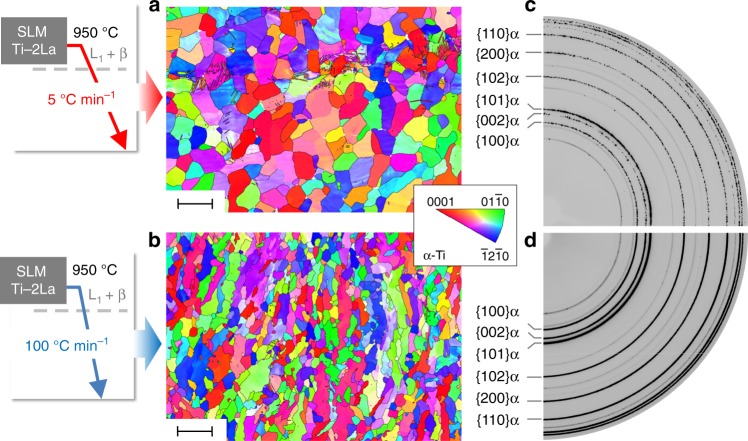
Grain refinement in the Ti-2wt.% La (Ti-2La) alloy after selective laser melting (SLM). Post thermal treatment of the SLM as-built condition by cooling with a 5 °C min−1 and b 100 °C min−1 from 950 °C (L1 + β field) down to room temperature, results in the formation of new α grains of smaller size with increasing cooling rate and extensive globularization. Scale bars, 50 μm. c, d Representative quarters of Debye–Scherrer rings obtained for a gauge volume of 1 × 1 × 5 mm3 and the microstructures shown in a, b respectively. The spotty rings obtained for 5 °C min−1 compared with the continuous {hkl}α rings shown for 100 °C min−1, reflects for the latter a remarkably smaller grain size in the bulk of the alloy. Black lines in a, b indicate high angle grain boundaries (misorientation >10°)
Fig. 4
Fig. 4
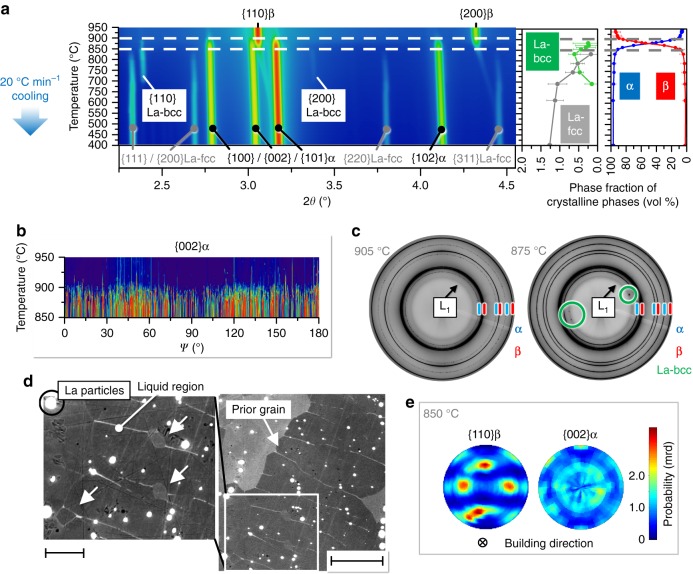
Phase transformation kinetics of the Ti-2wt.% La alloy. Formation of α starts in the L1 + β field and, subsequently, α transforms from β during cooling. a Color-coded 2D plot of the evolution of {hkl} reflections of β, α, La-bcc and La-fcc for a representative range of 2.25–4.55°, combined with the simultaneous evolution of volume fractions of crystalline phases obtained from Rietveld analysis during continuous cooling from 950 °C down to 400 °C with 20 °C min−1. No changes are observed for T < 400 °C. b Color-coded 2D plot of the evolution of {002}α Bragg reflections for an azimuthal angle (ψ) range 0–180° during continuous cooling between 950–850 °C with 20 °C min−1. c Presence of α coexisting with β and L1 phases during transformation is revealed in the complete Debye-Scherrer rings acquired at 905 °C and 875 °C. d Nucleation of α particles (pointed by arrows) at former β/L1 interfaces is visible in a microstructure quenched from 950 °C. Scale bar, 5 μm (right side); 2 μm in magnified image (left side). e Normalized pole figures of {110}β and {002}α reconstructed from a gauge volume of 1 × 1 × 5 mm3, indicating that α does not inherit the texture of the parent β phase right after β → α transformation of Ti-2La during cooling down to 850 °C. The transformation of α from β (β → α) is reflected in the rapid increase in the volume fraction of α between 900–850 °C shown in a
Fig. 5
Fig. 5
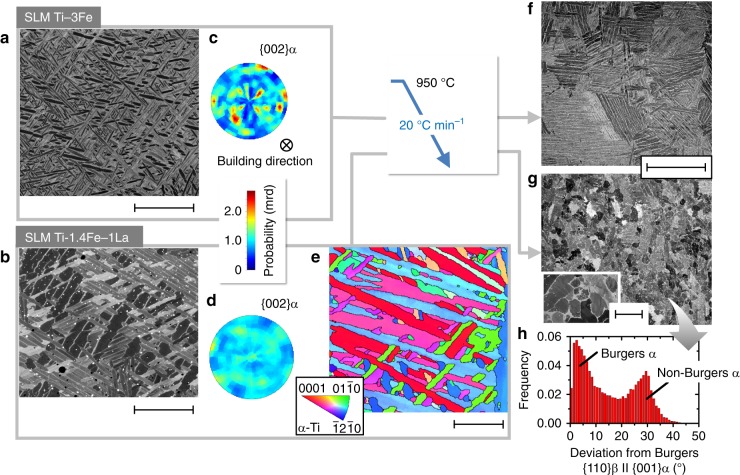
Reducing solidification texture during additive manufacturing of titanium alloys. Formation of fine α particles with multiple orientations occurs within colonies of α lamellae by addition of the peritectic forming solute La. a, b Transformation of α during selective laser melting (SLM) of Ti-3wt.% Fe (Ti-3Fe) and Ti-1.4Fe-1La (wt.%), respectively (scale bars, 10 μm). For the first case, α forms directly from parent β grains: the typical path of β → α transformation that results in a lamellar α+β microstructure. For the second, an additional path of α formation not linked with the orientation relationship of the parent β phase takes place. This is reflected in c, d: normalized pole figures of {002}α reconstructed from a gauge volume of 1 × 1 × 5 mm3 for Ti-3Fe and Ti-1.4Fe-1La, respectively. e α particles of diverse orientations that can reach diameters <1 μm form at boundaries of α lamellae during SLM of Ti-1.4Fe-1La. Black lines indicate high angle grain boundaries (misorientation >10°). Scale bar, 5 μm. f, g Post thermal treatment by slow cooling the Ti-3Fe and Ti-1.4Fe-1La alloys from 950 °C with 20 °C min−1 down to room temperature, leads on the one hand, to a typical lamellar α + β microstructure and on the other, to extensive globularization of α, respectively. Scale bars in f and g, 250 μm; 30 μm in the inset of g. h The two paths of α formation taking place for the heat treated Ti-1.4Fe-1La alloy are reflected in the bi-modal distribution obtained for lattice correlation boundaries between α and β phases

References

    1. Dutta B, Froes FH. Additive Manufacturing (AM) of Titanium Alloys. Oxford: Elsevier; 2015.
    1. Martin JH, et al. 3D printing of high-strength aluminium alloys. Nature. 2017;549:365–369. doi: 10.1038/nature23894. - DOI - PubMed
    1. Froes FH, Dutta B. The additive manufacturing (AM) of titanium alloys. Adv. Mater. Res. 2014;1019:19–25. doi: 10.4028/www.scientific.net/AMR.1019.19. - DOI
    1. Dehoff R, et al. Case study: additive manufacturing of aerospace brackets. Adv. Mater. Process. 2013;171:19–22.
    1. Antonysamy AA, Meyer J, Prangell PB. Effect of build geometry on the β-grain structure and texture in additive manufacture of Ti-6Al-4V by selective electron beam melting. Mater. Charact. 2013;84:153–168. doi: 10.1016/j.matchar.2013.07.012. - DOI

Publication types