. 2018 Dec:183:574-583.
doi: 10.1016/j.neuroimage.2018.08.051. Epub 2018 Aug 23.

Altered functional network connectivity relates to motor development in children born very preterm

Affiliations

Altered functional network connectivity relates to motor development in children born very preterm

M D Wheelock et al. Neuroimage. 2018 Dec.

Abstract

Individuals born very preterm (<32 weeks gestation) are at increased risk for neuromotor impairments. The ability to characterize the structural and functional mechanisms underlying these impairments remains limited using existing neuroimaging techniques. Resting state-functional magnetic resonance imaging (rs-fMRI) holds promise for defining the functional network architecture of the developing brain in relation to typical and aberrant neurodevelopment. In 58 very preterm and 65 term-born children studied from birth to age 12 years, we examined relations between functional connectivity measures from low-motion rs-fMRI data and motor skills assessed using the Movement Assessment Battery for Children, 2nd edition. Across all subscales, motor performance was better in term than very preterm children. Examination of relations between functional connectivity and motor measures using enrichment analysis revealed between-group differences within cerebellar, frontoparietal, and default mode networks, and between basal ganglia-motor, thalamus-motor, basal ganglia-auditory, and dorsal attention-default mode networks. Specifically, very preterm children exhibited weaker associations between motor scores and thalamus-motor and basal ganglia-motor network connectivity. These findings highlight key functional brain systems underlying motor development. They also demonstrate persisting developmental effects of preterm birth on functional connectivity and motor performance in childhood, providing evidence for an alternative network architecture supporting motor function in preterm children.

Keywords: Functional connectivity; Motor development; Neurodevelopmental outcome; Prematurity; Resting state functional MRI.


Conflict of interest statement

DISCLOSURE STATEMENT

The authors report no conflicts of interest.

Figures
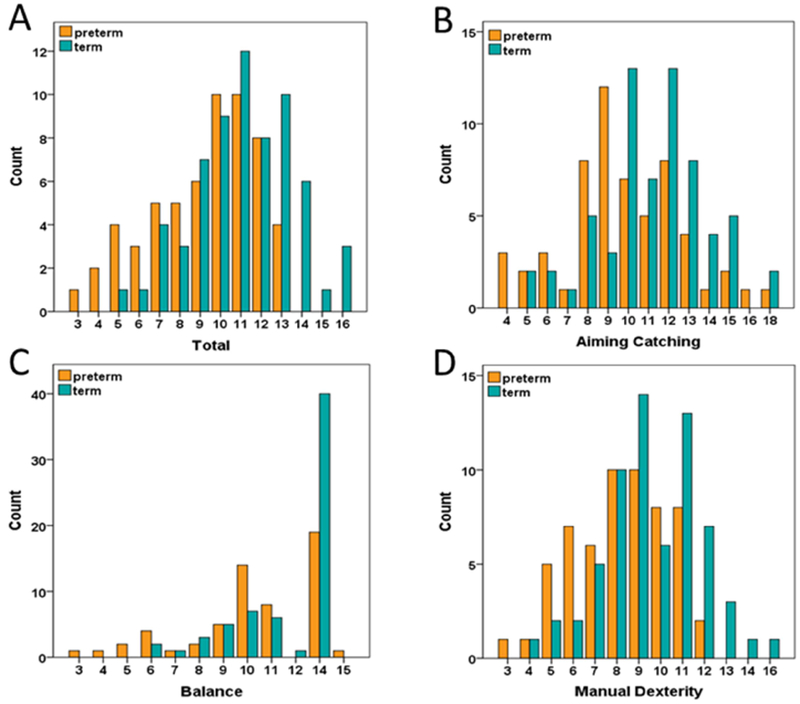
Figure 1.
Figure 1.
Distributions of MABC total and subscale standardized scores for very preterm (N=58) and term children (N=65).
Figure 2.
Figure 2.
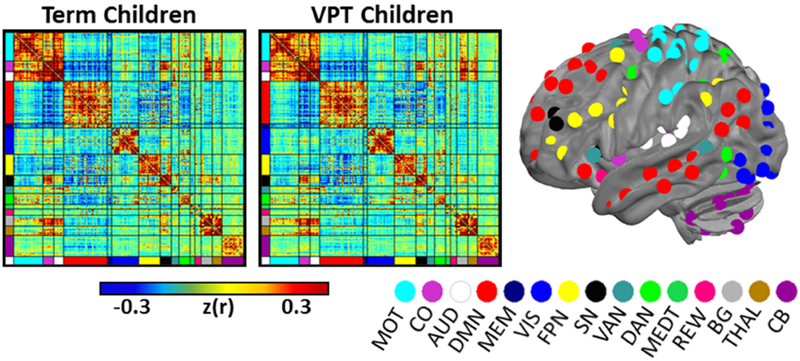
Group mean functional connectivity matrix for very preterm (center) and term (left) children. The 288 ROIs have been sorted according to the functional network model used in the study. The spatial locations of each ROI are displayed on the left lateral surface of the brain with coloring representative of the functional network assignments. Cortical network assignments as in Power et al. (2011). MOT, Motor; CO, cingulo-opercular; AUD, Auditory; DMN, Default Mode Network; MEM, Memory; VIS, Visual; FPN, frontoparietal network; SN, salience network; VAN, ventral attention network; DAN, dorsal attention network; MEDT, medial temporal; REW, reward; BG, Basal Ganglia; THAL, Thalamus; CB, cerebellum.
Figure 3.
Figure 3.
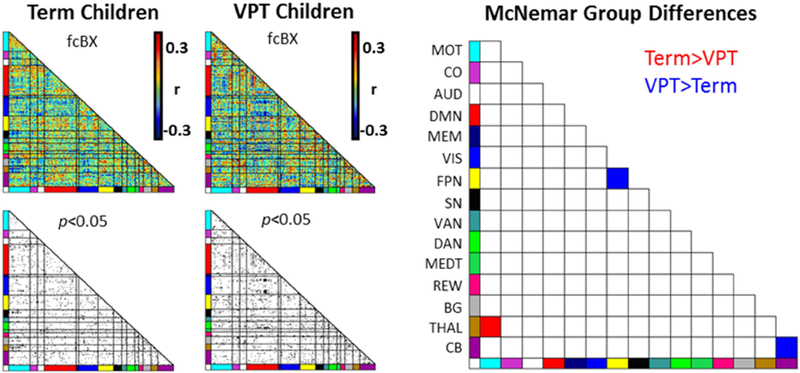
Brain-behavior differences between very preterm and term children for motor Total score. Red squares indicate network pairs that were significantly more enriched with strong rs-fMRI correlations with the MABC Total Standard Score in term than very preterm children. Blue squares indicate networks exhibiting stronger enrichment of brain-behavior correlations in very preterm than term children. MOT, Motor; CO, cingulo-opercular; AUD, Auditory; DMN, Default Mode Network; MEM, Memory; VIS, Visual; FPN, frontoparietal network; SN, salience network; VAN, ventral attention network; DAN, dorsal attention network; MEDT, medial temporal; REW, reward; BG, Basal Ganglia; THAL, Thalamus; CB, cerebellum.
Figure 4.
Figure 4.
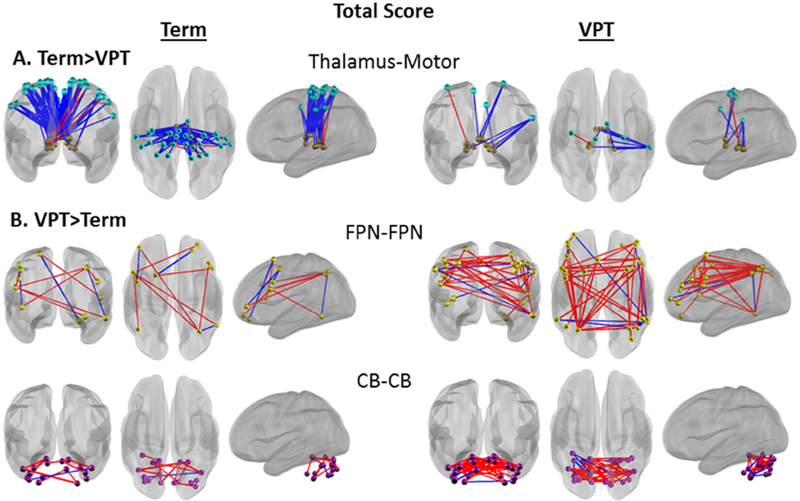
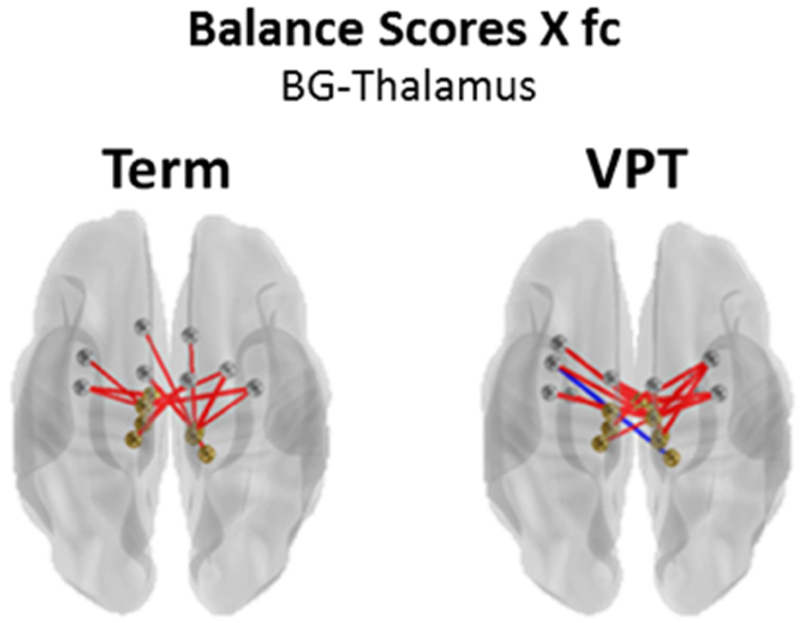
Network pair connectivity correlated with MABC Total Standard Score. Blue lines represent a negative brain-behavior correlation, red lines represent a positive brain-behavior correlation. A) Greater enrichment of strong brain-behavior correlations in term (brains on the left) than very preterm (brains on the right) children. B) Greater enrichment of strong brain-behavior correlations in very preterm than term children. All correlations shown at p<0.05. FPN, Frontoparietal Network; CB, Cerebellum.
Figure 5.
Figure 5.
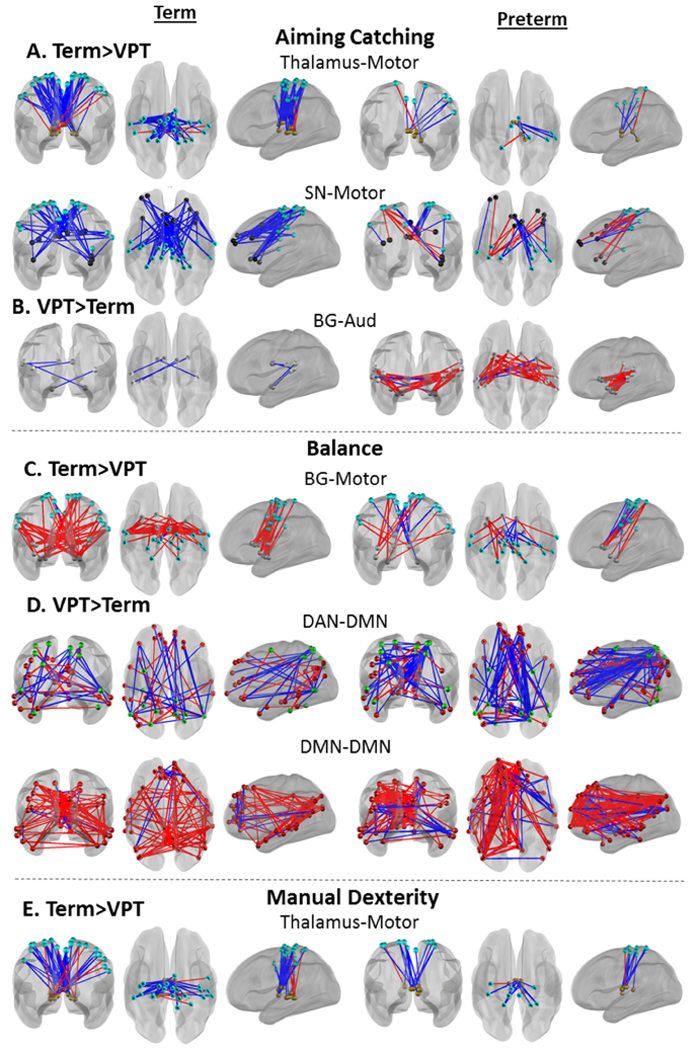
Enrichment analysis of MABC subscales suggest commonalities and differences in brain-behavior correlations supporting behavior across motor domains. Data from term children are plotted on the left, very preterm children are plotted on the right. Very preterm children exhibit a sparser pattern of brain-behavior correlations than term children (A, C, E) and a denser pattern of brain-behavior correlations in B and D. All plots represent connections with brain-behavior correlation p<0.05. Blue lines represent a negative brain-behavior correlation, red lines represent a positive brain-behavior correlation. SN, Salience Network; BG, Basal Ganglia; CB, Cerebellum; Aud, Auditory Network; DMN, Default Mode Network; DAN, Dorsal Attention Network.
Figure 6.
Figure 6.
Networks with common significant enrichment of brain-behavior correlations in very preterm and term children. All correlations p<0.05. Blue lines represent a negative brain-behavior correlation, red lines represent a positive brain-behavior correlation. BG, Basal Ganglia.

References

    1. Albert NB, Robertson EM, Miall RC. 2009. The resting human brain and motor learning. Curr Biol. 19:1023–1027. - PMC - PubMed
    1. Allin M, Matsumoto H, Santhouse AM, Nosarti C, AlAsady MHS, Stewart AL, Rifkin L, Murray RM. 2001. Cognitive and motor function and the size of the cerebellum in adolescents born very pre-term. Brain. 124:60–66. - PubMed
    1. Anderson PJ. 2014. Neuropsychological outcomes of children born very preterm. Semin Fetal Neonatal Med. 19:90–96. - PubMed
    1. Backes C, Ruhle F, Stoll M, Haas J, Frese K, Franke A, Lieb W, Wichmann H, Weis T, Kloos W, Lenhof H, Meese E, Katus H, Meder B, Keller A. 2014. Systematic permutation testing in GWAS pathway analyses: identification of genetic networks in dilated cardiomyopathy and ulcerative colitis. BMC Genomics. 15:622. - PMC - PubMed
    1. Ball G, Aljabar P, Arichi T, Tusor N, Cox D, Merchant N, Nongena P, Hajnal JV, Edwards AD, Counsell SJ. 2016. Machine-learning to characterise neonatal functional connectivity in the preterm brain. Neuroimage. 124:267–275. - PMC - PubMed

Publication types

MeSH terms