


Keeping the patient in the center: Common challenges in the practice of shared decision making
- PMID: 30144968
- PMCID: PMC6376968
- DOI: 10.1016/j.pec.2018.08.007
Keeping the patient in the center: Common challenges in the practice of shared decision making
Abstract
Objective: To examine situations where shared decision making (SDM) in practice does not achieve the goal of a patient-centered decision.
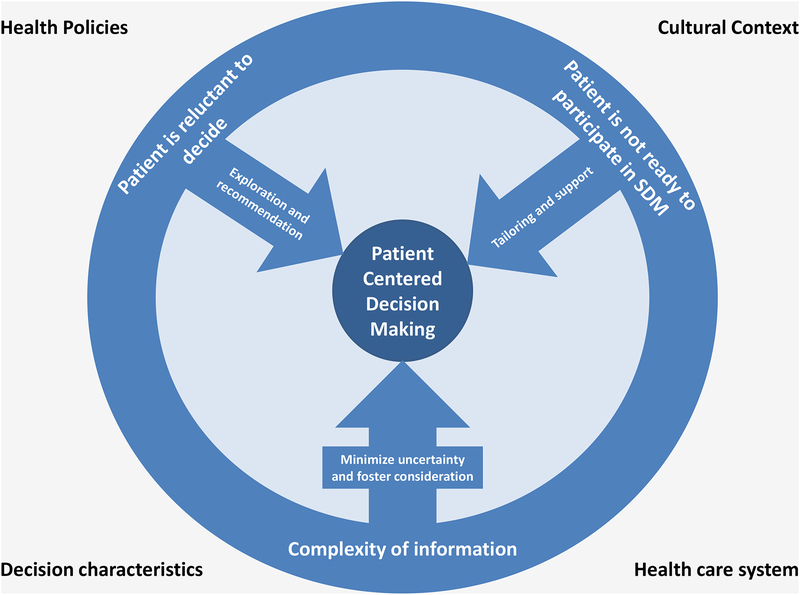
Methods: We explore circumstances in which elements necessary to realize SDM - patient readiness to participate and understanding of the decision - are not present. We consider the influence of contextual factors on decision making.
Results: Patients' preference and readiness for participation in SDM are influenced by multiple interacting factors including the patient's comprehension of the decision, their emotional state, the strength of their relationship with the clinician, and the nature of the decision. Uncertainty often inherent in information can lead to misconceptions and ill-formed opinions that impair patients' understanding. In combination with cognitive biases, these factors may result in decisions that are incongruent with patients' preferences. The impact of suboptimal understanding on decision making may be augmented by the context.
Conclusions: There are circumstances in which basic elements required for SDM are not present and therefore the clinician may not achieve the goal of a patient-centered decision.
Practice implications: A flexible and tailored approach that draws on the full continuum of decision making models and communication strategies is required to achieve the goal of a patient-centered decision.
Keywords: Decisional agency; Healthcare setting; Patient engagement; Shared decision making.
Copyright © 2018 Elsevier B.V. All rights reserved.
Conflict of interest statement
Conflicts of interest
None.
Figures
References
-
- Barry MJ, Edgman-Levitan S. Shared decision making--pinnacle of patient-centered care. N.Engl.J.Med 2012;366:780–781. - PubMed
-
- Joseph-Williams N, Elwyn G, Edwards A. Knowledge is not power for patients: a systematic review and thematic synthesis of patient-reported barriers and facilitators to shared decision making. Patient Educ.Couns 2014;94:291–309. - PubMed
-
- Légaré F, Ratte S, Gravel K, Graham ID. Barriers and facilitators to implementing shared decision-making in clinical practice: update of a systematic review of health professionals’ perceptions. Patient Educ.Couns 2008;73:526–535. - PubMed
Publication types
MeSH terms
Grants and funding
LinkOut - more resources
Full Text Sources
Other Literature Sources
