


Nucleic acids-based tools for ballast water surveillance, monitoring, and research
- PMID: 30147432
- PMCID: PMC6104837
- DOI: 10.1016/j.seares.2017.02.005
Nucleic acids-based tools for ballast water surveillance, monitoring, and research
Abstract
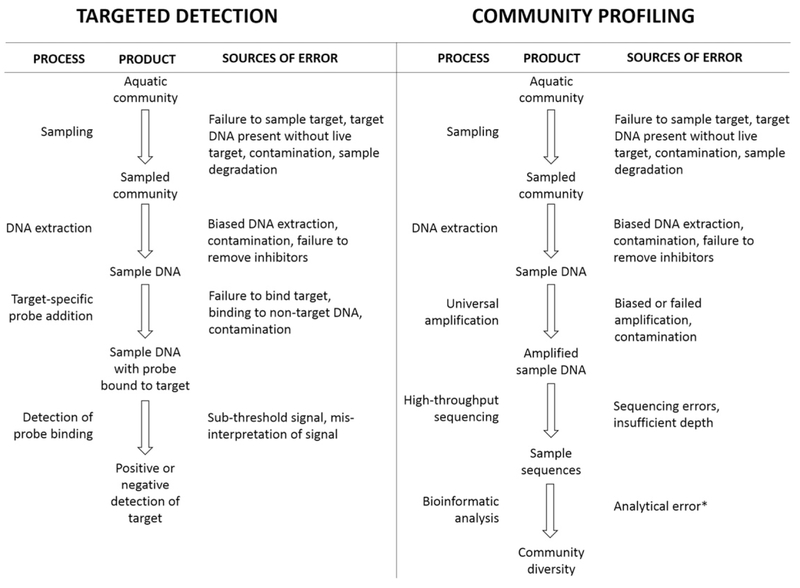
Understanding the risks of biological invasion posed by ballast water-whether in the context of compliance testing, routine monitoring, or basic research-is fundamentally an exercise in biodiversity assessment, and as such should take advantage of the best tools available for tackling that problem. The past several decades have seen growing application of genetic methods for the study of biodiversity, driven in large part by dramatic technological advances in nucleic acids analysis. Monitoring approaches based on such methods have the potential to increase dramatically sampling throughput for biodiversity assessments, and to improve on the sensitivity, specificity, and taxonomic accuracy of traditional approaches. The application of targeted detection tools (largely focused on PCR but increasingly incorporating novel probe-based methodologies) has led to a paradigm shift in rare species monitoring, and such tools have already been applied for early detection in the context of ballast water surveillance. Rapid improvements in community profiling approaches based on high throughput sequencing (HTS) could similarly impact broader efforts to catalogue biodiversity present in ballast tanks, and could provide novel opportunities to better understand the risks of biotic exchange posed by ballast water transport-and the effectiveness of attempts to mitigate those risks. These various approaches still face considerable challenges to effective implementation, depending on particular management or research needs. Compliance testing, for instance, remains dependent on accurate quantification of viable target organisms; while tools based on RNA detection show promise in this context, the demands of such testing require considerable additional investment in methods development. In general surveillance and research contexts, both targeted and community-based approaches are still limited by various factors: quantification remains a challenge (especially for taxa in larger size classes), gaps in nucleic acids reference databases are still considerable, uncertainties in taxonomic assignment methods persist, and many applications have not yet matured sufficiently to offer standardized methods capable of meeting rigorous quality assurance standards. Nevertheless, the potential value of these tools, their growing utilization in biodiversity monitoring, and the rapid methodological advances over the past decade all suggest that they should be seriously considered for inclusion in the ballast water surveillance toolkit.
Keywords: Ballast water; Compliance; High throughput sequencing; Monitoring; Nucleic acids; PCR.
Figures
References
-
- Adams J, Briski E, Ram J, Bailey S, 2014. Evaluating the response of freshwater organisms to vital staining. Manag. Biol. Invasions 5, 197–208.
-
- Ardura A, Zaiko A, Martinez JL, Samuiloviene A, Borrell Y, Garcia-Vazquez E, 2015. Environmental DNA evidence of transfer of North Sea molluscs across tropical waters through ballast water. J. Molluscan Stud. 81, 495–501.
-
- Aridgides LJ, Doblin MA, Berke T, Dobbs FC, Matson DO, Drake LA, 2004. Multiplex PCR allows simultaneous detection of pathogens in ships’ ballast water. Mar. Pollut. Bull. 48, 1096–1101. - PubMed
-
- Barnes MA, Turner CR, 2015. The ecology of environmental DNA and implications for conservation genetics. Conserv. Genet. 17, 1–17.
-
- Barry SC, Hayes KR, Hewitt CL, Behrens HL, Dragsund E, Bakke SM, 2008. Ballast water risk assessment: principles, processes, and methods. ICES J. Mar. Sci. 65, 121–131.
Grants and funding
LinkOut - more resources
Full Text Sources
Other Literature Sources
Miscellaneous