. 2018:2018:PO.17.00235.
doi: 10.1200/PO.17.00235. Epub 2018 Jul 13.

Analysis of MDM2 Amplification: Next-Generation Sequencing of Patients With Diverse Malignancies

Affiliations

Analysis of MDM2 Amplification: Next-Generation Sequencing of Patients With Diverse Malignancies

Shumei Kato et al. JCO Precis Oncol. 2018.

Abstract

Purpose: MDM2 amplification can promote tumorigenesis directly or indirectly through p53 inhibition. MDM2 has increasing clinical relevance because inhibitors are under evaluation in clinical trials, and MDM2 amplification is a possible genomic correlate of accelerated progression, known as hyperprogression, after anti-PD-1/PD-L1 immunotherapy. We used next-generation sequencing (NGS) to ascertain MDM2 amplification status across a large number of diverse cancers.

Methods: We interrogated the molecular profiles of 102,878 patients with diverse malignancies for MDM2 amplification and co-altered genes using clinical-grade NGS (182 to 465 genes).

Results: MDM2 amplification occurred in 3.5% of patients (3,650 of 102,878). The majority of tumor types had a small subset of patients with MDM2 amplification. Most of these patients (99.0% [3,613/3,650]) had co-alterations that accompanied MDM2 amplification. Various pathways, including those related to tyrosine kinase (37.9% [1,385 of 3,650]), PI3K signaling (25.4% [926 of 3,650]), TP53 (24.9% [910 of 3,650]), and MAPK signaling (23.6% [863 of 3,650]), were involved. Although infrequent, mismatch repair genes and PD-L1 amplification also were co-altered (2.2% [79 of 3,650]). Most patients (97.6% [3,563 of 3,650]) had one or more co-alterations potentially targetable with either a Food and Drug Administration-approved or investigational agent. MDM2 amplifications were less frequently associated with high tumor mutation burden compared with the MDM2 wild-type population (2.9% v 6.5%; P < .001). An illustrative patient who harbored MDM2 amplification and experienced hyperprogression with an immune checkpoint inhibitor is presented.

Conclusion: MDM2 amplification was found in 3.5% of 102,878 patients, 97.6% of whom harbored genomic co-alterations that were potentially targetable. This study suggests that a small subset of most tumor types have MDM2 amplification as well as pharmacologically tractable co-alterations.


Conflict of interest statement

AUTHORS’ DISCLOSURES OF POTENTIAL CONFLICTS OF INTEREST The following represents disclosure information provided by authors of this manuscript. All relationships are considered compensated. Relationships are self-held unless noted. I = Immediate Family Member, Inst = My Institution. Relationships may not relate to the subject matter of this manuscript. For more information about ASCO’s conflict of interest policy, please refer to www.asco.org/rwc orascopubs.org/po/author-center.

Figures
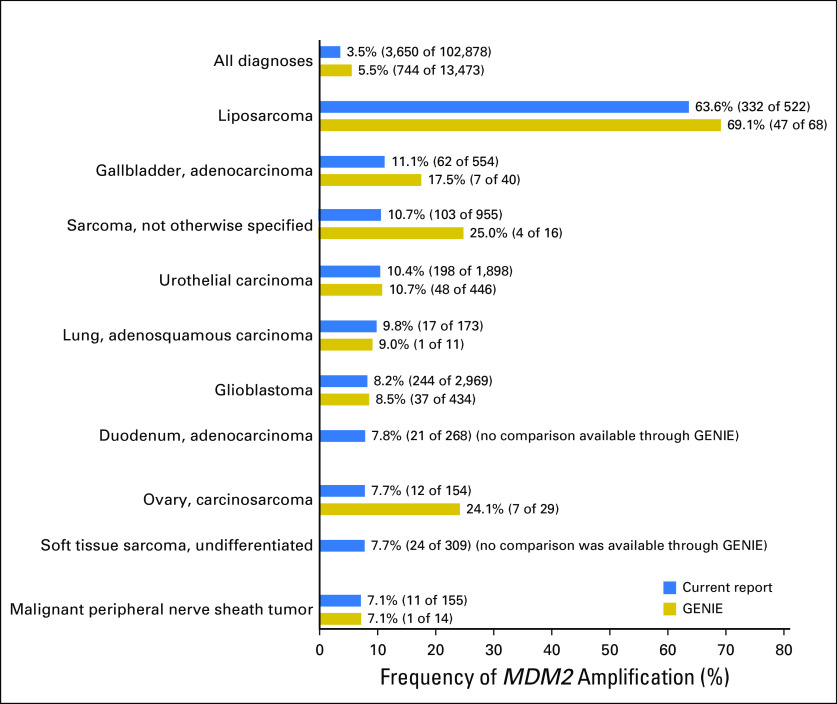
Fig 1.
Fig 1.
Comparison of rate of MDM2 amplification in the current report (N = 102,878 samples) versus in Genomics Evidence Neoplasia Information Exchange (GENIE; N = 13,473 samples). Data from GENIE were obtained as previously described. The 10 most common diagnoses that harbor MDM2 amplification from the current report were selected for the comparison. MDM2 amplifications were seen in 3.5% (3,650 of 102,878) of patients in the current report versus 5.5% (744 of 13,473) from GENIE. MDM2 amplification was most commonly seen in patients with liposarcoma (63.6% [332 of 522] in the current report and 69.1% [47 of 68] from GENIE); gallbladder, adenocarcinoma (11.1% [62 of 554] in the current report and 17.5% [seven of 40] from GENIE); sarcoma, not otherwise specified (10.7% [103 of 955] in the current report and 25.0% [four of 16] from GENIE); urothelial carcinoma (10.4% [198 of 1,898] in the current report and 10.7% [48 of 446] from GENIE); and lung, adenosquamous carcinoma (9.8% [17 of 173] in the current report and 9.0% [one of 11] from GENIE).
Fig 2.
Fig 2.
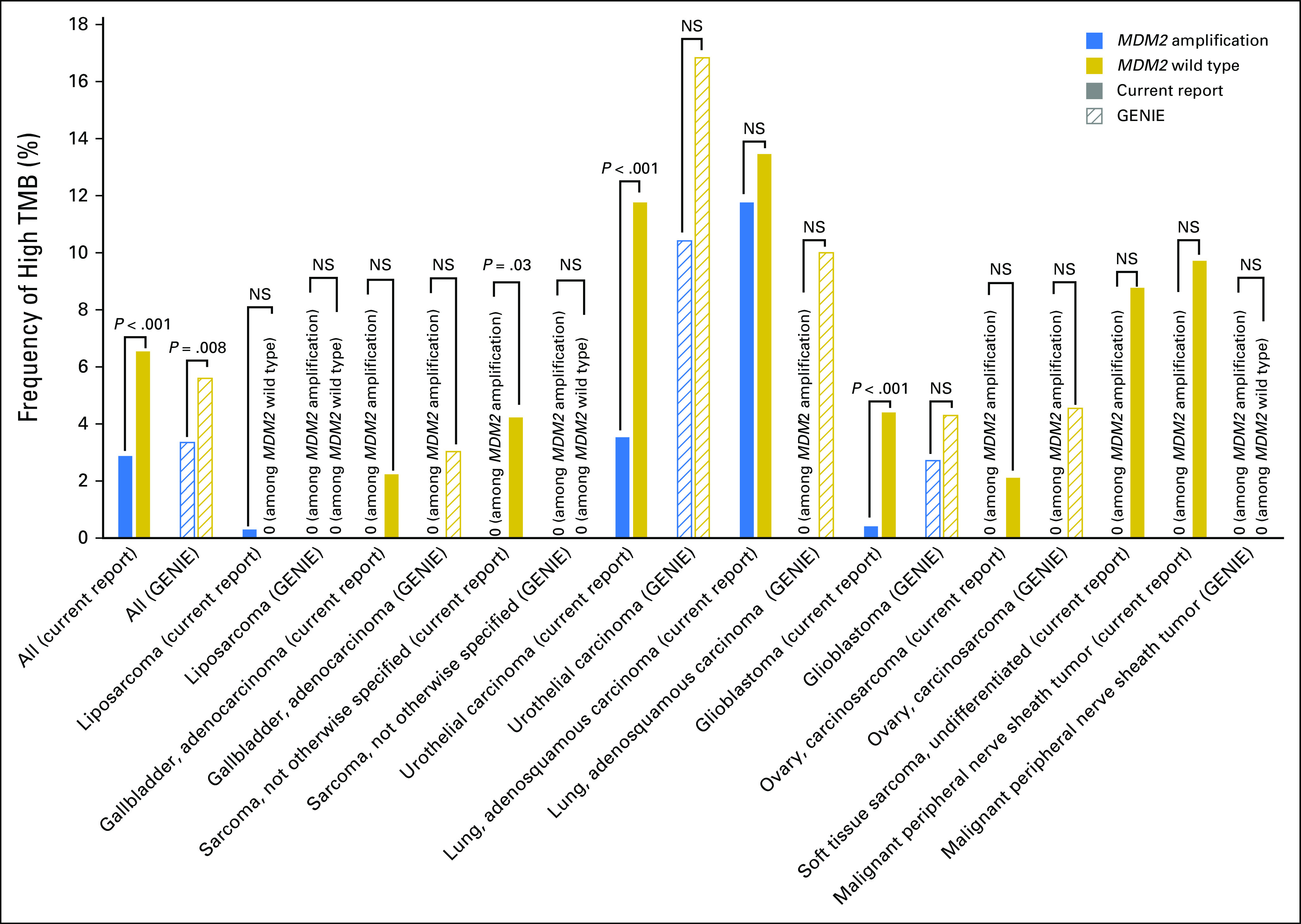
Association between MDM2 amplification and tumor mutation burden (TMB). Among patients with MDM2 amplification (n = 3,650), 2.9% (105) had high TMB, 23.3% (852) had intermediate TMB, and 73.8% (2,693) had low TMB. Among diverse cancers (N = 102,878), high TMB status was significantly less frequent in patients with MDM2 amplification than in those with MDM2 wild type (2.9% [105 of 3,650] v 6.5% [6,492 of 99,228]; P < .001). The Genomics Evidence Neoplasia Information Exchange (GENIE) data set also showed a similar observation (frequency of high TMB among MDM2 amplification v MDM2 wild type, 3.4% [25 of 744] v 5.6% [714 of 12,729], respectively; P = .008). In the current data set, certain cancers with MDM2 amplification were significantly less associated with high TMB than with MDM2 wild type (sarcoma, not otherwise specified, 0% [zero of 103] v 4.2% [36 of 852], respectively [P = .03]; urothelial carcinoma, 3.5% [seven of 198] v 11.8% [200 of 1,700], respectively [P < .001]; glioblastoma, 0.4% [one of 244] v 4.4% [120 of 2,725], respectively [P < .001]); these subsets did not show significant differences in GENIE, but the number of patient samples in GENIE was considerably smaller (Data Supplement). NS, not significant.
Fig 3.
Fig 3.
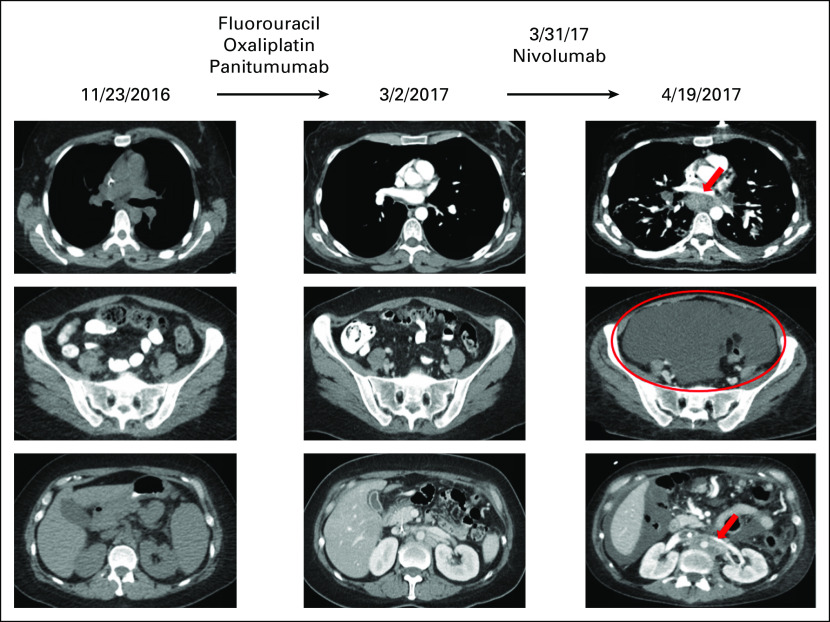
Hyperprogression in a patient with MDM2 amplification treated with an anti–PD-1 checkpoint inhibitor. A 36-year-old woman presented with worsening dysphagia and anemia. Additional work-up revealed adenocarcinoma of the gastro-esophageal junction, stage IIIC. The patient was initially started on combination chemotherapy with epirubicin, oxaliplatin, and capecitabine with persistent lymphadenopathy. Therapy was switched to fluorouracil, oxaliplatin, and panitumumab with overall stable disease; however, the patient had persistent subcentimeter lymphadenopathy (left and middle). The regimen was then switched to nivolumab (anti–PD-1 inhibitor). Within 3 weeks, the patient showed marked clinical deterioration, and imaging showed rapid progression in mediastinal and retroperitoneal lymph nodes as well as emerging massive ascites (right). Pace of progression increased by 6.4-fold, tumor burden increased by 460% compared with pre-immunotherapy imaging, and time to treatment failure was 3 weeks (hyperprogression after immunotherapy previously defined as more than a two-fold increase in progression pace, a > 50% increase in tumor burden compared with pre-immunotherapy imaging, and a time to treatment failure < 2 months). Therapy was then changed to fluorouracil, oxaliplatin, and trastuzumab, but the patient died 1.5 months after nivolumab was administered. Molecular profiling of the primary tumor revealed multiple alterations, including MDM2 amplification. Other alterations were ERBB3, ARAF, CDK4, and EGFR amplifications and alterations in PIK3CA, FRS2, GLI1, and IKZF1. Tumor mutation burden was low and microsatellite stable. PD-1 and PD-L1 status by immunohistochemistry were not evaluated.
Fig 4.
Fig 4.
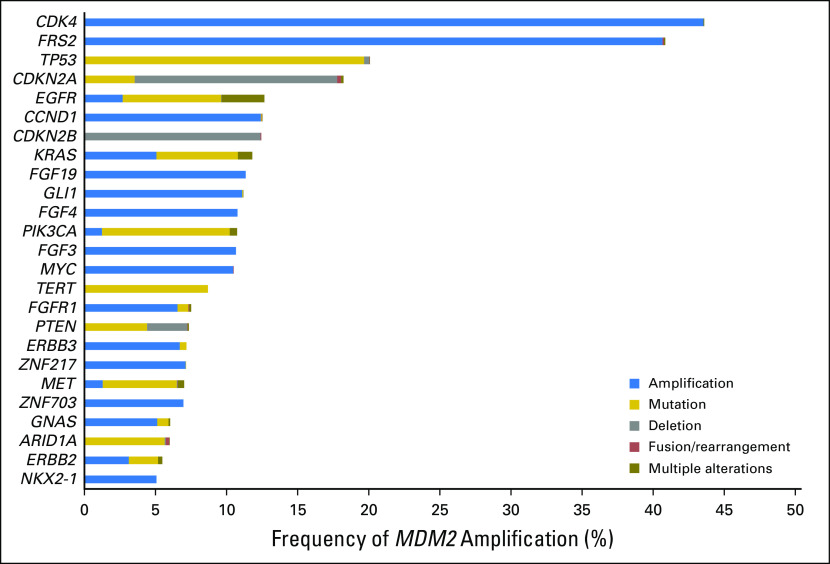
Genomic co-alterations associated with MDM2 amplification (n = 3,650). The most common co-alterations associated with MDM2 amplification were CDK4 (43.6% [1,591 of 3,650]), FRS2 (40.8% [1,491 of 3,650]), TP53 (20.1% [733 of 3,650]), CDKN2A (18.2% [665 of 3,650]), and EGFR (12.7% [462 of 3,650]; Data Supplement).

References

    1. Chène P. Inhibiting the p53-MDM2 interaction: An important target for cancer therapy. Nat Rev Cancer. 2003;3:102–109. - PubMed
    1. Li Q, Lozano G. Molecular pathways: Targeting Mdm2 and Mdm4 in cancer therapy. Clin Cancer Res. 2013;19:34–41. - PMC - PubMed
    1. Wade M, Li YC, Wahl GM. MDM2, MDMX and p53 in oncogenesis and cancer therapy. Nat Rev Cancer. 2013;13:83–96. - PMC - PubMed
    1. Cancer Genome Atlas Research Network Comprehensive genomic characterization defines human glioblastoma genes and core pathways. Nature. 2008;455:1061–1068. Erratum: Nature 494:506, 2013. - PMC - PubMed
    1. Ito M, Barys L, O’Reilly T, et al. Comprehensive mapping of p53 pathway alterations reveals an apparent role for both SNP309 and MDM2 amplification in sarcomagenesis. Clin Cancer Res. 2011;17:416–426. - PubMed