Complement and Bacterial Infections: From Molecular Mechanisms to Therapeutic Applications
- PMID: 30149378
- PMCID: PMC6784045
- DOI: 10.1159/000491439
Complement and Bacterial Infections: From Molecular Mechanisms to Therapeutic Applications
Abstract
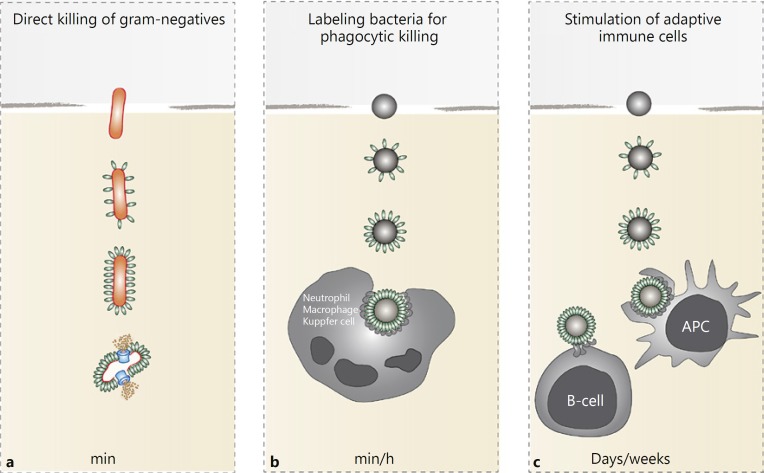
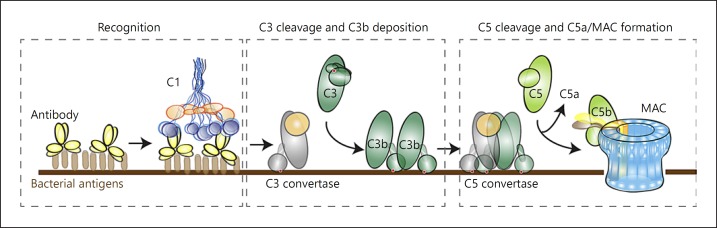
Complement is a complex protein network of plasma, and an integral part of the innate immune system. Complement activation results in the rapid clearance of bacteria by immune cells, and direct bacterial killing via large pore-forming complexes. Here we review important recent discoveries in the complement field, focusing on interactions relevant for the defense against bacteria. Understanding the molecular interplay between complement and bacteria is of great importance for future therapies for infectious and inflammatory diseases. Antibodies that support complement-dependent bacterial killing are of interest for the development of alternative therapies to treat infections with antibiotic-resistant bacteria. Furthermore, a variety of novel therapeutic complement inhibitors have been developed to prevent unwanted complement activation in autoimmune inflammatory diseases. A better understanding of how such inhibitors may increase the risk of bacterial infections is essential if such therapies are to be successful.
Keywords: Antibiotic resistance; Antibody therapy; Bacteria; Complement; Eculizumab; Infections; Inflammatory diseases; Membrane attack complex; Neisseria.
© 2018 S. Karger AG, Basel.
Figures
References
-
- Medzhitov R, Janeway C. Innate immune recognition: mechanisms and pathways. Immunol Rev. 2000;173:89–97. - PubMed
-
- Walport MJ. Complement. First of two parts. N Engl J Med. 2001;344:1058–1066. - PubMed
-
- Berends ETM, Kuipers A, Ravesloot MM, Urbanus RT, Rooijakkers SHM. Bacteria under stress by complement and coagulation. FEMS Microbiol Rev. 2014;38:1146–1171. - PubMed
-
- Schmalstieg FC, Goldman AS. Jules Bordet (1870–1961): a bridge between early and modern immunology. J Med Biogr. 2009;17:217–224. - PubMed
Publication types
MeSH terms
Substances
LinkOut - more resources
Full Text Sources
Other Literature Sources
Medical