. 2018 Aug 24;10(9):451.
doi: 10.3390/v10090451.

Characterization of Unknown Orthobunya-Like Viruses from India

Affiliations

Characterization of Unknown Orthobunya-Like Viruses from India

Shannon L M Whitmer et al. Viruses. .

Abstract

Next-generation sequencing (NGS) of agents causing idiopathic human diseases has been crucial in the identification of novel viruses. This study describes the isolation and characterization of two novel orthobunyaviruses obtained from a jungle myna and a paddy bird from Karnataka State, India. Using an NGS approach, these isolates were classified as Cat Que and Balagodu viruses belonging to the Manzanilla clade of the Simbu serogroup. Closely related viruses in the Manzanilla clade have been isolated from mosquitos, humans, birds, and pigs across a wide geographic region. Since Orthobunyaviruses exhibit high reassortment frequency and can cause acute, self-limiting febrile illness, these data suggest that human and livestock infections of the Oya/Cat Que/Manzanilla virus may be more widespread and/or under-reported than anticipated. It therefore becomes imperative to identify novel and unknown viruses in order to understand their role in human and animal pathogenesis. The current study is a step forward in this regard and would act as a prototype method for isolation, identification and detection of several other emerging viruses.

Keywords: Cat Que virus; Manzanilla virus; Orthobunyavirus; pathogen discovery.


Conflict of interest statement

The authors declare no competing conflicts of interest. The funders had no role in the design of the study; in the collection, analyses, or interpretation of data; in the writing of the manuscript, and in the decision to publish the results. The findings and conclusions in this report are those of the authors and do not necessarily represent the official position of the Centers for Disease Control and Prevention.

Figures
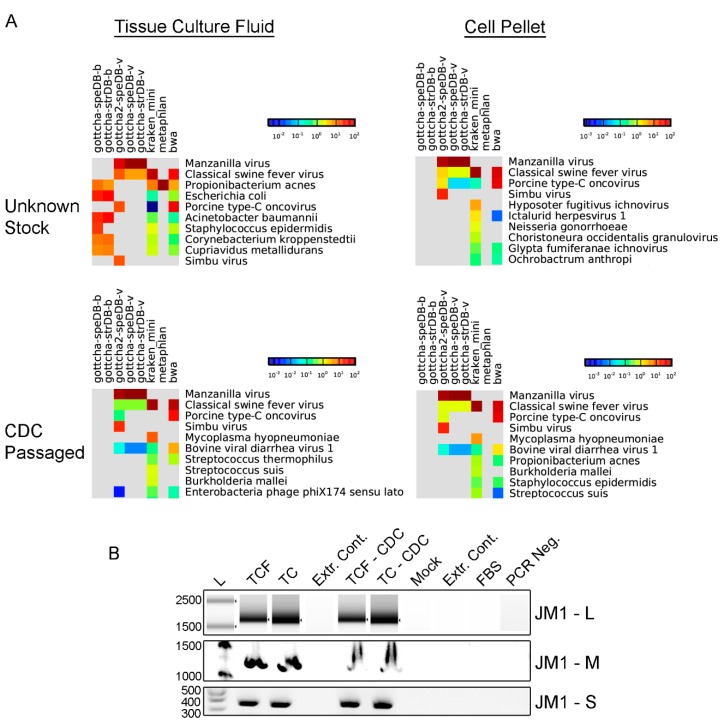
Figure 1
Figure 1
Identification of viral and bacterial nucleic acids using EDGE and RT-PCR from samples infected with JM1. (A) Identification of viral and bacterial reads using EDGE from specimens infected with JM1. Colors, as indicated by scale bar, show the number of reads specific to each organism. Only the top ten scoring organisms are presented. Columns present the results from individual pathogen identification programs (gottcha, gottcha2, ktaken, metaPhlan, bwa) and databases (speDB-b(acterial), speDB-v(iral)); (B) RT-PCR confirms presence of nucleic acids from JM1-infected samples. L—ladder, TCF—tissue culture fluid, TC—tissue culture monolayer, Extr. Cont.—Extraction control, FBS—Fetal bovine serum, PCR Neg.—PCR negative control. Images are compressed to remove extraneous lanes.
Figure 2
Figure 2
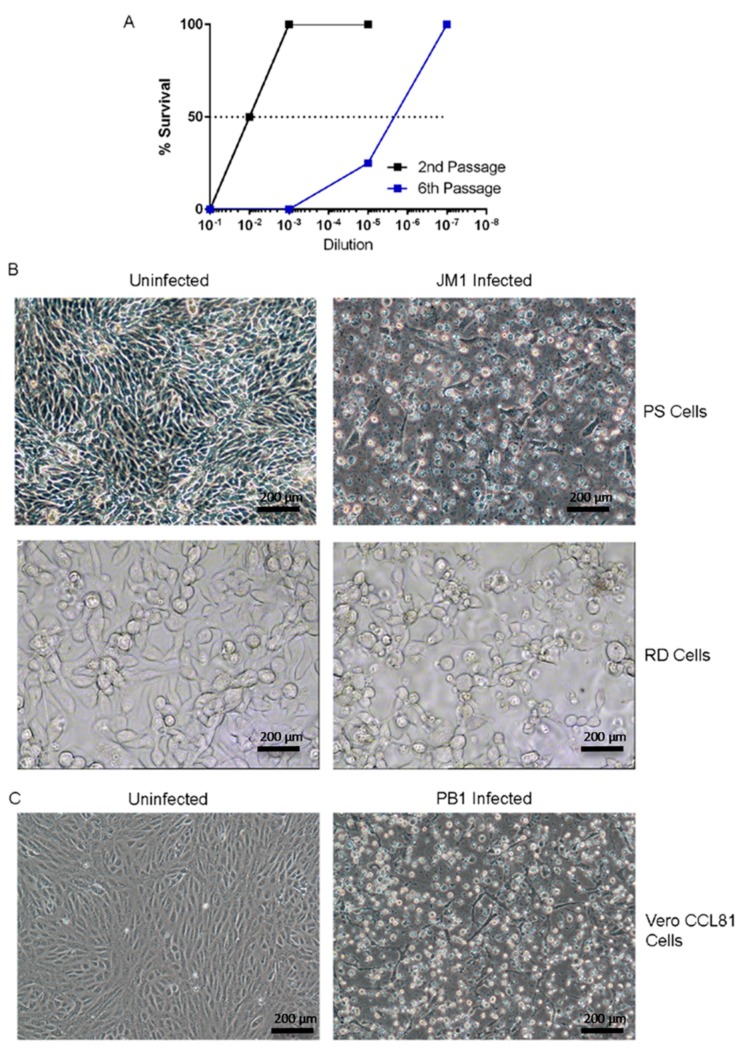
Isolation and characterization of novel infectious agents. (A) Overview of infectivity of JM1 after 2nd and 6th serial passage within infant mice; (B) Cytopathic effect seen in JM1-infected human pig kidney epithelial cells (PS) at 3 days post infection (top) and in rhabdomyosarcoma (RD) cells at 5 days post infection (bottom); (C) Cytopathic effect in PB1-infected Vero CCL81 cells at 3 days post infection.
Figure 3
Figure 3
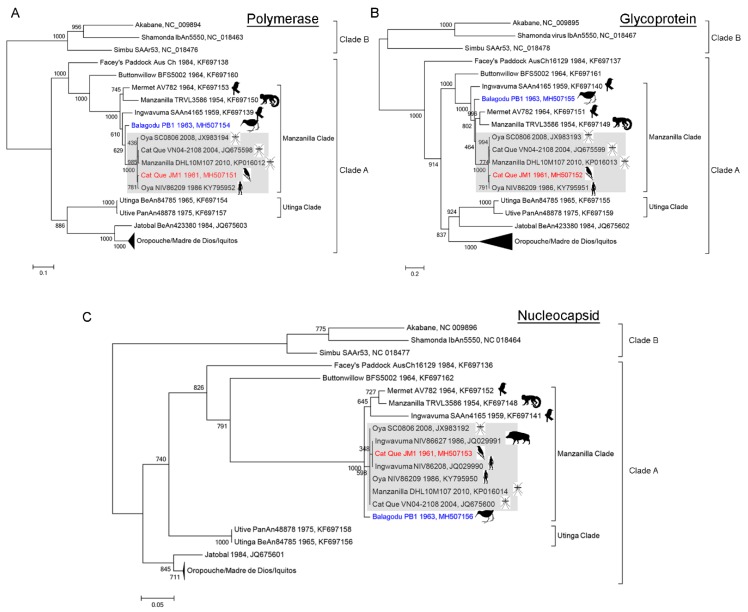
Phylogenetic analysis of members of the genus Orthobunyavirus, Simbu serogroup clade. New sequences included herein are highlighted in red (Cat Que JM1) and blue (Balagodu PB1). Images for organisms from which the viruses were originally isolated are included for the Manzanilla clade. The core Oya/Cat Que/Manzanilla subclade is shaded grey. (A) Phylogenetic relationships inferred using a protein alignment of RNA-dependent RNA polymerases from the L segment; (B) Phylogenetic relationships inferred using a protein alignment of full length glycoproteins from the M segment; (C) Phylogenetic relationships inferred using a protein alignment of nucleocapsid proteins from the S segment. Branch lengths are in substitutions/site.
Figure 4
Figure 4
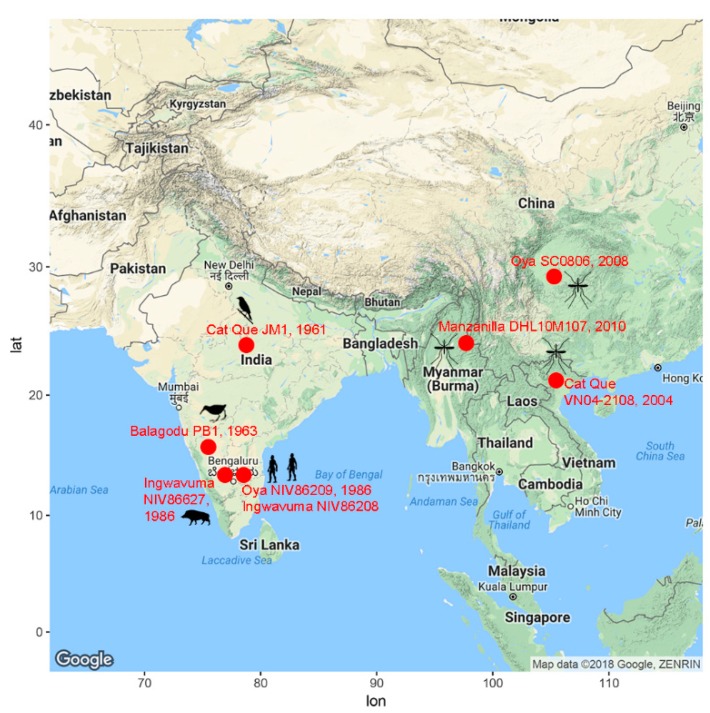
Geographic, temporal, and host distribution of Oya/Cat Que/Manzanilla virus subclade. Only sequences from the core Oya/Cat Que/Manzanilla subclade (Figure 4, shaded grey) are included in the map.

References

    1. Rivers T.M. Viruses and Koch’s Postulates. J. Bacteriol. 1937;33:1–12. - PMC - PubMed
    1. Lipkin W.I. Microbe hunting. Microbiol. Mol. Biol. Rev. 2010;74:363–377. doi: 10.1128/MMBR.00007-10. - DOI - PMC - PubMed
    1. Fredricks D.N., Relman D.A. Sequence-based identification of microbial pathogens: A reconsideration of Koch’s postulates. Clin. Microbiol. Rev. 1996;9:18–33. - PMC - PubMed
    1. Piantadosi A., Mukerji S.S., Chitneni P., Cho T.A., Cosimi L.A., Hung D.T., Goldberg M.B., Sabeti P.C., Kuritzkes D.R., Grad Y.H. Metagenomic Sequencing of an Echovirus 30 Genome From Cerebrospinal Fluid of a Patient With Aseptic Meningitis and Orchitis. Open Forum. Infect. Dis. 2017;4:ofx138. doi: 10.1093/ofid/ofx138. - DOI - PMC - PubMed
    1. Kosoy O.I., Lambert A.J., Hawkinson D.J., Pastula D.M., Goldsmith C.S., Hunt D.C., Staples J.E. Novel thogotovirus associated with febrile illness and death, United States, 2014. Emerg. Infect. Dis. 2015;21:760–764. doi: 10.3201/eid2105.150150. - DOI - PMC - PubMed

Publication types

Supplementary concepts

LinkOut - more resources