. 2018 Oct 23;200(22):e00428-18.
doi: 10.1128/JB.00428-18. Print 2018 Nov 15.

Three Distinct Contact-Dependent Growth Inhibition Systems Mediate Interbacterial Competition by the Cystic Fibrosis Pathogen Burkholderia dolosa

Affiliations

Three Distinct Contact-Dependent Growth Inhibition Systems Mediate Interbacterial Competition by the Cystic Fibrosis Pathogen Burkholderia dolosa

Andrew I Perault et al. J Bacteriol. .

Abstract

The respiratory tracts of individuals afflicted with cystic fibrosis (CF) harbor complex polymicrobial communities. By an unknown mechanism, species of the Gram-negative Burkholderia cepacia complex, such as Burkholderia dolosa, can displace other bacteria in the CF lung, causing cepacia syndrome, which has a poor prognosis. The genome of Bdolosa strain AU0158 (BdAU0158) contains three loci that are predicted to encode contact-dependent growth inhibition (CDI) systems. CDI systems function by translocating the toxic C terminus of a large exoprotein directly into target cells, resulting in growth inhibition or death unless the target cells produce a cognate immunity protein. We demonstrate here that each of the three bcpAIOB loci in BdAU0158 encodes a distinct CDI system that mediates interbacterial competition in an allele-specific manner. While only two of the three bcpAIOB loci were expressed under the in vitro conditions tested, the third conferred immunity under these conditions due to the presence of an internal promoter driving expression of the bcpI gene. One BdAU0158 bcpAIOB allele is highly similar to bcpAIOB in Burkholderia thailandensis strain E264 (BtE264), and we showed that their BcpI proteins are functionally interchangeable, but contact-dependent signaling (CDS) phenotypes were not observed in BdAU0158. Our findings suggest that the CDI systems of BdAU0158 may provide this pathogen an ecological advantage during polymicrobial infections of the CF respiratory tract.IMPORTANCE Human-associated polymicrobial communities can promote health and disease, and interbacterial interactions influence the microbial ecology of such communities. Polymicrobial infections of the cystic fibrosis respiratory tract impair lung function and lead to the death of individuals suffering from this disorder; therefore, a greater understanding of these microbial communities is necessary for improving treatment strategies. Bacteria utilize contact-dependent growth inhibition systems to kill neighboring competitors and maintain their niche within multicellular communities. Several cystic fibrosis pathogens have the potential to gain an ecological advantage during infection via contact-dependent growth inhibition systems, including Burkholderia dolosa Our research is significant, as it has identified three functional contact-dependent growth inhibition systems in Bdolosa that may provide this pathogen a competitive advantage during polymicrobial infections.

Keywords: Bcc; Burkholderia; contact-dependent inhibition; interbacterial competition; two-partner secretion.


Figures

FIG 1
FIG 1
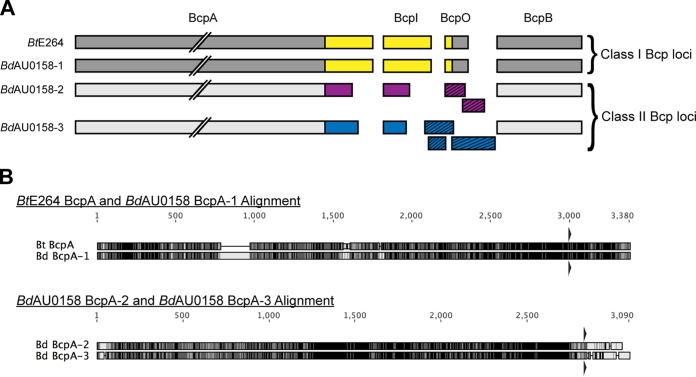
bcpAIOB loci in BdAU0158. (A) Schematic of the BcpAIOB proteins encoded by the BdAU0158 bcp-1 (BdAU0158-1), bcp-2 (BdAU0158 bcp-2), and bcp-3 (BdAU0158-3) loci, as well as the BcpAIOB proteins encoded by the BtE264 bcp locus. Gray coloration corresponds to conserved regions of the proteins, whereas variable regions spanning BcpA-CT, BcpI, and BcpO are denoted in yellow (for the BtE264 and BdAU0158-1 alleles), purple (for the BdAU0158-2 allele), and blue (for the BdAU0158-3 allele). Potential BcpO proteins encoded by the BdAU0158 bcp-2 and bcp-3 loci are indicated by slashed boxes. (B) Amino acid alignments of BtE264 BcpA and BdAU0158 BcpA-1 and of BdAU0158 BcpA-2 and BdAU0158 BcpA-3. Residue similarity is denoted by grayscale, with black indicating identical residues and white indicating disparate residues. Triangles above and below alignments represent NX(E/Q)LYN motifs.
FIG 2
FIG 2
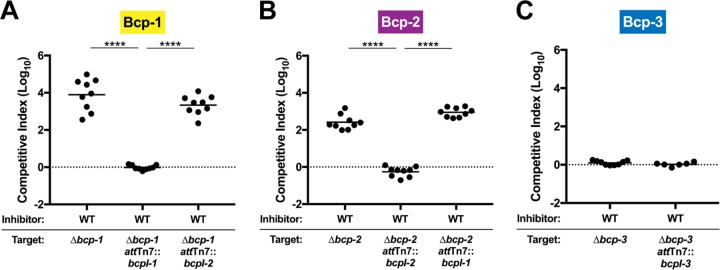
The Bcp-1 and Bcp-2 CDI systems provide BdAU0158 a competitive advantage during in vitro growth. (A) Competition assays between BdAU0158 WT inhibitor cells and Δbcp-1, Δbcp-1 attTn7::bcpI-1, and Δbcp-1 attTn7::bcpI-2 target cells. (B) Competition assays between BdAU0158 WT inhibitor cells and Δbcp-2, Δbcp-2 attTn7::bcpI-2, and Δbcp-2 attTn7::bcpI-1 target cells. (C) Competition assays between BdAU0158 WT inhibitor cells and Δbcp-3 and Δbcp-3 attTn7::bcpI-3 target cells. For each competition, results from three separate biological replicates, each with three technical replicates (except for the WT versus Δbcp-3 attTn7::bcpI-3 competitions in panel C, which show two biological replicates, each with three technical replicates). Solid horizontal lines represent mean log10 C.I. values. The dotted lines (log10 C.I. = 0) indicate no competitive advantage for inhibitor or target strain. ****, P < 0.0001, Mann-Whitney test.
FIG 3
FIG 3
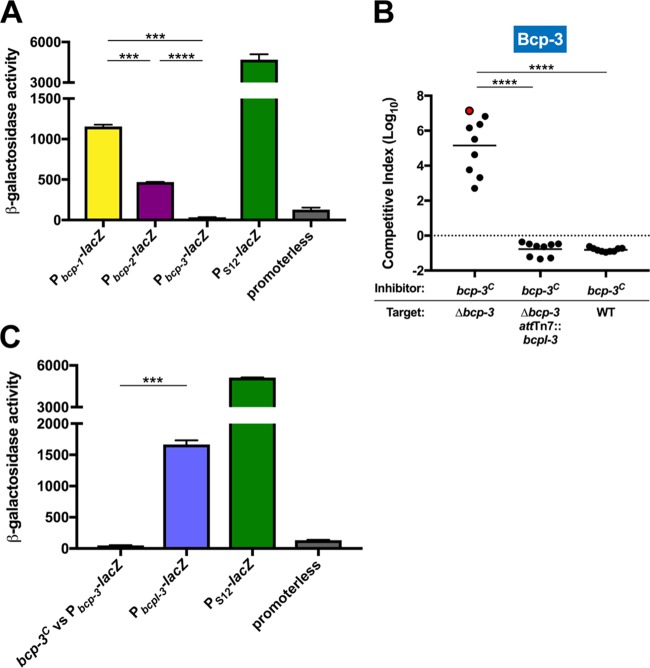
The BdAU0158 bcp-3 locus encodes a functional CDI system that is not expressed under in vitro competition conditions. (A) β-Galactosidase activity assays for promoters of the BdAU0158 bcp-1, bcp-2, and bcp-3 loci. A BdAU0158 strain harboring a constitutively expressed lacZ reporter (PS12-lacZ) served as a positive control, whereas a BdAU0158 strain harboring a lacZ reporter without a promoter (promoterless) served as a negative control. (B) Competition assays between BdAU0158 bcp-3C inhibitor cells and Δbcp-3, Δbcp-3 attTn7::bcpI-3, and WT target cells. The dotted line (log10 C.I. = 0) indicates no competitive advantage for inhibitor or target strain. The red-filled circle indicates a competition from which no target cells were recovered following 48 h of coculture. (C) β-Galactosidase activity assays for the BdAU0158 Pbcp-3 reporter strain cocultured with BdAU0158 bcp-3C (bcp-3C versus Pbcp-3-lacZ), as well as the BdAU0158 PbcpI-3 reporter strain (PbcpI-3-lacZ), with PS12-lacZ and promoterless positive and negative controls, respectively, as described for panel A. β-Galactosidase activity assays in panels A and C show results from two biological replicates, each with three technical replicates. ***, P < 0.001; ****, P < 0.0001, unpaired t test. Competition assays in in panel B show results from three biological replicates, each with three technical replicates. Solid horizontal lines represent mean log10 C.I. values. ****, P < 0.0001, Mann-Whitney test.
FIG 4
FIG 4
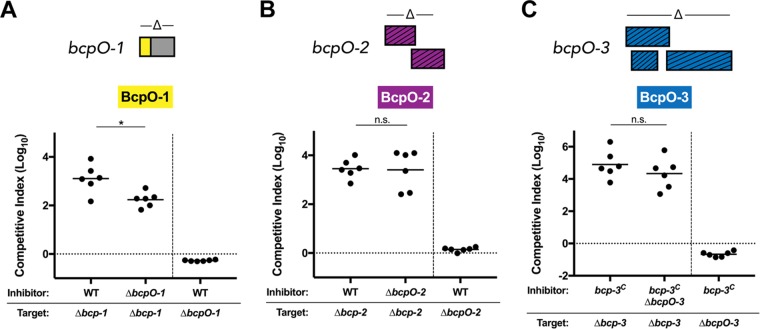
BdAU0158 BcpO proteins are not required for CDI-mediated competition or resistance to CDI. (A) Competition assays between BdAU0158 WT inhibitor cells and Δbcp-1 target cells, BdAU0158 ΔbcpO-1 inhibitor cells and Δbcp-1 target cells, and BdAU0158 WT inhibitor cells and ΔbcpO-1 target cells (right of dashed vertical line). (B) Competition assays between BdAU0158 WT inhibitor cells and Δbcp-2 target cells, BdAU0158 ΔbcpO-2 inhibitor cells and Δbcp-2 target cells, and BdAU0158 WT inhibitor cells and ΔbcpO-2 target cells (right of dashed vertical line). (C) Competition assays between BdAU0158 bcp-3C inhibitor cells and Δbcp-3 target cells, BdAU0158 bcp-3CΔbcpO-3 inhibitor cells and Δbcp-3 target cells, and BdAU0158 bcp-3C inhibitor cells and ΔbcpO-3 target cells (right of dashed vertical line). bcpO gene deletion schematics are shown above each graph. For each competition, results from two separate biological replicates, each with three technical replicates. Solid horizontal lines represent mean log10 C.I. values. Dotted horizontal lines (log10 C.I. = 0) indicate no competitive advantage for inhibitor or target strain. *, P < 0.05; n.s., not significant (Mann-Whitney test).
FIG 5
FIG 5
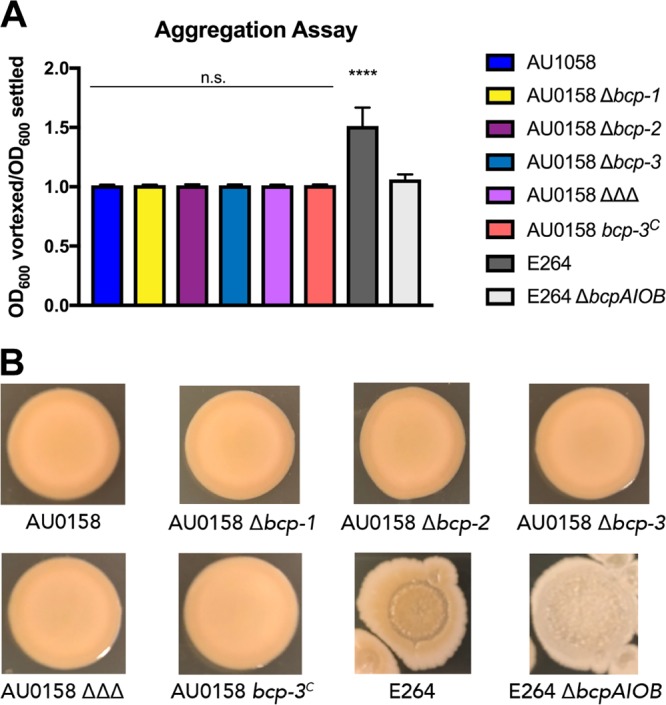
The Bcp-dependent community behaviors of autoaggregation and pigment production are not evident in BdAU0158. (A) Autoaggregation assays of BdAU0158 and BtE264 cultures grown in minimal medium, measured by determining the ratio of OD600 values of vortexed and settled cultures. Only BtE264 WT cells exhibit autoaggregation. Results from three separate biological replicates, with mean ratios plotted. Mean ratios compared to nonautoaggregating BtE264 ΔbcpAIOB to determine if cells autoaggregated. ****, P < 0.0001, Student's t test. n.s., not significant. (B) Pigment production assays of BdAU0158 and BtE264 colony biofilms grown on LSLB agar. Only BtE264 exhibits Bcp-dependent pigment production. Images are representative of at least three biological replicates.
FIG 6
FIG 6
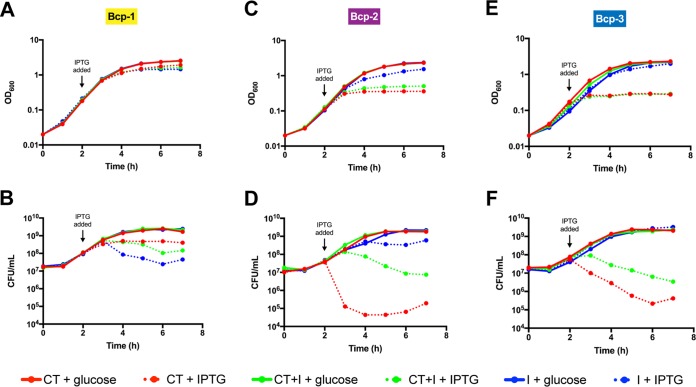
E. coli autotoxicity due to inducible production of the BdAU0158 Bcp-2 and Bcp-3 CT toxins but not the Bcp-1 CT toxin. (A, C, E) OD600 values of cultures of E. coli BL21(DE3) strains producing BdAU0158 Bcp CT toxins (red dotted lines), coproducing CT toxins and BcpI proteins (green dotted lines), and producing BcpI proteins (blue dotted lines) of the Bcp-1 (A), Bcp-2 (C), and Bcp-3 (E) CDI systems. (B, D, F) Cell viability, as measured in CFU per milliliter, of the Bcp-1 protein-producing (B), Bcp-2 protein-producing (D), and Bcp-3 protein-producing (F) E. coli BL21(DE3) cultures. Solid lines represent cultures in which BdAU0158 Bcp protein production was repressed by the addition of 0.2% glucose. For each intracellular toxicity assay, means from three biological replicates are plotted.
FIG 7
FIG 7
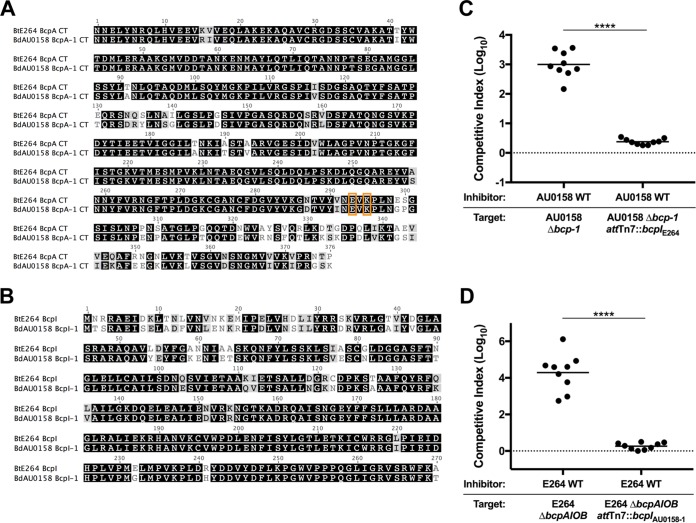
The BdAU0158 Bcp-1 allele contains the same CT toxin-immunity pair as the BtE264 Bcp allele. (A) Amino acid sequence alignment of the BdAU0158 BcpA-1-CT and BtE264 BcpA-CT. The glutamate and lysine residues required for toxicity are boxed in orange. (B) Amino acid sequence alignment of the BdAU0158 BcpI-1 and BtE264 BcpI proteins. For panels A and B, identical residues are highlighted in black, similar residues are highlighted in gray, and disparate residues are not highlighted. (C) Competition assays between BdAU0158 WT inhibitor cells and Δbcp-1 and Δbcp-1 attTn7::bcpIE264 target cells. (D) Competition assays between BtE264 WT inhibitor cells and ΔbcpAIOB and ΔbcpAIOB attTn7::bcpIAU0158-1 target cells. For each competition, results are from three separate biological replicates, each with three technical replicates. Solid horizontal lines represent mean log10 C.I. values. Dotted lines (log10 C.I. = 0) indicate no competitive advantage for inhibitor or target strain. ****, P < 0.0001, Mann-Whitney test.
FIG 8
FIG 8
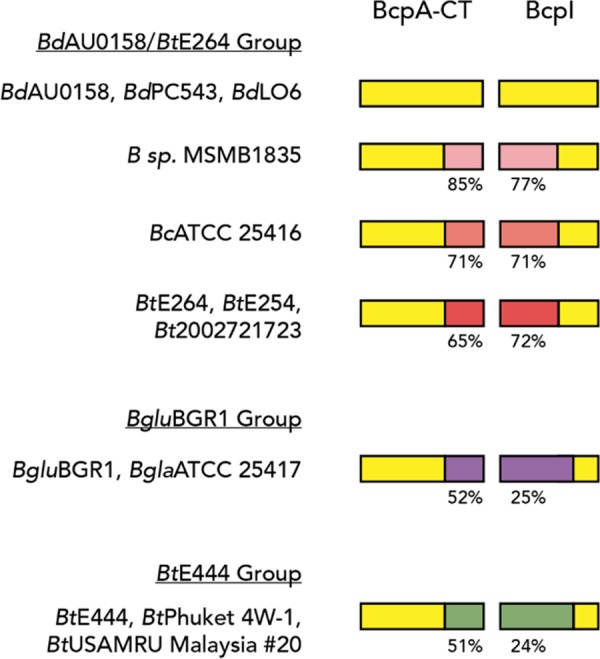
Orthologs of the BdAU0158 BcpA-CT and BcpI across several Burkholderia strains. Yellow indicates regions of amino acid sequence identity. Regions of amino acid sequence variation are indicated by shades of pink (BdAU0158/BtE264 group), purple (BgluBGR1 group), and green (BtE444 group), with percent identity to the corresponding BdAU0158 sequence shown below. Members of the BdAU0158/BtE264 group have variable sequences that are more similar to each other than they are to members of the BgluBGR1 and BtE444 groups. BdPC543, B. dolosa strain PC543; BdLO6, B. dolosa strain LO6 (also called B. cepacia LO6); BcATCC 25416, B. cepacia strain ATCC 25416; BtE254, B. thailandensis strain E254; Bt2002721723, B. thailandensis strain 2002721723; BgluBGR1, B. glumea strain BGR1; BglaATCC 25417, B. gladioli strain ATCC 25417; BtE444, B. thailandensis strain E444; BtPhuket 4W-1, B. thailandensis strain Phuket 4W-1; BtUSAMRU Malaysia #20, B. thailandensis strain USAMRU Malaysia #20; B. sp. MSMB1835, species unknown.

References

    1. Hansen SK, Rainey PB, Haagensen JAJ, Molin S. 2007. Evolution of species interactions in a biofilm community. Nature 445:533–536. doi:10.1038/nature05514. - DOI - PubMed
    1. Ren D, Madsen JS, Sørensen SJ, Burmølle M. 2015. High prevalence of biofilm synergy among bacterial soil isolates in cocultures indicates bacterial interspecific cooperation. ISME J 9:81–89. doi:10.1038/ismej.2014.96. - DOI - PMC - PubMed
    1. Rendueles O, Ghigo J-M. 2015. Mechanisms of competition in biofilm communities. Microbiol Spectr 3:319–342. doi:10.1128/microbiolspec.MB-0009-2014. - DOI - PubMed
    1. Flemming H-C, Wingender J, Szewzyk U, Steinberg P, Rice SA, Kjelleberg S. 2016. Biofilms: an emergent form of bacterial life. Nat Rev Microbiol 14:563–575. doi:10.1038/nrmicro.2016.94. - DOI - PubMed
    1. Foster KR, Bell T. 2012. Competition, not cooperation, dominates interactions among culturable microbial species. Curr Biol 22:1845–1850. doi:10.1016/j.cub.2012.08.005. - DOI - PubMed

Publication types

MeSH terms

Substances

LinkOut - more resources