


A Comparison of the 2017 American College of Cardiology/American Heart Association Blood Pressure Guideline and the 2017 American Diabetes Association Diabetes and Hypertension Position Statement for U.S. Adults With Diabetes
- PMID: 30150235
- PMCID: PMC6196827
- DOI: 10.2337/dc18-1307
A Comparison of the 2017 American College of Cardiology/American Heart Association Blood Pressure Guideline and the 2017 American Diabetes Association Diabetes and Hypertension Position Statement for U.S. Adults With Diabetes
Abstract
Objective: To determine the concordance in the prevalence of hypertension and pharmacological antihypertensive treatment recommendations for U.S. adults with diabetes using definitions from the 2017 American College of Cardiology/American Heart Association (ACC/AHA) blood pressure (BP) guideline and the 2017 American Diabetes Association (ADA) diabetes and hypertension position statement.
Research design and methods: We analyzed data for U.S. adults with diabetes in the U.S. National Health and Nutrition Examination Survey (NHANES), 2011-2016 (n = 2,266). Diabetes was defined by treatment with glucose-lowering medication, glycosylated hemoglobin ≥6.5%, fasting serum glucose ≥126 mg/dL, or nonfasting serum glucose ≥200 mg/dL. BP was measured three times and antihypertensive medication use was self-reported.
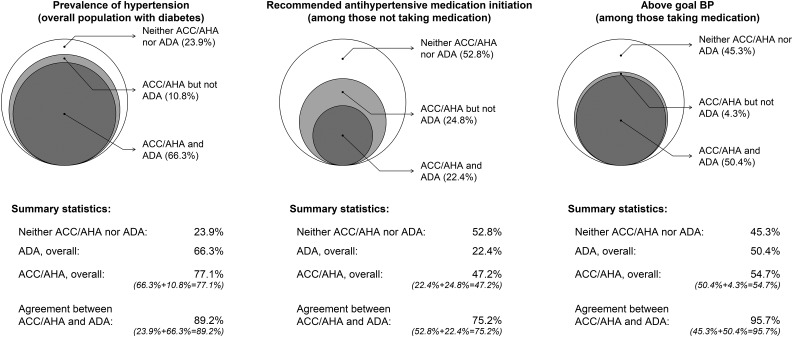
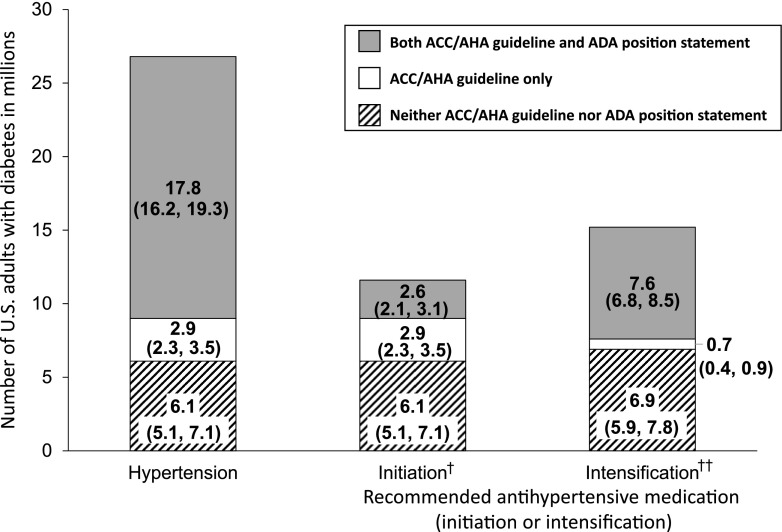
Results: The prevalence (95% CI) of hypertension among U.S. adults with diabetes was 77.1% (73.9, 80.0) and 66.3% (63.4, 69.1) according to the ACC/AHA and ADA definitions, respectively. Also, 22.9% (20.0, 26.1) did not have hypertension according to either definition, and the concordance in hypertension status was 89.2% (87.2, 91.0). Among U.S. adults with diabetes not taking antihypertensive medication, 52.8% (47.7, 57.8) were not recommended to initiate antihypertensive medication by either the ACC/AHA or the ADA document and 22.4% (19.2, 25.9) were recommended to initiate it by both documents (overall concordance 75.2% [70.4, 79.4]). Among those taking antihypertensive medication, 45.3% (41.3, 49.4) and 50.4% (46.5, 54.2) had BP above the goal in neither and both documents, respectively (overall concordance 95.7% [93.4, 97.2]).
Conclusions: A high percentage of U.S. adults with diabetes are provided identical antihypertensive treatment recommendations by the ACC/AHA BP guideline and the ADA diabetes and hypertension position statement.
© 2018 by the American Diabetes Association.
Figures
References
-
- Kannel WB, Wilson PW, Zhang TJ. The epidemiology of impaired glucose tolerance and hypertension. Am Heart J 1991;121:1268–1273 - PubMed
-
- Tarnow L, Rossing P, Gall MA, Nielsen FS, Parving HH. Prevalence of arterial hypertension in diabetic patients before and after the JNC-V. Diabetes Care 1994;17:1247–1251 - PubMed
-
- Goff DC Jr, Lloyd-Jones DM, Bennett G, et al.; American College of Cardiology/American Heart Association Task Force on Practice Guidelines . 2013 ACC/AHA Guideline on the Assessment of Cardiovascular Risk: a report of the American College of Cardiology/American Heart Association Task Force on Practice Guidelines. J Am Coll Cardiol 2014;63:2935–2959 - PMC - PubMed
-
- Whelton PK, Carey RM, Aronow WS, et al. 2017 ACC/AHA/AAPA/ABC/ACPM/AGS/APhA/ASH/ASPC/NMA/PCNA Guideline for the Prevention, Detection, Evaluation, and Management of High Blood Pressure in Adults: a report of the American College of Cardiology/American Heart Association Task Force on Clinical Practice Guidelines [published correction appears in Hypertension 2018;71:e140–e144]. Hypertension 2018;71:e13–e115. - PubMed
Publication types
MeSH terms
Substances
Grants and funding
LinkOut - more resources
Full Text Sources
Other Literature Sources
Medical
Research Materials
