. 2018 Sep 11;115(37):9228-9233.
doi: 10.1073/pnas.1802901115. Epub 2018 Aug 27.

Methylglyoxal-derived posttranslational arginine modifications are abundant histone marks

Affiliations

Methylglyoxal-derived posttranslational arginine modifications are abundant histone marks

James J Galligan et al. Proc Natl Acad Sci U S A. .

Abstract

Histone posttranslational modifications (PTMs) regulate chromatin dynamics, DNA accessibility, and transcription to expand the genetic code. Many of these PTMs are produced through cellular metabolism to offer both feedback and feedforward regulation. Herein we describe the existence of Lys and Arg modifications on histones by a glycolytic by-product, methylglyoxal (MGO). Our data demonstrate that adduction of histones by MGO is an abundant modification, present at the same order of magnitude as Arg methylation. These modifications were detected on all four core histones at critical residues involved in both nucleosome stability and reader domain binding. In addition, MGO treatment of cells lacking the major detoxifying enzyme, glyoxalase 1, results in marked disruption of H2B acetylation and ubiquitylation without affecting H2A, H3, and H4 modifications. Using RNA sequencing, we show that MGO is capable of altering gene transcription, most notably in cells lacking GLO1. Finally, we show that the deglycase DJ-1 protects histones from adduction by MGO. Collectively, our findings demonstrate the existence of a previously undetected histone modification derived from glycolysis, which may have far-reaching implications for the control of gene expression and protein transcription linked to metabolism.

Keywords: DJ-1; QuARKMod; glyoxalase 1; histone; methylglyoxal.


Conflict of interest statement

The authors declare no conflict of interest.

Figures

Fig. 1.
Fig. 1.
MGO generates stable Lys (A) and Arg (B) protein adducts. Three isoforms of MG-H are possible with MG-H3 undergoing hydrolysis to generate CEA.
Fig. 2.
Fig. 2.
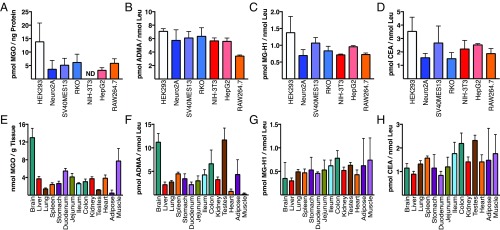
(A) Cells were cultured for 24 h in low-glucose medium (5 mM) and cellular MGO was quantified. ND, not detected. (B–D) Chromatin was extracted from the indicated cells and subjected to QuARKMod, demonstrating basal levels of ADMA (B), MG-H1 (C), and CEA (D). (E–H) Basal levels of MGO (E), chromatin ADMA (F), MG-H1 (G), and CEA (H) were also evaluated in tissues isolated from mice. Data are presented as the mean ± SD of three measurements.
Fig. 3.
Fig. 3.
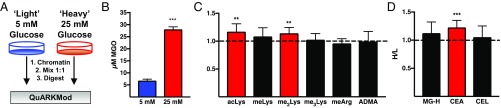
SILAC was used to measure global changes in Lys and Arg PTMs following exposure to hyperglycemic conditions. (A) Experimental procedure. (B) Cellular MGO is elevated following hyperglycemia. (C) Changes in canonical histone PTMs following hyperglycemia are shown as an increase in the heavy:light (H/L) ratio. (D) A significant elevation in CEA is observed following hyperglycemia. Red indicates significance from H/L = 1. **P < 0.01; ***P < 0.001. Data are presented as mean ± SD; n > 6.
Fig. 4.
Fig. 4.
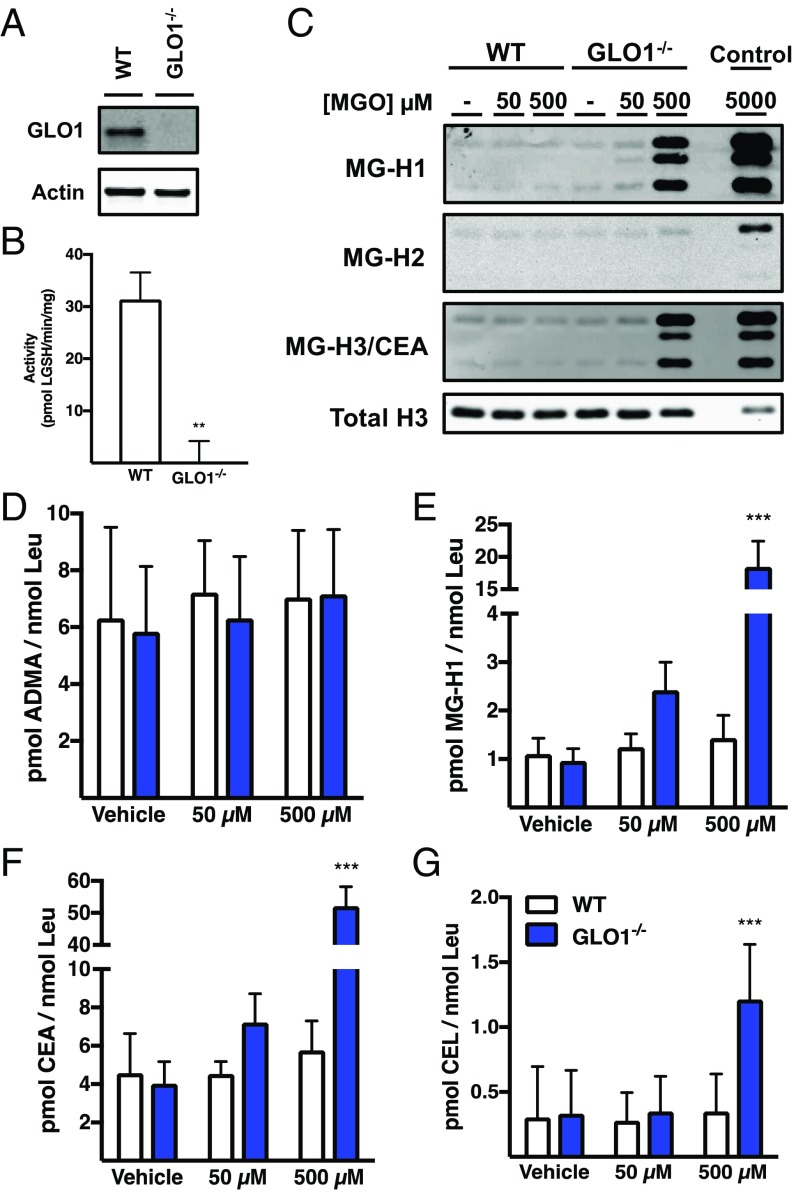
Histones are modified by MGO. (A) Western blot analysis demonstrates complete knockout of GLO1. (B) GLO1−/− cells lack any measurable GLO1 activity. **P < 0.01. (C) Western blot analysis of chromatin fractions using isoform-specific MG-H antibodies reveals histones as targets for modification with markedly increased levels observed in GLO1−/− cells treated with electrophile. Owing to a lack of measurable MG-H2 protein adduction, chromatin was treated with 5 mM MGO for 6 h (control) to serve as a positive control for MGO modification. (DG) QuARKMod demonstrates the levels of ADMA (D), MG-H1 (E), and CEA (F); the levels of MG-H1 and CEA are comparable to the level of ADMA under basal culture conditions, with marked elevations observed following treatment with MGO. (G) The levels of CEL are an order of magnitude lower than those of Arg-MGO PTMs. Data are presented as the mean ± SD; n = 3. Statistical significance was determined by two-way ANOVA. ***P < 0.001.
Fig. 5.
Fig. 5.
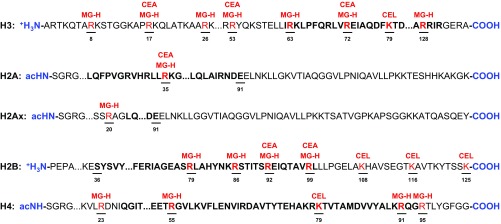
Identification of 28 site-specific MGO modifications on histones. Proteomic interrogation of site-specific MGO PTMs reveals the N terminus of H3 and the globular domain (bold) of H2B to be heavily susceptible to modification by MGO.
Fig. 6.
Fig. 6.
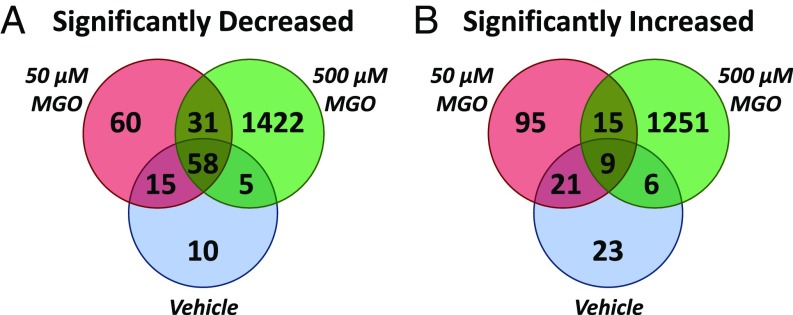
RNA-Seq reveals transcripts altered by MGO. The Venn diagrams display significantly decreased (A) or increased (B) protein coding transcripts in GLO1−/− cells treated with either vehicle, 50 µM MGO, or 500 µM MGO compared with WT vehicle control. n = 3 for each cohort.
Fig. 7.
Fig. 7.
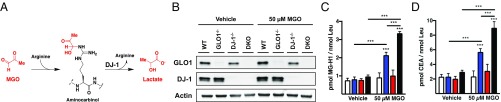
DJ-1 protects chromatin from modification by MGO. (A) DJ-1 hydrolyzes the intermediate aminocarbinol product of MGO and Arg. (B) Western blot analysis demonstrates complete knockout of DJ-1 in both WT and GLO1−/− cell lines (DKO). (C and D) QuARKMod was performed on chromatin fractions isolated from each cohort, demonstrating significant increases in MG-H1 and CEA in DKO cells compared with GLO1−/− alone. Treatments were provided for 6 h. Data are presented as mean ± SD; n = 3. Statistical significance was determined via two-way ANOVA. ***P < 0.001.

References

    1. Jenuwein T, Allis CD. Translating the histone code. Science. 2001;293:1074–1080. - PubMed
    1. Huang H, Sabari BR, Garcia BA, Allis CD, Zhao Y. SnapShot: Histone modifications. Cell. 2014;159:458–458.e1. - PMC - PubMed
    1. Fan J, Krautkramer KA, Feldman JL, Denu JM. Metabolic regulation of histone post-translational modifications. ACS Chem Biol. 2015;10:95–108. - PMC - PubMed
    1. Sabari BR, Zhang D, Allis CD, Zhao Y. Metabolic regulation of gene expression through histone acylations. Nat Rev Mol Cell Biol. 2017;18:90–101. - PMC - PubMed
    1. Galligan JJ, Marnett LJ. Histone adduction and its functional impact on epigenetics. Chem Res Toxicol. 2017;30:376–387. - PMC - PubMed

Publication types

MeSH terms