. 2018 Aug 27;9(1):3446.
doi: 10.1038/s41467-018-05635-1.

Black carbon radiative effects highly sensitive to emitted particle size when resolving mixing-state diversity

Affiliations

Black carbon radiative effects highly sensitive to emitted particle size when resolving mixing-state diversity

Hitoshi Matsui et al. Nat Commun. .

Abstract

Post-industrial increases in atmospheric black carbon (BC) have a large but uncertain warming contribution to Earth's climate. Particle size and mixing state determine the solar absorption efficiency of BC and also strongly influence how effectively BC is removed, but they have large uncertainties. Here we use a multiple-mixing-state global aerosol microphysics model and show that the sensitivity (range) of present-day BC direct radiative effect, due to current uncertainties in emission size distributions, is amplified 5-7 times (0.18-0.42 W m-2) when the diversity in BC mixing state is sufficiently resolved. This amplification is caused by the lifetime, core absorption, and absorption enhancement effects of BC, whose variability is underestimated by 45-70% in a single-mixing-state model representation. We demonstrate that reducing uncertainties in emission size distributions and how they change in the future, while also resolving modeled BC mixing state diversity, is now essential when evaluating BC radiative effects and the effectiveness of BC mitigation on future temperature changes.


Conflict of interest statement

The authors declare no competing interests.

Figures
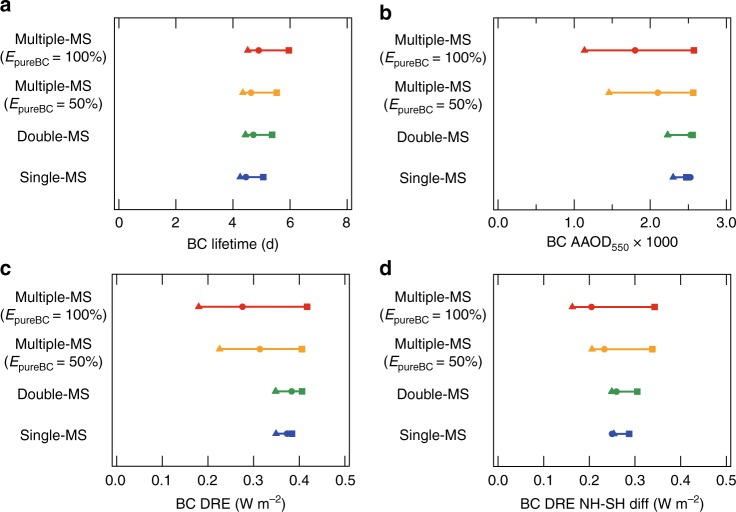
Fig. 1
Fig. 1
Sensitivity of black carbon properties to emission size distributions. The maximum-minimum ranges for a black carbon (BC) lifetime, b BC absorption aerosol optical depth at 550 nm (AAOD550), c BC direct radiative effect (DRE), and d the contrast of BC DRE between the Northern and Southern Hemispheres. Squares, circles, and triangles show the values in the Small-size, Base-size, and Large-size simulations, respectively
Fig. 2
Fig. 2
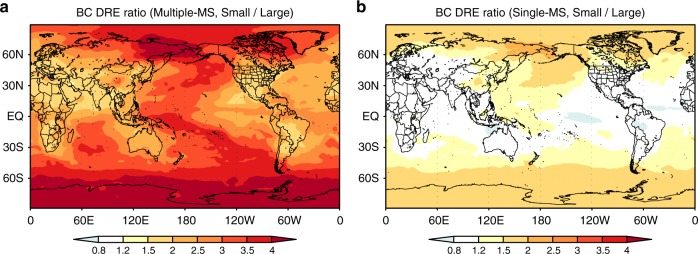
Spatial distributions of the sensitivity of black carbon direct radiative effect. The ratio (dimensionless) of black carbon (BC) direct radiative effect (DRE) between the Small-size and Large-size simulations for the a Multiple-mixing-state and b Single-mixing-state representations
Fig. 3
Fig. 3
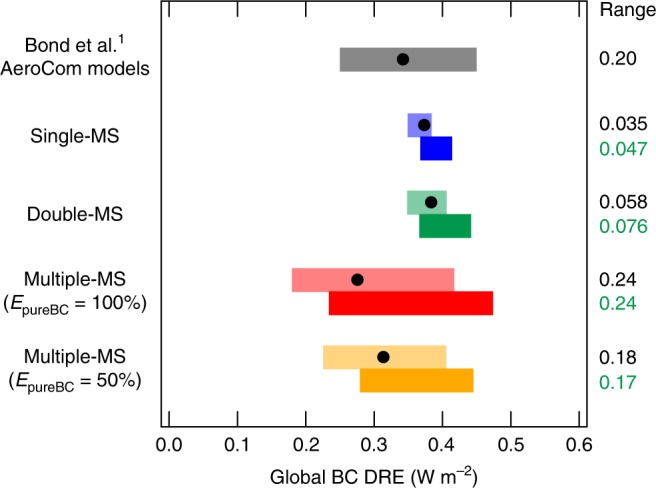
Sensitivity of black carbon direct radiative effect to emission size distributions. Black carbon (BC) direct radiative effect (DRE) (circles, Base-size simulations) and its ranges (horizontal bars). The ranges are shown for the Small-size and Large-size simulations (upper bars) and the simulations using the emission size distributions of the AeroCom models (lower bars). The mean BC DRE and its inter-model variability by the AeroCom model simulations are shown for comparison (gray bar)
Fig. 4
Fig. 4
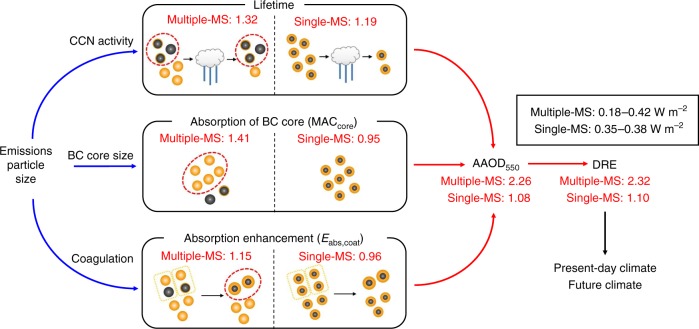
Causes of high sensitivity of black carbon direct radiative effect by resolving mixing state. The flowchart shows why the Multiple-mixing-state representation results in high sensitivity of black carbon (BC) direct radiative effect (DRE) due to emission size distributions. Blue and red arrows show negative and positive responses, respectively, in the Multiple-mixing-state representation. Specifically, decreasing particle sizes at emission (e.g., Small-size simulation) increases BC lifetime, BC core absorption, and absorption enhancement, and these enhancements increase absorption aerosol optical depth at 550 nm (AAOD550) and DRE of BC in the Multiple-mixing-state representation. The values shown by red are the ratios between the Small-size and Large-size simulations. The representation of particles in red circles is especially important for accurate calculations of the lifetime (pure BC and thinly-coated BC particles), BC core absorption (BC-free particles), and absorption enhancement (thickly-coated BC particles) effects, which are the causes of different BC DRE sensitivity between the Multiple-mixing-state and Single-mixing-state representations
Fig. 5
Fig. 5
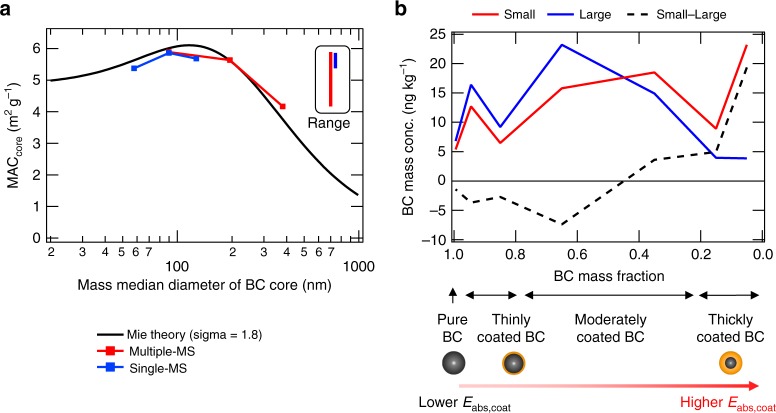
Key variables for the high sensitivity in black carbon direct radiative effect. a Size dependence of the mass absorption cross section of black carbon (BC) core (MACcore, Eq. (2)) for the Multiple-mixing-state and Single-mixing-state representations. Squares correspond to the Small-size, Base-size, and Large-size simulations (at the surface). Black line shows theoretical calculations (using the algorithms of Bohren and Huffman based on the Mie theory) assuming lognormal size distributions (sigma = 1.8). The ranges of MACcore are shown by red (Multiple-mixing-state) and blue (Single-mixing-state) vertical bars. b BC mixing state distributions of BC mass for the Small-size (red) and Large-size (blue) simulations in the Multiple-mixing-state representation (at the surface). BC particles are gradually shifted to the right by aging processes in the atmosphere
Fig. 6
Fig. 6
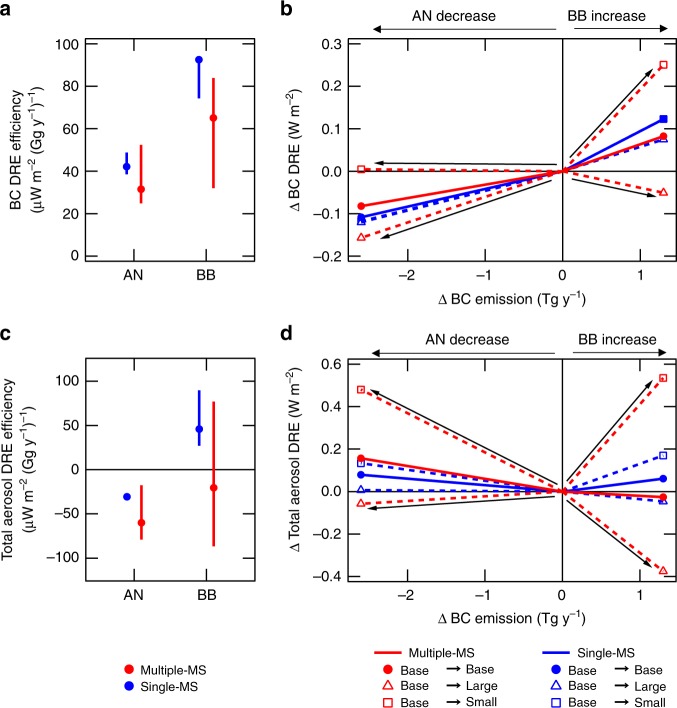
Sensitivity of direct radiative effect to emission changes in the future. a, c Direct radiative effect (DRE) efficiency (see Methods) is shown for (a) black carbon (BC) and (c) total aerosols (sum of BC, organic aerosol, sulfate, and nitrate) for anthropogenic (AN) and biomass burning (BB) sources. Vertical bars show the maximum-minimum ranges of the Base-size, Small-size, and Large-size simulations. The values for the Base-size simulations are shown by circles. b, d Responses of (b) BC and (d) total aerosol DRE to changes in AN and BB emission fluxes. Changes in DRE when emission size distributions (for all sources) are changed from the Base-size (present-day) to the Base-size, Small-size, and Large-size (future) are shown by closed circles, open squares, and open triangles, respectively. Total aerosol DRE and its efficiency in (c) and (d) are calculated with the scaling of BC and non-BC radiative forcing to radiative forcings in Myhre et al. (see Methods)

References

    1. Bond TC, et al. Bounding the role of black carbon in the climate system: a scientific assessment. J. Geophys. Res. Atmos. 2013;118:5380–5552. doi: 10.1002/jgrd.50171. - DOI
    1. Boucher, O. et al. in Climate Change 2013: The Physical Science Basis (ed. Stocker, T. F.) 571–658 (IPCC, Cambridge Univ. Press, Cambridge, UK, 2013).
    1. Myhre, G. et al. in Climate Change 2013: The Physical Science Basis (ed. Stocker, T. F.) 659–740 (IPCC, Cambridge Univ. Press, Cambridge, UK, 2013).
    1. Moteki N, et al. Evolution of mixing state of black carbon particles: aircraft measurements over the western Pacific in March 2004. Geophys. Res. Lett. 2007;34:L11803. doi: 10.1029/2006GL028943. - DOI
    1. Shiraiwa M, et al. Radiative impact of mixing state of black carbon aerosol in Asian outflow. J. Geophys. Res. 2008;113:D24210. doi: 10.1029/2008JD010546. - DOI

Publication types