


Associations between glucocorticoids and sociality across a continuum of vertebrate social behavior
- PMID: 30151183
- PMCID: PMC6106170
- DOI: 10.1002/ece3.4059
Associations between glucocorticoids and sociality across a continuum of vertebrate social behavior
Abstract
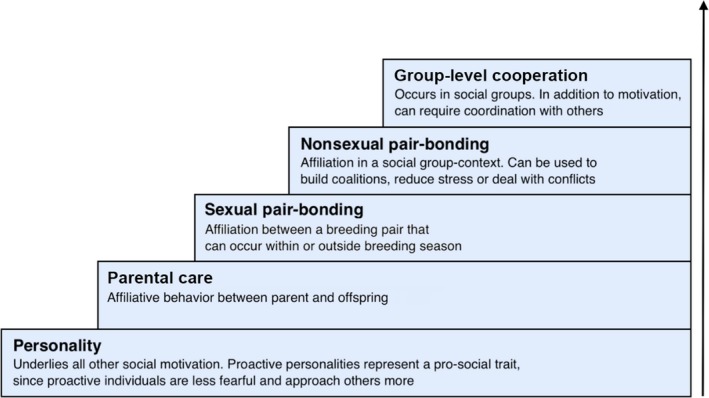
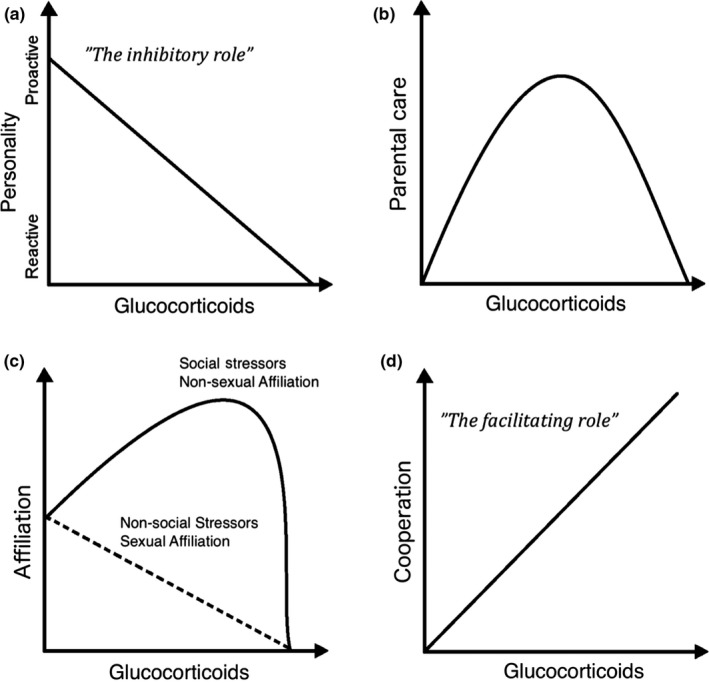
The causes and consequences of individual differences in animal behavior and stress physiology are increasingly studied in wild animals, yet the possibility that stress physiology underlies individual variation in social behavior has received less attention. In this review, we bring together these study areas and focus on understanding how the activity of the vertebrate neuroendocrine stress axis (HPA-axis) may underlie individual differences in social behavior in wild animals. We first describe a continuum of vertebrate social behaviors spanning from initial social tendencies (proactive behavior) to social behavior occurring in reproductive contexts (parental care, sexual pair-bonding) and lastly to social behavior occurring in nonreproductive contexts (nonsexual bonding, group-level cooperation). We then perform a qualitative review of existing literature to address the correlative and causal association between measures of HPA-axis activity (glucocorticoid levels or GCs) and each of these types of social behavior. As expected, elevated HPA-axis activity can inhibit social behavior associated with initial social tendencies (approaching conspecifics) and reproduction. However, elevated HPA-axis activity may also enhance more elaborate social behavior outside of reproductive contexts, such as alloparental care behavior. In addition, the effect of GCs on social behavior can depend upon the sociality of the stressor (cause of increase in GCs) and the severity of stress (extent of increase in GCs). Our review shows that the while the associations between stress responses and sociality are diverse, the role of HPA-axis activity behind social behavior may shift toward more facilitating and less inhibiting in more social species, providing insight into how stress physiology and social systems may co-evolve.
Keywords: animal personality; cooperation; cooperative breeding; glucocorticoids; hypothalamic‐pituitary‐adrenal axis; pair‐bond; parental care; social behavior; stress.
Figures
References
-
- Adams, N. J. , Farnworth, M. J. , Rickett, J. , Parker, K. A. , & Cockrem, J. F. (2011). Behavioral and corticosterone responses to capture and confinement of wild blackbirds (Turdus merula). Applied Animal Behavior Science, 134, 246–255.
-
- Adrian, O. , Kaiser, S. , Sachser, N. , Jandewerth, P. , Lottker, P. , Epplen, J. T. , & Hennessy, M. B. (2008). Female influences on pair formation, reproduction and male stress responses in a monogamous cavy (Galea monasteriensis). Hormones and Behavior, 53, 403–412. - PubMed
-
- Algera, D. A. , Brownscombe, J. W. , Gilmour, K. M. , Lawrence, M. J. , Zolderdo, A. J. , & Cooke, S. J. (2017). Cortisol treatment affects locomotor activity and swimming behaviour of male smallmouth bass engaged in paternal care: A field study using acceleration biologgers. Physiology & Behavior, 181, 59–68. - PubMed
-
- Algera, D. A. , Gutowsky, L. F. , Zolderdo, A. J. , & Cooke, S. J. (2017). Parental care in a stressful world: experimentally elevated cortisol and brood size manipulation influence nest success probability and nest‐tending behavior in a wild teleost fish. Physiological and Biochemical Zoology, 90, 85–95. - PubMed
-
- Almasi, B. , Roulin, A. , Jenni‐Eiermann, S. , & Jenni, L. (2008). Parental investment and its sensitivity to corticosterone is linked to melanin‐based coloration in barn owls. Hormones and Behavior, 54(1), 217–223. - PubMed
Publication types
LinkOut - more resources
Full Text Sources
Other Literature Sources
