. 2018 Aug 28;13(8):e0202274.
doi: 10.1371/journal.pone.0202274. eCollection 2018.

Effects of carbon-based nanomaterials on seed germination, biomass accumulation and salt stress response of bioenergy crops

Affiliations

Effects of carbon-based nanomaterials on seed germination, biomass accumulation and salt stress response of bioenergy crops

Kamal Pandey et al. PLoS One. .

Abstract

Bioenergy crops are an attractive option for use in energy production. A good plant candidate for bioenergy applications should produce a high amount of biomass and resist harsh environmental conditions. Carbon-based nanomaterials (CBNs) have been described as promising seed germination and plant growth regulators. In this paper, we tested the impact of two CBNs: graphene and multi-walled carbon nanotubes (CNTs) on germination and biomass production of two major bioenergy crops (sorghum and switchgrass). The application of graphene and CNTs increased the germination rate of switchgrass seeds and led to an early germination of sorghum seeds. The exposure of switchgrass to graphene (200 mg/l) resulted in a 28% increase of total biomass produced compared to untreated plants. We tested the impact of CBNs on bioenergy crops under salt stress conditions and discovered that CBNs can significantly reduce symptoms of salt stress imposed by the addition of NaCl into the growth medium. Using an ion selective electrode, we demonstrated that the concentration of Na+ ions in NaCl solution can be significantly decreased by the addition of CNTs to the salt solution. Our data confirmed the potential of CBNs as plant growth regulators for non-food crops and demonstrated the role of CBNs in the protection of plants against salt stress by desalination of saline growth medium.


Conflict of interest statement

The authors would like to declare the following provisional patent application associated with this research: U.S. Number 62/401,334. The authors have no other competing interests to declare.

Figures
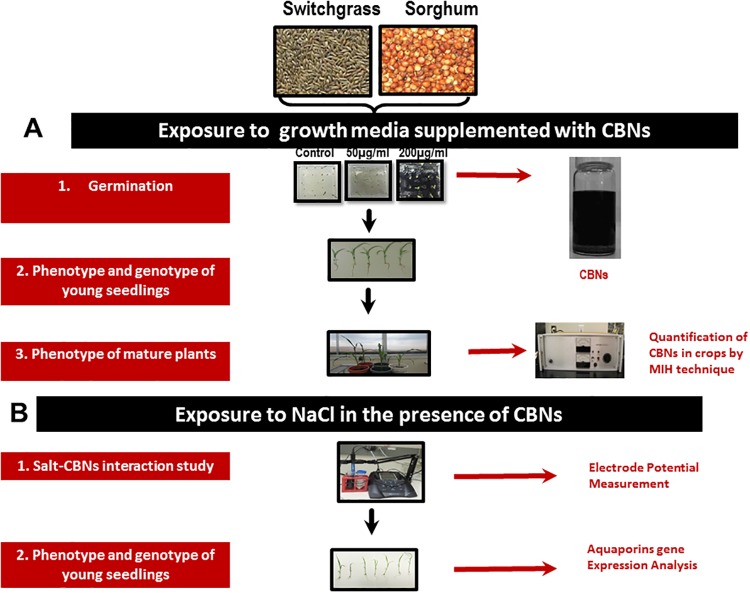
Fig 1
Fig 1. Schematic diagram showing the experimental design of this study.
The effects of CBNs in seed germination, growth, and development of bioenergy crops. The seeds of sorghum and switchgrass were exposed to graphene or multi-walled CNTs by addition to the growth medium. Germination and plant growth between CBN-treated and control bioenergy crops were calculated. The quantification of multi-walled CNTs inside the shoots of matured bioenergy crops was performed using the microwave induced heating (MIH) technique. For salt stress experiments, seeds were exposed to growth medium supplimented with NaCl and different concentration of CNTs or graphene (50, 100, 200, 500, 1000 μg/ml) and germination and seedling growth was monitered. The physical interaction between multi-walled CNTs and ions (Na+ or Cl¯) presented in salty solutions supplemented with CNTs was confirmed by measuring the electrode potential using ion-selective electrodes.
Fig 2
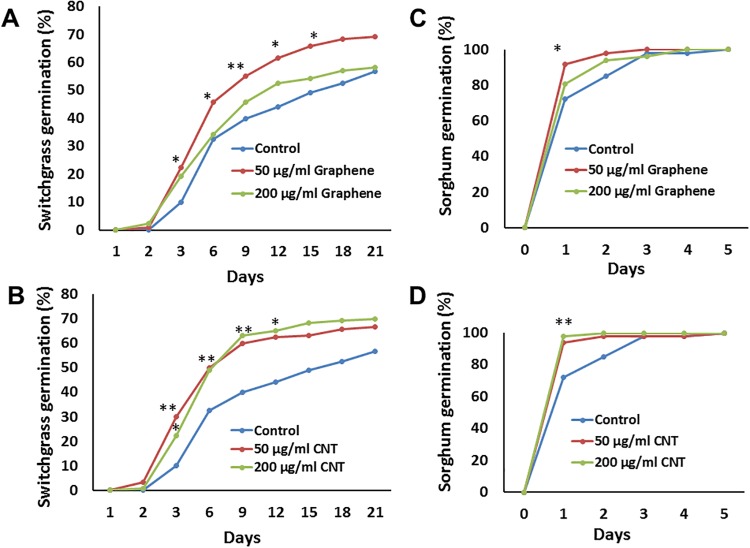
Fig 2. Activation of seed germination of switchgrass and sorghum by exposure to carbon-based nanomaterials (CBNs).
The graphs show the germination rate of seeds of switchgrass (A, B) and sorghum (C, D) exposed to graphene (A, C) and multi-walled carbon nanotubes (B, D) by the addition of nanomaterials into the Murashige and Skoog growth medium. Seed germination rate is expressed in percentage. Each Magenta box contains ten sorghum seeds or 20 switchgrass seeds (n = 60 for each treatment of sorghum and n = 120 for each treatment for switchgrass). (* = p < .05 and ** = p < .01).
Fig 3
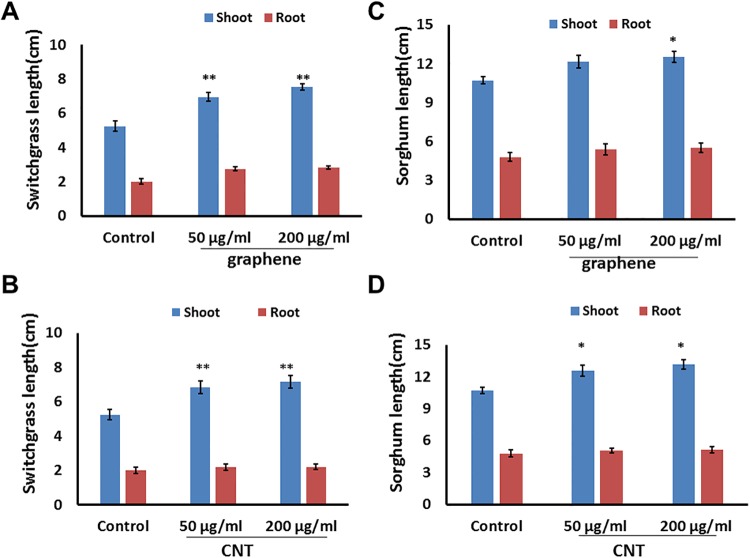
Fig 3. Growth enhancement of switchgrass (A, B) and sorghum (C, D) seedlings by exposure to carbon-based nanomaterials.
Effects on growth of bioenergy crops by CNTs (B, D) graphene (A, C) added to growth medium. Measurements were performed on 10-day-old seedlings (n = 30 for both sorghum and switchgrass). (* = p < .05 and ** = p < .01).
Fig 4
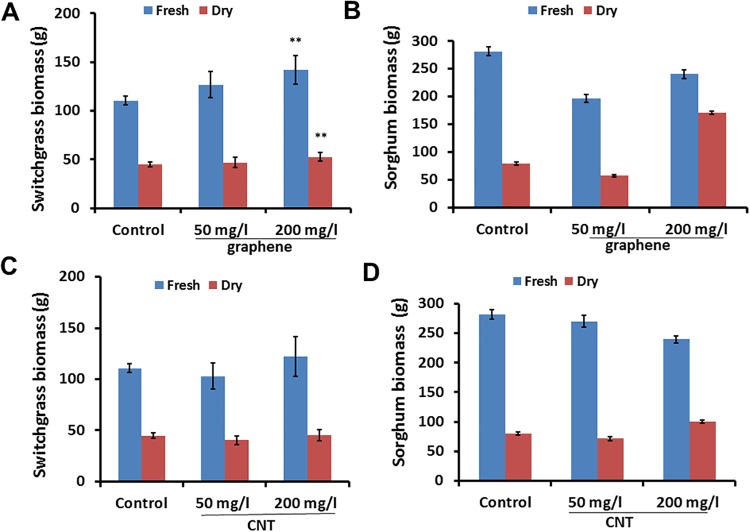
Fig 4. Effects of graphene (A, B) and CNTs (C, D) on shoot biomass production of bioenergy crops (sorghum, switchgrass) cultivated for 90 days in soil mix supplemented with CBNs (graphene, CNTs).
(* = p < .05 and ** = p < .01).
Fig 5
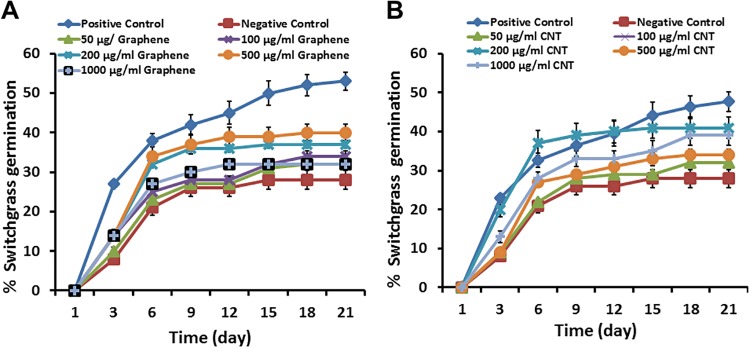
Fig 5. The addition of graphene (A) and multi-walled CNTs (B) can reduce the negative effect of NaCl on germination of switchgrass seeds.
For positive control, seeds were placed on regular Murashige and Skoog medium. For negative control, seeds were placed on Murashige and Skoog medium (MS) supplemented with 100 mM NaCl. For treatment with CBNs, seeds were placed on MS medium supplemented with 100 mM NaCl and different concentrations of CNTs or graphene (50, 100, 200, 500, 1000 μg/ml).
Fig 6
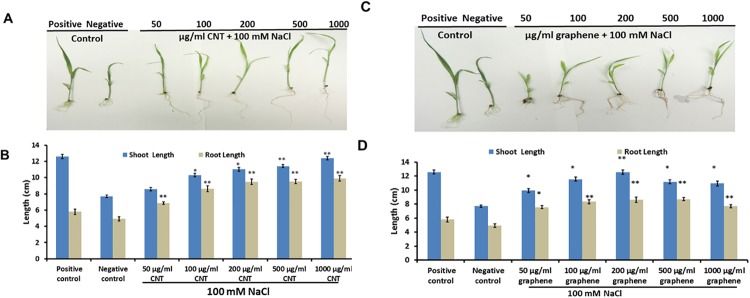
Fig 6. The addition of CNTs (A, B) and graphene (C, D) to growth medium reduce suppression of shoot and root length of 10-days old sorghum seedlings exposed to 100 mM NaCl.
For positive control (P) seedlings were grown on regular Murashige and Skoog medium. For negative control (N) seedlings were grown on Murashige and Skoog medium (MS) supplemented with 100 mM NaCl. For treatment with CBNs, seedlings were grown on MS medium supplemented with 100 mM NaCl and different concentrations of CNTs or graphene (50, 100, 200, 500, 1000 μg/ml). (* = p < .05 and ** = p < .01).
Fig 7
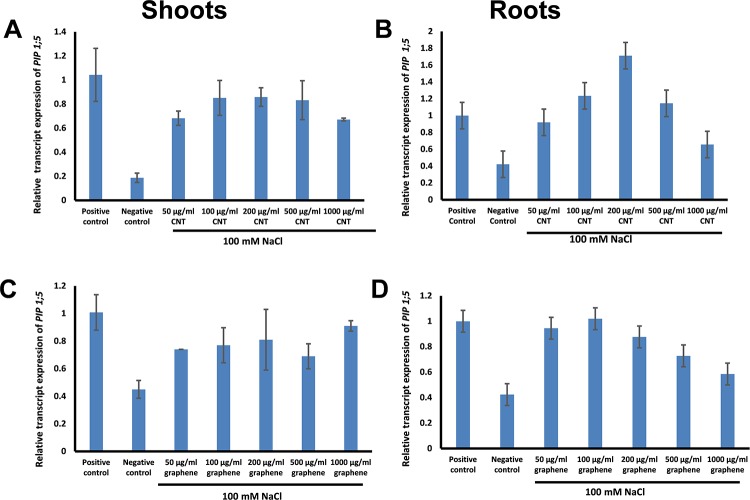
Fig 7. Real-time PCR analysis of expression of sorghum water channel gene (PIP 1;5) in 10 day-old sorghum shoots (A, C) and roots (B, D) grown in saline Murashige and Skoog medium (100 mM NaCl) supplemented with a wide range of CNTs concentrations (A, C) or graphene (B, D).
For positive control, seedlings were grown on regular Murashige and Skoog medium. For negative control, seedlings were grown on Murashige and Skoog medium (MS) supplemented with 100 mM NaCl.
Fig 8
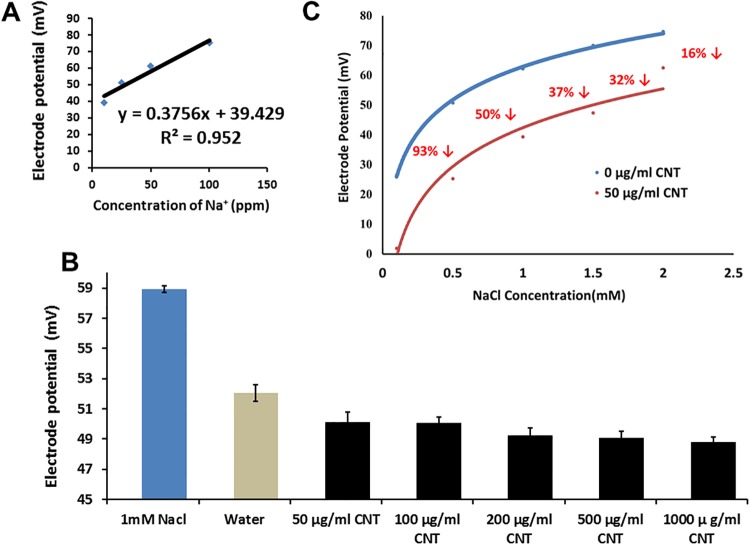
Fig 8. Measurements of electrode potential of saline solutions supplemented with CNTs using sodium ion selective electrode.
A standard curve potential (mV) versus Na+ concentration (ppm) was performed using a sodium ion selective electrode (A), effects of a wide range of concentrations of CNTs on the electrode potential of 1 mM NaCl solutions (B) as well as effects of CNTs (50 μg/ml) on electrode potential of saline solutions with different concentrations of NaCl (C) were recorded. All the experiments were done in triplicate.

References

    1. Johnson JMF, Coleman MD, Gesch R, Jaradat A, Mitchell R, Reicosky D, et al. Biomass-bioenergy crops in the United States: A changing paradigm. Am J Plant Sci—Biotech. 2007;1:1–28.
    1. Ragauskas AJ, Williams CK, Davison BH, Britovsek G, Cairney J, Eckert CA, et al. The Path Forward for Biofuels and Biomaterials\r10.1126/science.1114736. Science (80-) [Internet]. 2006;311(5760):484–9. Available from: http://www.sciencemag.org/cgi/content/abstract/311/5760/484 - PubMed
    1. Torney F, Moeller L, Scarpa A, Wang K. Genetic engineering approaches to improve bioethanol production from maize. Curr Opin Biotechnol. 2007;18(3):193–9. 10.1016/j.copbio.2007.03.006 - DOI - PubMed
    1. Demirbas AH, Demirbas I. Importance of rural bioenergy for developing countries. Energy Convers Manag. 2007;48(8):2386–98.
    1. Yuan JS, Tiller KH, Al-Ahmad H, Stewart NR, Stewart CN. Plants to power: bioenergy to fuel the future. Trends Plant Sci. 2008;13(8):421–9. 10.1016/j.tplants.2008.06.001 - DOI - PubMed

Publication types

MeSH terms