


A Study of Diagnostic Accuracy Using a Chemical Sensor Array and a Machine Learning Technique to Detect Lung Cancer
- PMID: 30154385
- PMCID: PMC6164114
- DOI: 10.3390/s18092845
A Study of Diagnostic Accuracy Using a Chemical Sensor Array and a Machine Learning Technique to Detect Lung Cancer
Abstract
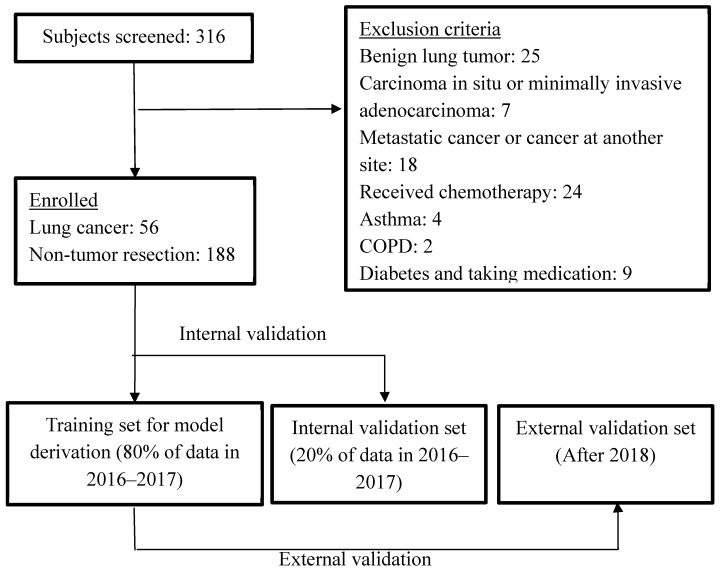
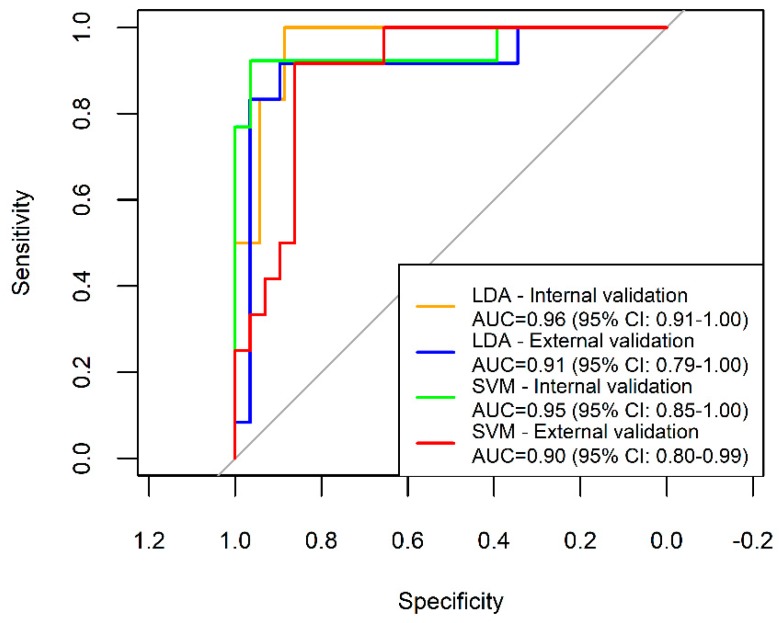
Lung cancer is the leading cause of cancer death around the world, and lung cancer screening remains challenging. This study aimed to develop a breath test for the detection of lung cancer using a chemical sensor array and a machine learning technique. We conducted a prospective study to enroll lung cancer cases and non-tumour controls between 2016 and 2018 and analysed alveolar air samples using carbon nanotube sensor arrays. A total of 117 cases and 199 controls were enrolled in the study of which 72 subjects were excluded due to having cancer at another site, benign lung tumours, metastatic lung cancer, carcinoma in situ, minimally invasive adenocarcinoma, received chemotherapy or other diseases. Subjects enrolled in 2016 and 2017 were used for the model derivation and internal validation. The model was externally validated in subjects recruited in 2018. The diagnostic accuracy was assessed using the pathological reports as the reference standard. In the external validation, the areas under the receiver operating characteristic curve (AUCs) were 0.91 (95% CI = 0.79⁻1.00) by linear discriminant analysis and 0.90 (95% CI = 0.80⁻0.99) by the supportive vector machine technique. The combination of the sensor array technique and machine learning can detect lung cancer with high accuracy.
Keywords: electronic nose; lung cancer; sensor array.
Conflict of interest statement
The authors declare no conflict of interest.
Figures
References
-
- World Health Organization Cancer. [(accessed on 26 October 2017)]; Available online: http://www.who.int/mediacentre/factsheets/fs297/en/
-
- Oken M.M., Hocking W.G., Kvale P.A., Andriole G.L., Buys S.S., Church T.R., Crawford E.D., Fouad M.N., Isaacs C., Reding D.J., et al. Screening by chest radiograph and lung cancer mortality: The Prostate, Lung, Colorectal, and Ovarian (PLCO) randomized trial. JAMA. 2011;306:1865–1873. doi: 10.1001/jama.2011.1591. - DOI - PubMed
-
- Moyer V.A., U.S. Preventive Services Task Force. Screening for lung cancer: U.S. Preventive Services Task Force recommendation statement. Ann. Intern. Med. 2014;160:330–338. - PubMed
Publication types
MeSH terms
Grants and funding
LinkOut - more resources
Full Text Sources
Other Literature Sources
Medical
