


Home-based balance training using Wii Fit™: a pilot randomised controlled trial with mobile older stroke survivors
- PMID: 30155268
- PMCID: PMC6109315
- DOI: 10.1186/s40814-018-0334-0
Home-based balance training using Wii Fit™: a pilot randomised controlled trial with mobile older stroke survivors
Abstract
Background: Several studies have reported that using the Wii™ Balance Board can provide added value regarding balance (re-)training in neurological diseases. However, for the large group of mobile older stroke survivors, there is no evidence regarding the feasibility of an unsupervised Wii™ Balance Board training in the home setting. The aim of this study was to investigate the feasibility of a home-based Wii™ balance training for these patients and to identify methodological challenges for randomised controlled trials in the future.
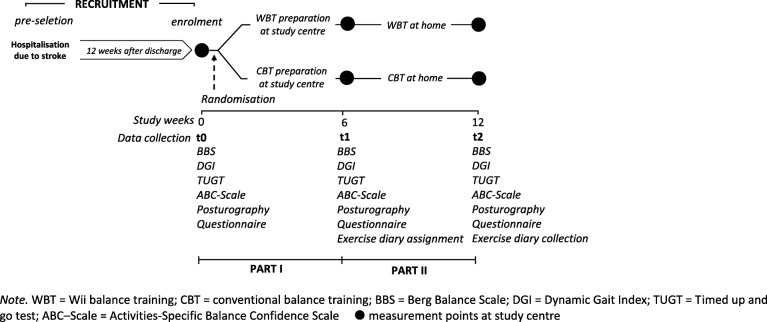
Methods: We conducted a pilot randomised controlled trial with two intervention arms in participants' homes. Mobile stroke survivors (aged 60 years or above; 12 weeks after discharge from hospital) received a 6-week (once per week) supervised balance training at the study centre, followed by a 6-week (three times per week) unsupervised balance training at home. We used the Nintendo Wii™ Balance Board for one intervention arm and conventional balance exercises for the other intervention arm. Feasibility was assessed by recruiting rates, appropriateness of assessments regarding sensitivity to changes and acceptance of the intervention by the participants.
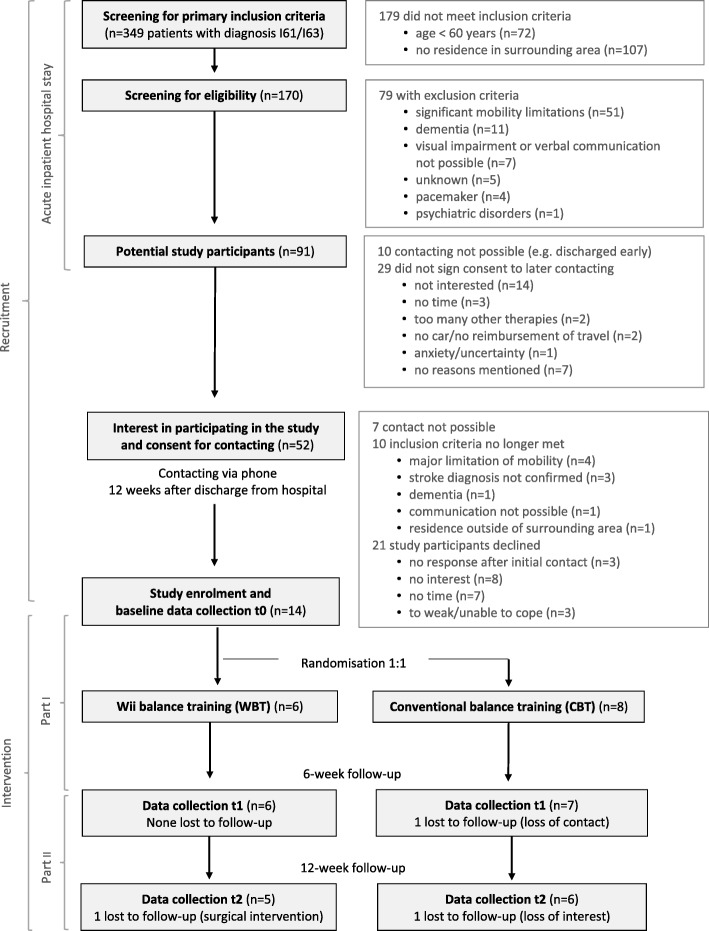
Results: In two German hospital stroke units, 349 stroke survivors were screened over a period of 6 months, 91 were eligible and 52 were interested. Twelve weeks after discharge, 14 participants agreed and 11 completed the intervention (7 men and 4 women, mean age 74 years). The Berg Balance Scale and Dynamic Gait Index showed ceiling effects already at baseline measure. The participants in both intervention arms evaluated the unsupervised training positively and feasible for self-application. No falls or injuries occurred over the intervention period, while the required scope of the exercises could largely be achieved.
Conclusions: In this pilot study, the recruitment of participants and the chosen assessments were not satisfactory due to selection bias and corresponding ceiling effects. However, the two home-based balance interventions proved feasible for mobile older stroke survivors with low functional limitations.
Trial registration: ClinicalTrials.gov, NCT02251470. Registered 29 September 2014.
Keywords: Balance exercise; Feasibility; Home rehabilitation; Nintendo Wii™; Stroke.
Conflict of interest statement
The trial protocol and informed consent were approved by the Ethics Committee of the Medical Faculty of the Martin Luther University Halle-Wittenberg. The study was conducted in accordance with the principles of Good Clinical Practice.Not applicable.The authors declare that they have no competing interests.Springer Nature remains neutral with regard to jurisdictional claims in published maps and institutional affiliations.
Figures
References
-
- Pessoa TM, Coutinho DS, Pereira VM, de Oliveira Ribeiro NP, Nardi AE, e Silva ACDO. The Nintendo Wii as a tool for neurocognitive rehabilitation, training and health promotion. Comput Hum Behav. 2014;31:384–392. doi: 10.1016/j.chb.2013.10.025. - DOI
-
- Laver K, George S, Thomas S, Deutsch JE, Cortty M. Cochrane review: virtual reality for stroke rehabilitation. Eur J Phys Rehabil Med. 2012;48:523–530. - PubMed
Associated data
LinkOut - more resources
Full Text Sources
Other Literature Sources
Medical
