


Sensitivity to Peer Feedback in Young Adolescents with Symptoms of ADHD: Examination of Neurophysiological and Self-Report Measures
- PMID: 30155685
- PMCID: PMC6395560
- DOI: 10.1007/s10802-018-0470-2
Sensitivity to Peer Feedback in Young Adolescents with Symptoms of ADHD: Examination of Neurophysiological and Self-Report Measures
Abstract
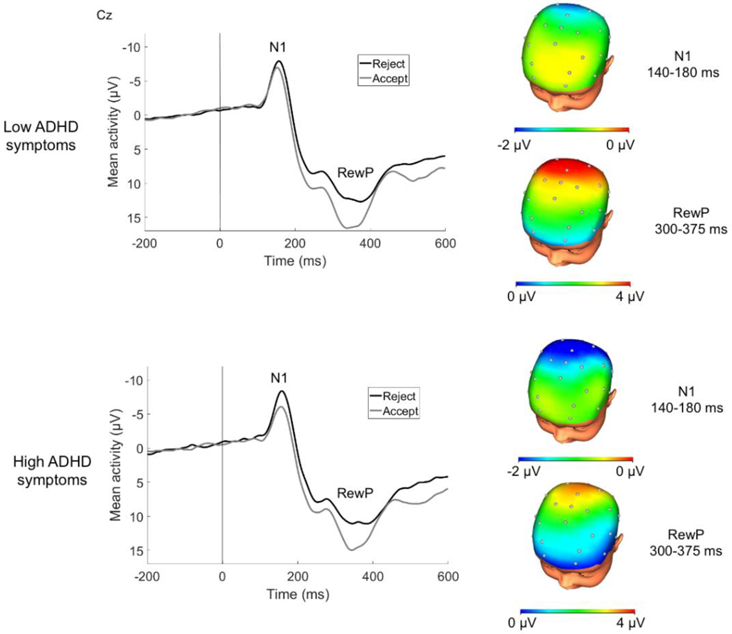
Many youth with ADHD experience peer difficulties, but the mechanisms underlying this dysfunction remain unknown. Very little work has examined neurophysiological measures of social feedback processing in relation to ADHD symptoms. The goal of this study was to examine associations of ADHD symptoms with indicators of sensitivity to social feedback in a laboratory task and self-report of rejection sensitivity. A large community sample of 10- to 15-year-old adolescents (N = 391; Mage = 12.64, 48.6% girls) participated in the study. Mothers rated youth ADHD symptoms. Youth completed the Island Getaway task, which elicits neurophysiological (i.e., event-related potentials [ERP]) measures of sensitivity to peer rejection and acceptance feedback, and also completed self-ratings of rejection sensitivity. Greater ADHD symptoms were associated with an enhanced N1 ERP component, which correlated with higher levels of self-reported rejection sensitivity. In addition, greater ADHD symptoms were associated with reduced reactivity to social acceptance, as measured by the later reward positivity ERP component. Youth with elevated ADHD symptoms exhibited enhanced sensitivity to peer rejection at the neurophysiological and self-report level, as well as reduced neurophysiological reactivity to peer acceptance. Future work including neural measures of social functioning may serve to elucidate mechanisms underlying the social dysfunction characteristic of ADHD.
Keywords: ADHD; Event-related potential (ERP); Peer feedback; Rejection; Social processes.
Figures
References
-
- Achenbach TM, & Rescorla L (2001). ASEBA school-age forms and profiles Burlington, VT: Aseba.
-
- Andrade BF, Waschbusch DA, Doucet A, King S, MacKinnon M, McGrath PJ, … Corkum P (2012). Social information processing of positive and negative hypothetical events in children with ADHD and conduct problems and controls. Journal of Attention Disorders, 16, 491–504. 10.1177/1087054711401346 - DOI - PubMed
-
- Axelson D, Birmaher B, Zelazny J, Kaufman J, & Gill MK (2009). The Schedule for Affective Disorders and Schizophrenia-Present and Lifetime Version (K-SADS-PL) 2009 Working Draft Advanced Center for Intervention and Services Research, Western Psychiatric Institute and Clinic; (http://www.psychiatry.pitt.edu/sites/default/files/Documents/assessments...).
-
- Becker SP, Luebbe AM, & Langberg JM (2012). Co-occurring mental health problems and peer functioning among youth with attention-deficit/hyperactivity disorder: a review and recommendations for future research. Clinical Child and Family Psychology Review, 15, 279–302. 10.1007/s10567-012-0122-y - DOI - PubMed
Publication types
MeSH terms
Grants and funding
LinkOut - more resources
Full Text Sources
Other Literature Sources
Medical
