. 2019 Jan;160(1):160-171.
doi: 10.1097/j.pain.0000000000001387.

Activation of the integrated stress response in nociceptors drives methylglyoxal-induced pain

Affiliations

Activation of the integrated stress response in nociceptors drives methylglyoxal-induced pain

Paulino Barragán-Iglesias et al. Pain. 2019 Jan.

Abstract

Methylglyoxal (MGO) is a reactive glycolytic metabolite associated with painful diabetic neuropathy at plasma concentrations between 500 nM and 5 μM. The mechanisms through which MGO causes neuropathic pain at these pathological concentrations are not known. Because MGO has been linked to diabetic neuropathic pain, which is prevalent and poorly treated, insight into this unsolved biomedical problem could lead to much needed therapeutics. Our experiments provide compelling evidence that ∼1-μM concentrations of MGO activate the integrated stress response (ISR) in IB4-positive nociceptors in the dorsal root ganglion (DRG) of mice in vivo and in vitro. Blocking the integrated stress response with a specific inhibitor (ISRIB) strongly attenuates and reverses MGO-evoked pain. Moreover, ISRIB reduces neuropathic pain induced by diabetes in both mice and rats. Our work elucidates the mechanism of action of MGO in the production of pain at pathophysiologically relevant concentrations and suggests a new pharmacological avenue for the treatment of diabetic and other types of MGO-driven neuropathic pain.


Conflict of interest statement

Conflict of interest statement

The authors have no conflict of interest to declare.

P. Barragan-Iglesias received a Postdoctoral Conacyt Fellowship (274414). A.B. Salinas-Abarca is a graduate Conacyt fellowship (277977).

Figures
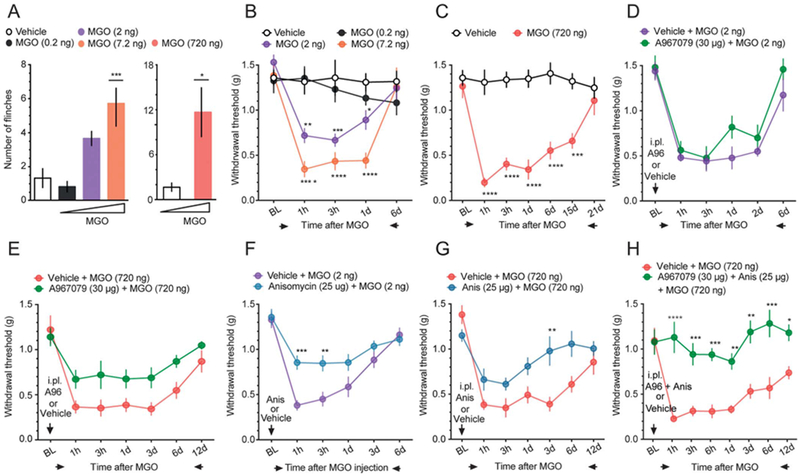
Figure 1.
Figure 1.
Intraplantar administration of methylglyoxal produces nociceptive responses: involvement of TRPA1 channels and nascent protein synthesis. (A) Intraplantar (i.p.) administration of MGO produces dose-dependent acute flinching behavior. One-way ANOVA: F(3, 20) = 10.22, P = 0.003; post-hoc Dunnett: ***P < 0.001, vehicle vs MGO (7.2 ng). Unpaired t test: t = 3.012; *P = 0.0131, vehicle vs MGO (720 ng). n = 6. (B) A low dose of MGO (0.2-7.2 ng/25 μL i.p.) induces a short-term mechanical hypersensitivity. Two-way ANOVA: F(12, 80) = 5.62, P < 0.001. Post-hoc Tukey; vehicle vs MGO (2 ng) at 1 hour: **P = 0.018, at 3 hours: ***P = 0.003, at 1 day: *P = 0.0398. vehicle vs MGO (7.2 ng) at 1 hour, 3 hours, 1 day: ****P = 0.0001. n = 6. (C) A high dose of MGO (720 ng/25 μL i.p.) produces long-lasting mechanical hypersensitivity. Two-way ANOVA: F(6, 60) = 8.163, P < 0.0001. Post-hoc Bonferroni; vehicle vs MGO (720 ng)at 1 hour, 3 hours, 1 day, and 6 days: ****P < 0.0001, at 15 days: ***P = 0.002. n = 6. (D) Methylglyoxal-induced short-term mechanical hypersensitivity is not blocked by A967079 (30 μg, i.p.), a TRPA1 channel antagonist. (E) A967079 (30 μg, i.p.) produced a minor antinociceptive effect after a high dose of MGO (720 ng/25 μL, i.p.). (F) Anisomycin (25 μg, i.p.), a nascent protein synthesis inhibitor, attenuates mechanical hypersensitivity produced by a low dose of MGO. Two-way ANOVA: F(5,132) = 3.343, P = 0.0071. Post-hoc Bonferroni; MGO + vehicle vs MGO + anisomycin at 1 hour: ****P = 0.0003, at 3 hours: **P = 0.0035. n = 12. (G) Mechanical hypersensitivity produced the high dose of MGO is prevented by anisomycin (25 μg, i.p.). Two-way ANOVA: F(6, 79) = 2.513, P = 0.0281. Post-hoc Bonferroni; MGO + vehicle vs MGO + anisomycin at 3 days: **P = 0.0035. (H) Coadministration of A967079 (30 μg, i.p.) and anisomycin (25 μg, i.p.) completely blocks the mechanical hypersensitivity produced by the high dose of MGO. Two-way ANOVA: F(7,70) = 3.866, P = 0.0013. Post-hoc Bonferroni; MGO + vehicle vs MGO + A967079 + Anisomycin at 1 hour: ****P = 0.0001, at 3 hours: *** P = 0.0004, at 6 hours: ***P = 0.0003, at 1 days: **P = 0.0038, at 3 days: ***P = 0.002, at 6 days: ****P < 0.0001, and at 12 days: *0.0254. n 5 6. ANOVA, analysis of variance.
Figure 2.
Figure 2.
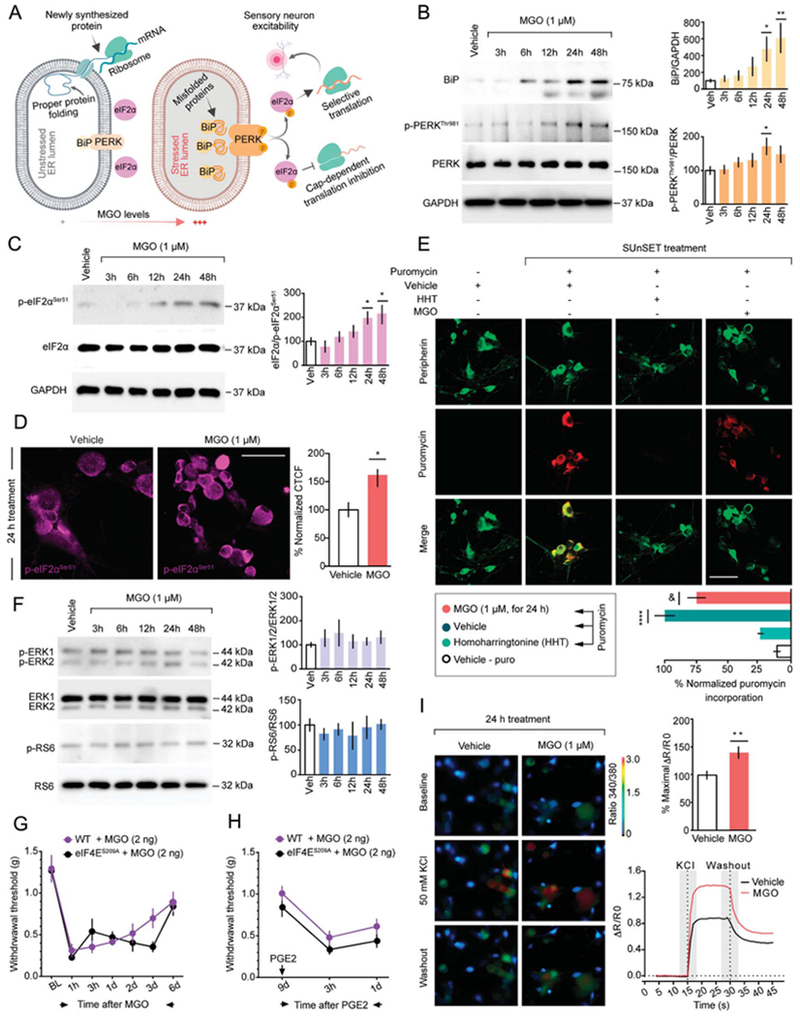
Methylglyoxal induces the ISR in cultured mouse DRG neurons. (A) Schematic representation of ISR signaling in DRG neurons under normal and pathophysiological MGO concentrations. (B) Incubation of DRG neurons at day 6 in vitro with MGO (1 μM) up-regulates the expression of the immunoglobulin heavy-chain-binding protein (BiP) and phosphorylates the PKR-like ER-localized eIF2α kinase (PERKThr981). For BiP: 1-way ANOVA, F(5,26) = 4.339, P = 0.0053; post-hoc Dunnett: vehicle (veh) + MGO at 24 hours: *P = 0.0472 and at 48 hours: **P = 0.0050. n = 5 to 6. For p-PERKThr981: 1-way ANOVA, F(5,30) = 2.161, P = 0.0851; post-hoc Dunnett: vehicle + MGO at 24 hours: *P = 0.0427. n = 6. (C and D) BiP activation and PERKThr981 phosphorylation converge on the subsequent phosphorylation of the eukaryotic initiation factor 2α at serine 51 (eIF2αSer51). For Western blot: 1-way ANOVA, F(5, 30) = 4.52, P = 0.0034; post-hoc Dunnett: vehicle + MGO at 24 hours: *P = 0.0475, at 48 hours: 0.0144. n = 6. For immunofluorescence: Unpaired t test: t = 2.396; *P = 0.0224, vehicle (n = 10) vs MGO (n = 25). (E) In the surface sensing of translation (SUnSET) method, cultured DRG neurons are incubated with MGO (1 μM) for 24 hours after addition of puromycin (1 μM) for an additional 15 minutes. Incubation with either MGO (1 μM for 24 hours) or the elongation inhibitor homoharringtonine (HHT) (50 μM for 1 hour), but not vehicle, significantly reduces nascent protein synthesis in DRG neurons. Staining is shown from top to bottom for puromycin (green), peripherin (red), or a merge. 1-way ANOVA, F(3, 21) = 28.83, P < 0.0001; post-hoc Tukey: ****P < 0.0001, veh-puro vs vehicle + puro; &P = 0.0445, vehicle + puro vs MGO + puro. (F) Treatment with MGO (1 μM) represses the phosphorylation of proteins mainly associated with cap-dependent translation such as the extracellular signal-regulated kinases 1 and 2 (ERK1/2) and the ribosomal protein S6. (G) Methylglyoxal (2 ng, i.p.) administration produces mechanical hypersensitivity in mice lacking phosphorylation of the cap-binding protein eIF4E (eIF4ES209A) and (H) precipitates mechanical hypersensitivity after an intraplantar injection of prostaglandin E2 (PGE2) at day 9 after i.p. MGO. (I) Activation of the ISR by MGO (1 μM, for 24 hours), but not vehicle, drives neuronal hyperexcitability in cultured DRG neurons revealed by an increase in Ca2+ signaling when they are stimulated with 50 mM KCl. Unpaired t test: = 3.13; *P = 0.0022, vehicle (n = 57) vs MGO (n = 76). Scale bar, 50 μm. ANOVA, analysis of variance; ISR, integrated stress response.
Figure 3.
Figure 3.
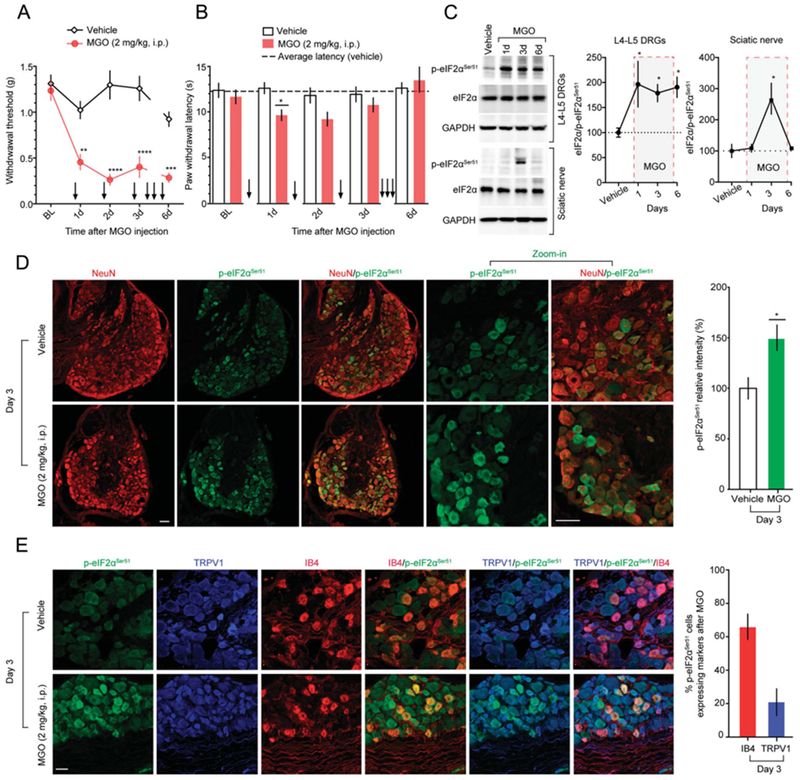
Methylglyoxal produces pain hypersensitivity and triggers the ISR in DRG neurons in vivo. (A) Daily administration of MGO (2 mg/kg, i.p; for 6 days) markedly increases mechanical sensitivity in mice tested at 3 hours after MGO injection. Two-way ANOVA, F(4, 40) = 7.156, P = 0.0002. Post-hoc Bonferroni; vehicle vs MGO at 1 days: **P = 0.0012, at 2 days: ****P < 0.0001, at 3 days: ****P = 0.0001, and at 6 days: ***P = 0.002. n = 6. (B) Methylglyoxal (2 mg/kg, i.p) produces a transient thermal hypersensitivity. Two-way ANOVA, F(4,107) = 1.771, P = 0.1400. Post-hoc Bonferroni; vehicle vs MGO at 1 day: *P = 0.0329. n = 12. (C) Methylglyoxal (2 mg/kg, i.p) produces a sustained increase on eIF2αSer51 phosphorylation, from day 1 to 6, in L4-L5 DRGs. One-way ANOVA, F(3,9) = 3.742, P = 0.05; post-hoc Dunnett: veh vs MGO at 1 day: *P = 0.0479, at 3 days: *P = 0.0456, at 6 days: *P = 0.0259. n = 4. Methylglyoxal also produces a transient significant increase on p-eIF2αSer51 at day 3 in the sciatic nerve of mice. One-way ANOVA, F(3,11) = 7.35, P = 0.0056. Post-hoc Dunnett: *P = 0.0055, vehicle vs MGO at day 3. n = 4. (D) The increase on eIF2αSer51 phosphorylation in the DRGs at day 3 is mainly present in neurons as shown by the colocalization with the neuronal marker NeuN. Unpaired t test: t = 2.967; *P = 0.0048, vehicle vs MGO. n = 24. (E) After i.p. MGO administration, 65.96% of p-eIF2α-positive cells in the DRG express IB4 and 20.82% express TRPV1. Scale bar, 50 μm. ANOVA, analysis of variance; ISR, integrated stress response.
Figure 4.
Figure 4.
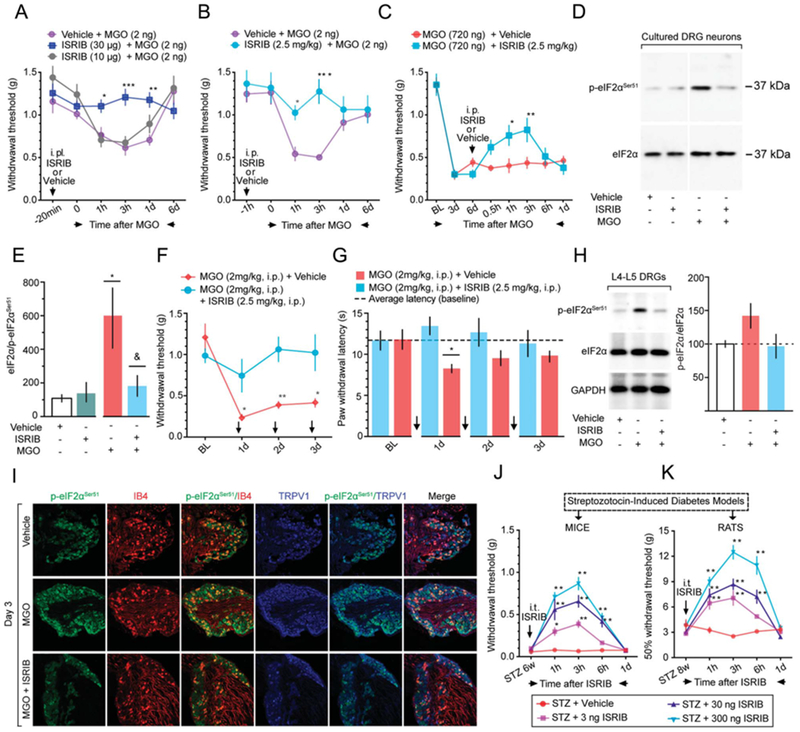
Integrated stress response with a specific inhibitor reverses the effects of eIF2αSer51 phosphorylation and attenuates mechanical hypersensitivity in a model of experimental diabetes. (A) i.p. (3,10 μg) or (B) i.p. (2.5 mg/kg) administration of ISRIB prevents the mechanical hypersensitivity produced by a low-dose MGO (2 ng, i.p.). For i.p., ISRIB: 2-way ANOVA, F(10,75) = 4.093, P = 0.002. Post-hoc Bonferroni: vehicle + MGO vs MGO + ISRIB (10 μg) at 1 hour: *P = 0.0386, at 3 hours: ***P = 0.001, at 24 hours: **P = 0.0028. For i.p. ISRIB: 2-way ANOVA, F(5,50) = 3.921, P = 0.0045. Post-hoc Bonferroni: vehicle + MGO vs MGO + ISRIB (2.5 mg/kg) at 1 hour: *P = 0.0396, and at 3 hours: ***P = 0.0002. n = 6. (C) Integrated stress response with a specific inhibitor (2.5 mg/kg, i.p.) partially reverses the long-lasting mechanical hypersensitivity produced by a high-dose MGO (720 ng, i.p.). Two-way ANOVA, F(7,70) = 3.037, P = 0.0076. Post-hoc Bonferroni; vehicle + MGO vs ISRIB + MGO at 1 hour: *P = 0.0219 and at 3 hours: **P = 0.0097. n = 6. (D and E) In cultured DRG neurons, ISRIB (200 nM, 4-hour treatment) reverses the eIF2αSer51 phosphorylation produced by MGO (1 μM, 24-hour treatment). One-way ANOVA, F(3,8) = 7.854, P = 0.0091. Post-hoc Dunnett: *P = 0.0178, vehicle vs MGO; &P = 0.405, MGO + vehicle vs MGO + ISRIB. n = 3. (F) Integrated stress response with a specific inhibitor (2.5 mg/kg, i.p.) for 3 consecutive days, prevents the mechanical and (G) thermal hypersensitivity, and normalizes the MGO-induced eIF2αSer51 phosphorylation in L4-L5 DRGs by Western blot (H) and IHC (I). For mechanical hypersensitivity: 2-way ANOVA, F(3, 30) = 6.528, P = 0.0016. Post-hoc Bonferroni; MGO + vehicle vs MGO + ISRIB at 1 day: *P = 0.0458, at 2 days: *P = 0.0043, and at 3 days: 0.0115. n = 6. Forthermal hypersensitivity: 2-way ANOVA, F(3,30) = 2.575, P = 0.0724. Post-hoc Bonferroni; MGO + vehicle vs MGO + ISRIB at 1 day: *P = 0.0116. n = 6. (J) In mice and (K) rats, ISRIB (3-300 ng, intrathecal), but not vehicle, reverses the mechanical hypersensitivity produced by streptozotocin-induced experimental diabetes. For mice (J): Two-way ANOVA, F(12,130) = 10.64, P < 0.0001. Post-hoc Bonferroni; STZ + vehicle vs STZ + ISRIB (3 ng) at 1h: *P = 0.0141, at 3 h: ****P < 0.0001. STZ + vehicle vs STZ + ISRIB (30 ng) at 1,3,6h: ****P < 0.0001. STZ + vehicle vs STZ + ISRIB (300 ng) at 1,3,6 h: ****P < 0.0001. n = 6. For rats (K): Two-way ANOVA, F(12,88) = 11.92, P < 0.0001. Post-hoc Bonferroni; STZ + vehicle vs STZ + ISRIB (3 ng) at 1 h: **P = 0.0017, at 3 h: ****P<0.0001. STZ + vehicle vs STZ + ISRIB (30 ng) at 1,3,6 h: ****P < 0.0001. STZ + vehicle vs STZ + ISRIB (300 ng) at 1,3,6 h: ****P < 0.0001. n = 6. Arrows in the figure indicate the time points of drug administration. Scale bar, 50 μm. ANOVA, analysis of variance.
Figure 5.
Figure 5.
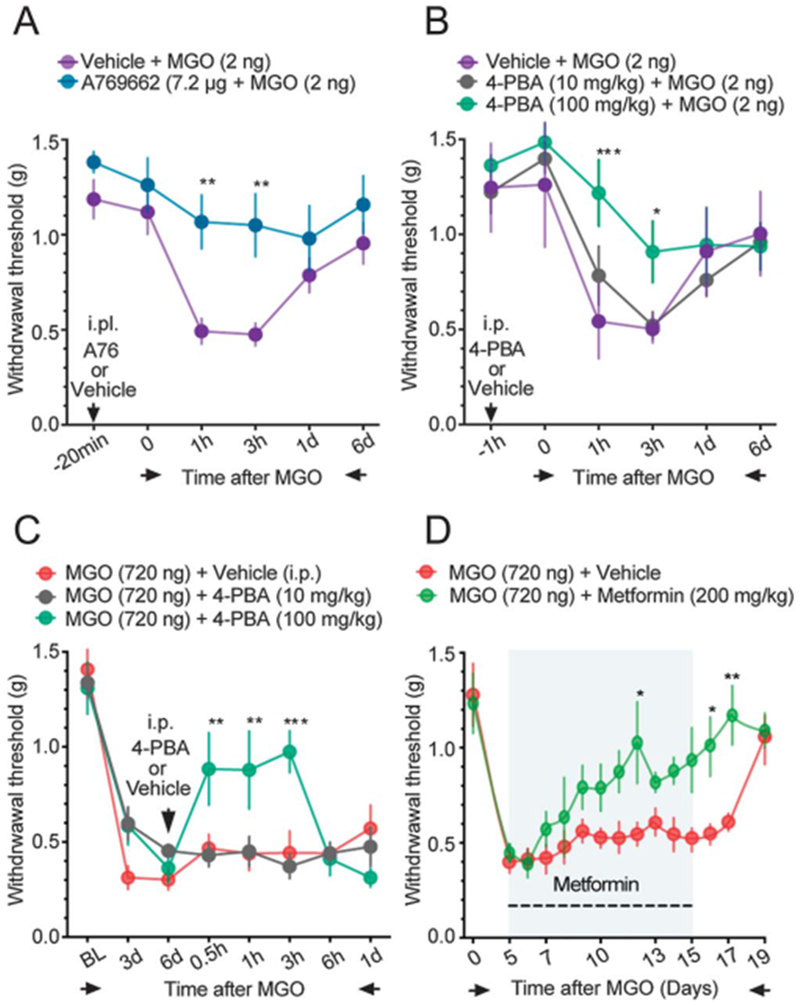
Effects of metformin, A769662, and 4-PBA on MGO-induced mechanical hypersensitivity. (A) A769662 (7.2 μg, i.p.) prevents the mechanical hypersensitivity produced by a low dose of MGO (2 μg, i.p.). (B) 4-PBA (100 mg/kg, i.p.) attenuates mechanical hypersensitivity produced by the low dose of MGO, whereas the low dose of 4-PBA (10 mg/kg) has no significant antinociceptive effect. For A769662: 2-way ANOVA, F(5, 60) = 1.424, P = 0.2287. Post-hoc Bonferroni; vehicle + MGO vs a769662 + MGO at 1 hour: **P = 0.0078, at 3 hours: **P = 0.0079. n = 6. For 4-PBA: 2-way ANOVA, F(10,90) = 1.591, P = 0.1221. Post-hoc Bonferroni; vehicle + MGO vs 4-PBA (100 mg/kg) + MGO at 1 hour: ***P = 0.0001, at 3 hours: **P = 0.0273. n = 6. (C) 4-PBA (10-100 mg/kg, i.p.) administration at day 6 reverses the mechanical hypersensitivity produced by a high-dose of MGO (720 ng, i.p.). Two-way ANOVA, F(14,105) = 3.857, P < 0.001. Post-hoc Bonferroni; MGO + vehicle vs MGO+ 4-PBA at 0.5 hours: **P = 0.0074, at 1 hour: **P = 0.0045, at 3 hours: ***P = 0.0005. n = 6. (D) Metformin (200 mg/kg, per os) administration for 10 days, starting at day 5, reverses the mechanical hypersensitivity and accelerates the recovery to baseline mechanical thresholds in mice injected with a high dose of MGO (720 ng, i.p.). Two-way ANOVA, F(13,130) = 1.872, P < 0.001. Post-hoc Bonferroni; MGO + vehicle vs MGO+metformin at 12 days: *P = 0.0143, at 15 days: P = 0.0762, at 16 days: **P = 0.0316, at 17 days: **P = 0.0029. n = 6. ANOVA, analysis of variance.
Figure 6.
Figure 6.
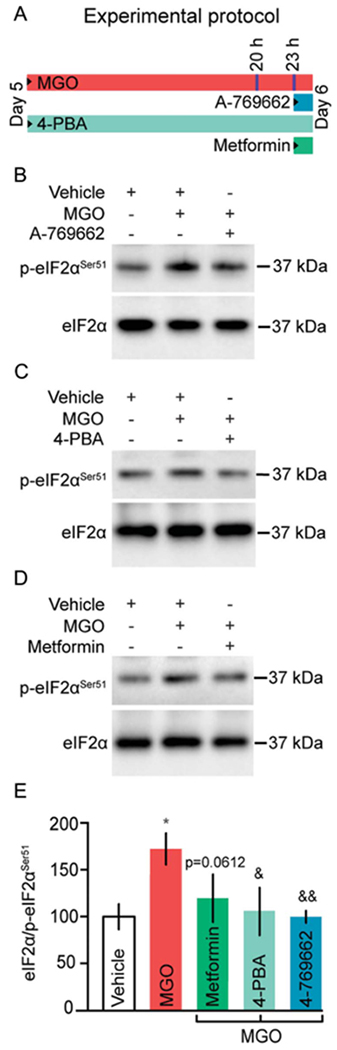
In vitro effects of A769662, 4-PBA, and metformin on MGO-induced eIF2αSer51 phosphorylation. (A) Schematic representation of the experimental protocol used for MGO or drug treatments. Cultured DRG neurons were stimulated at day 5 in vitro with MGO (1 μM) for 24 hours in the presence of vehicle, A769662 (200 μM, for 1 hour), 4-PBA (1 μM, for 24 hours), or metformin (20 mM, for 1 hour). (B) A-769662 and (C) attenuate eIF2αSer51 phosphorylation in cultured DRG neurons treated with MGO. (D) Treatment with metformin for 1 hour produces a trend towards the reduction of eIF2αSer51 phosphorylation. One-way ANOVA, F(4, 27) = 3.981, P = 0.0115. Post-hoc Bonferroni: *P = 0.0023, vehicle vs MGO; &P = 0.0612, MGO vs metformin; *P = 0.0023, MGO vs 4-PBA; &&P = 0.0072, vehicle vs A769662. n = 4. (E) Quantification of B–D. ANOVA, analysis of variance.

References

    1. Andersen ST, Witte DR, Dalsgaard EM, Andersen H, Nawroth P, Fleming T, Jensen TM, Finnerup NB, Jensen TS, Lauritzen T, Feldman EL, Callaghan BC, Charles M. Risk factors for incident diabetic polyneuropathy in a cohort with screen-detected type 2 diabetes followed for 13 years: ADDITION-Denmark. Diabetes Care 2018;41:1068–75. - PubMed
    1. Andersson DA, Gentry C, Light E, Vastani N, Vallortigara J, Bierhaus A, Fleming T, Bevan S. Methylglyoxal evokes pain by stimulating TRPA1. PLoS One 2013;8:e77986. - PMC - PubMed
    1. Barbosa C, Peixeiro I, Romao L. Gene expression regulation by upstream open reading frames and human disease. PLoS Genet 2013;9: e1003529. - PMC - PubMed
    1. Beiswenger KK, Calcutt NA, Mizisin AP. Epidermal nerve fiber quantification in the assessment of diabetic neuropathy. Acta Histochem 2008;110:351–62. - PMC - PubMed
    1. Bierhaus A, Fleming T, Stoyanov S, Leffler A, Babes A, Neacsu C, Sauer SK, Eberhardt M, Schnolzer M, Lasitschka F, Neuhuber WL, Kichko TI, Konrade I, Elvert R, Mier W, Pirags V, Lukic IK, Morcos M, Dehmer T, Rabbani N, Thornalley PJ, Edelstein D, Nau C, Forbes J, Humpert PM, Schwaninger M, Ziegler D, Stern DM, Cooper ME, Haberkorn U, Brownlee M, Reeh PW, Nawroth PP. Methylglyoxal modification of Nav1.8 facilitates nociceptive neuron firing and causes hyperalgesia in diabetic neuropathy. Nat Med 2012;18:926–33. - PubMed

MeSH terms