. 2018 Aug 29;18(1):174.
doi: 10.1186/s12870-018-1387-1.

Engineering plant architecture via CRISPR/Cas9-mediated alteration of strigolactone biosynthesis

Affiliations

Engineering plant architecture via CRISPR/Cas9-mediated alteration of strigolactone biosynthesis

Haroon Butt et al. BMC Plant Biol. .

Abstract

Background: Precision plant genome engineering holds much promise for targeted improvement of crop traits via unprecedented single-base level control over the genetic material. Strigolactones (SLs) are a key determinant of plant architecture, known for their role in inhibiting shoot branching (tillering).

Results: We used CRISPR/Cas9 in rice (Oryza sativa) for targeted disruption of CAROTENOID CLEAVAGE DIOXYGENASE 7 (CCD7), which controls a key step in SL biosynthesis. The ccd7 mutants exhibited a striking increase in tillering, combined with a reduced height, which could be rescued by application of the synthetic SL analog GR24. Striga germination assays and liquid chromatography-mass spectrometry analysis showed that root exudates of ccd7 mutants were also SL deficient.

Conclusions: Taken together, our results show the potential and feasibility of the use of the CRISPR/Cas9 system for targeted engineering of plant architecture and for elucidating the molecular underpinnings of architecture-related traits.

Keywords: CCD7; CRISPR/Cas9; Carotenoid cleavage dioxygenases; Carotenoids; Crop improvement; Genome editing; Plant architecture; Rice engineering; Strigolactones.


Conflict of interest statement

Ethics approval and consent to participate

Not applicable.

Consent for publication

Not applicable.

Competing interests

The authors declare that they have no competing interests.

Publisher’s Note

Springer Nature remains neutral with regard to jurisdictional claims in published maps and institutional affiliations.

Figures
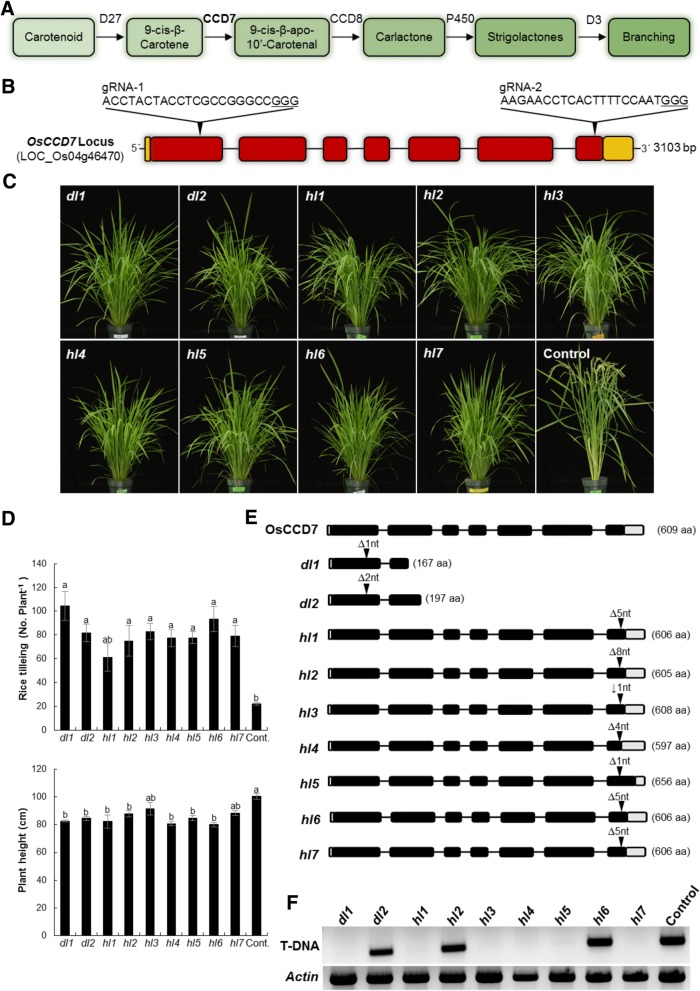
Fig. 1
Fig. 1
OsCCD7 mutagenesis produced high-tillering and reduced height phenotypes: a Schematic of the strigolactone biosynthesis pathway showing branching/tillering inhibition activity. Carotenoid Cleavage Dioxygenase 7 (CCD7) catalyzes 9′-cis-β-carotene at the initial steps of SL biosynthesis. b Gene model of OsCCD7/ D17 (Dwarf 17)/ HTD1 (High-Tillering Dwarf1), also called MAX3 ortholog (LOC_Os04g46470). Two gRNA were used to target the OsCCD7 locus. gRNA-1 was designed to target the 1st exon to produce a mutation similar to d17. The nomenclature used for these mutant lines is dl (d17-like). Two T0 lines were produced, dl1 and dl2. gRNA-2 was designed to target the 7th exon. The mutant lines produced were similar to htd1 and these lines were named as hl (htd1-like). Seven independent lines were produced, hl1 to hl7. The underlined GGG represents PAM sequence. c and d High-tillering and lower plant height phenotypes were observed for mutant plants. Tillering and plant height per plant were recorded from four plants per line (n = 4). All of the genotypes showed significant increases in tillers per plant and decreased plant height compared to control. e T1 generation of mutants were genotyped and mono-allelic lines were identified. Each of these mutations produced a protein variant. The nucleotide indels and protein alignments are shown in Additional file 1: Figure S2 and S3 respectively. f Analysis of the T2 generation showed some of the mutant lines do not carry a T-DNA. T-DNA-specific PCR analysis indicated that dl1, hl1, hl3, hl4, hl5 and hl7 are non-transgenic mutated plants. Actin PCR was done as a control
Fig. 2
Fig. 2
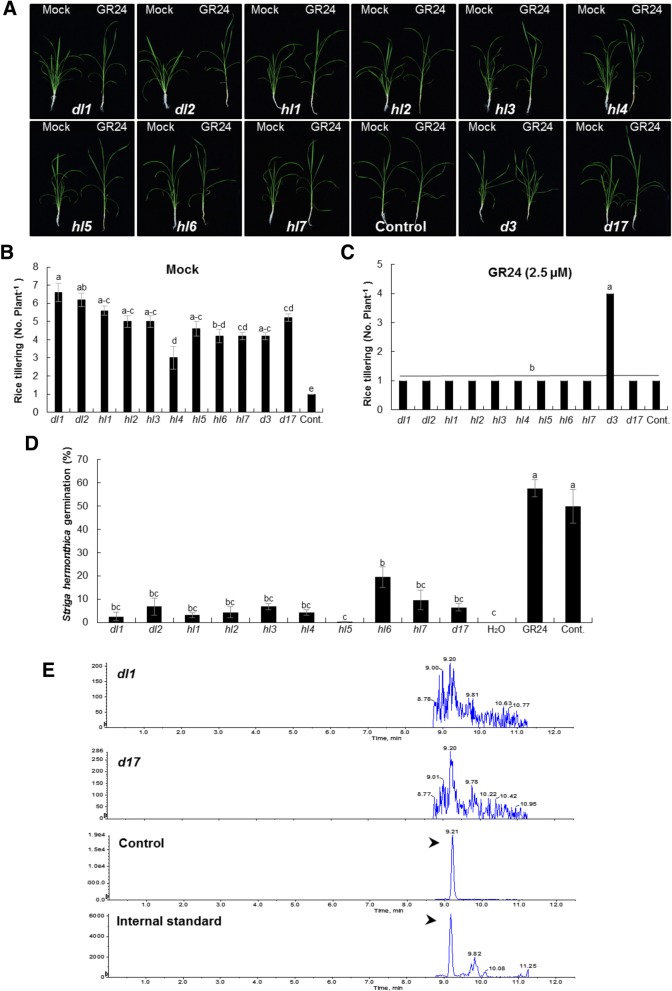
The ccd7 mutants showed impaired SL biosynthesis and decreased SL-dependent biological activity: a GR24 treatment rescued the tillering phenotype of all T1-mutant lines. One-week-old seedlings were grown in 50-ml tubes and GR24, a synthetic SL analog, was applied twice a week at 2.5 μM for 3 weeks. Cas9ox (Cont.), the SL-deficient mutant d17, and the SL-perception mutant d3 were used as controls. Tillering inhibition by GR24 feeding indicated that the high-tillering phenotype appeared because of lack of SLs biosynthesis. b-c Tillers per plant were recorded with or without GR24 treatment after 3 weeks of application. No. of tillers per plant were significantly reduced after GR24 treatment. Bars represent means ±SE (n = 6). Means not sharing a letter in common differ significantly at P0.05. d Striga germination bioassay was conducted to measure SL bioactivity in T1 mutant lines. The rice plants were grown under normal conditions for 3 weeks. Then in 4th week each line was grown under phosphate-deficient conditions for another week. The SLs were extracted from root exudates of each line and applied to pre-conditioned Striga seeds. Very low Striga seed germination was observed in mutants compared to control, indicating SL deficiency in these lines. Graph shows percent Striga germination in response to root exudates collected from each line. Cas9ox (Cont.) and d17 were used as control plant lines; in addition, the SL analog GR24 and H2O were applied to Striga seeds with no root extracts for controls to show maximum and minimum germination. e LC–MS/MS analysis using multiple reaction monitoring (MRM) of rice root exudates. The MRM transitions for various SLs from root exudates of control, d17 and ccd7 T1-mutant lines were observed. All of the mutants and d17 did not show any detectable signals for SLs. The chromatogram showed peaks for 4-deoxystrigol in the internal standard and control. One of the mutants (dl1) chromatogram is shown as an example

References

    1. Abe S, Sado A, Tanaka K, Kisugi T, Asami K, Ota S, Kim HI, Yoneyama K, Xie X, Ohnishi T, Seto Y, Yamaguchi S, Akiyama K, Yoneyama K, Nomura T. Carlactone is converted to carlactonoic acid by MAX1 in Arabidopsis and its methyl ester can directly interact with AtD14 in vitro. Proc Natl Acad Sci U S A. 2014;111(50):18084–18089. doi: 10.1073/pnas.1410801111. - DOI - PMC - PubMed
    1. Ahrazem O, Gomez-Gomez L, Rodrigo MJ, Avalos J, Limon MC. Carotenoid cleavage Oxygenases from microbes and photosynthetic organisms: features and functions. Int J Mol Sci. 2016;17(11):1781. doi: 10.3390/ijms17111781. - DOI - PMC - PubMed
    1. Al-Babili S, Bouwmeester HJ. Strigolactones, a novel carotenoid-derived plant hormone. Annu Rev Plant Biol. 2015;66:161–186. doi: 10.1146/annurev-arplant-043014-114759. - DOI - PubMed
    1. Alder A, Jamil M, Marzorati M, Bruno M, Vermathen M, Bigler P, Ghisla S, Bouwmeester H, Beyer P, Al-Babili S. The path from beta-carotene to carlactone, a strigolactone-like plant hormone. Science. 2012;335(6074):1348–1351. doi: 10.1126/science.1218094. - DOI - PubMed
    1. Ali Z, Mahas A, Mahfouz M. CRISPR/Cas13 as a tool for RNA interference. Trends Plant Sci. 2018;23(5):374–378. doi: 10.1016/j.tplants.2018.03.003. - DOI - PubMed

MeSH terms

LinkOut - more resources