


Diabetes mellitus and hyperglycemia control on the risk of colorectal adenomatous polyps: a retrospective cohort study
- PMID: 30157768
- PMCID: PMC6116428
- DOI: 10.1186/s12875-018-0835-1
Diabetes mellitus and hyperglycemia control on the risk of colorectal adenomatous polyps: a retrospective cohort study
Abstract
Background: Colorectal cancer (CRC) develops from colorectal adenomatous polyps. This study is to determine if diabetes mellitus (DM), its treatment, and hemoglobin A1c (HbA1c) level are associated with increased risk of colorectal adenomatous polyps.
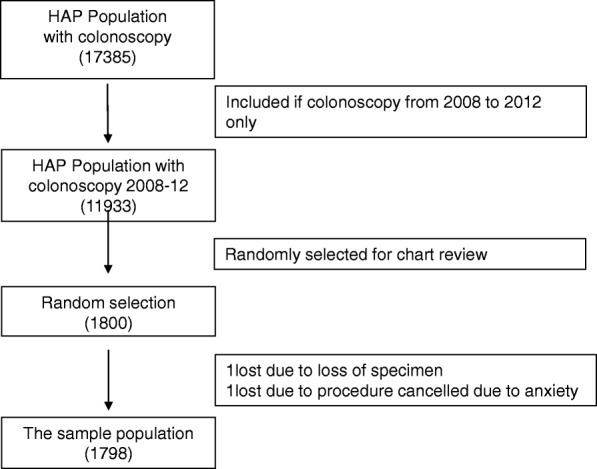
Methods: This was a retrospective cohort study that included patients who had at least one colonoscopy and were continuously enrolled in a single managed care organization during a 10-year period (2002-2012). Of these patients (N = 11,933), 1800 were randomly selected for chart review to examine the details of colonoscopy and pathology findings and to confirm the diagnosis of DM. Multivariable logistic regression analyses were performed to assess the associations between DM, its treatment, HbA1c level and adenomatous polyps (our main outcome).
Results: Among the total of 11,933 patients with a mean (standard deviation) age of 56 (± 8.8) years, 2306 (19.3%) had DM and 75 (0.6%) had CRC. Among the 1800 under chart review, 445 (24.7%) had DM, 11 (0.6%) had CRC and 537 (29.8%) had adenomatous polyps. In bivariate analysis, patients with DM had 1.45 odds of developing adenomatous polyps compared to those without DM. This effect was attenuated (odds ratio = 1.25, 95% CI: 0.96-1.62, p = 0.09) after adjusting for confounders such as age, gender, race/ethnicity, and body mass index. There was no significant association between type or duration of DM treatment or HbA1c level and adenomatous polyps.
Conclusions: Our study confirmed the known increased risk of adenomatous polyps with advancing age, male gender, Hispanic race/ethnicity and higher body mass index. Although it suggested an association between DM and adenomatous polyps, a statistically significant association was not observed after controlling for other potential confounders. Further studies with a larger sample size are needed to further elucidate this relationship.
Keywords: Adenomatous polyp; Colonoscopy; Diabetes mellitus; Treatment.
Conflict of interest statement
Ethics approval and consent to participate
The Henry Ford Health System Institutional Review Board approved this study. The Institutional Review Board waived the need for patient consent.
Consent for publication
Not applicable.
Competing interests
The authors declare that they have no competing interests.
Publisher’s Note
Springer Nature remains neutral with regard to jurisdictional claims in published maps and institutional affiliations.
Figures
References
-
- American Cancer Society . Cancer facts and figures 2015. Atlanta: American Cancer Society; 2015.
-
- National Cancer Institute. SEER cancer statistics factsheets: colon and rectum cancer. 2015 https://seer.cancer.gov/statfacts/html/colorect.html. Accessed Apr 2015.
MeSH terms
Substances
LinkOut - more resources
Full Text Sources
Other Literature Sources
Medical
