


Seasonal variations in Plasmodium falciparum genetic diversity and multiplicity of infection in asymptomatic children living in southern Ghana
- PMID: 30157794
- PMCID: PMC6114730
- DOI: 10.1186/s12879-018-3350-z
Seasonal variations in Plasmodium falciparum genetic diversity and multiplicity of infection in asymptomatic children living in southern Ghana
Abstract
Background: Genetic diversity in Plasmodium falciparum (P. falciparum) parasites is a major hurdle to the control of malaria. This study monitored changes in the genetic diversity and the multiplicity of P. falciparum parasite infection in asymptomatic children living in southern Ghana at 3 month intervals between April 2015 and January 2016.
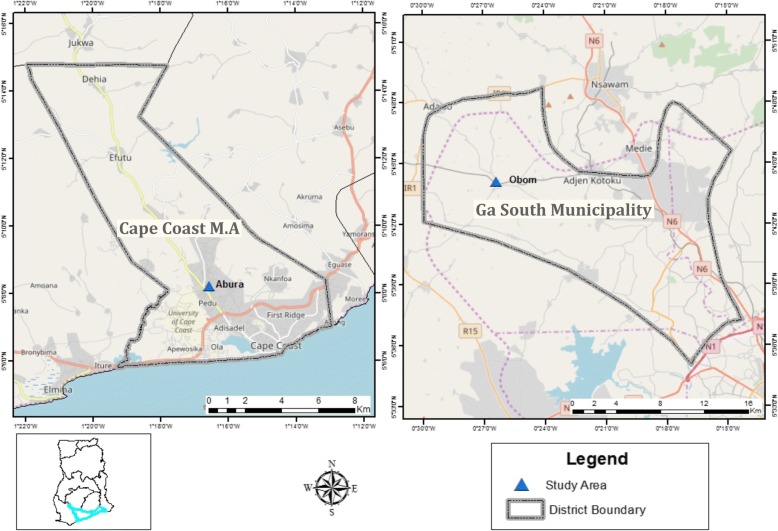
Methods: Filter paper blood spots (DBS) were collected quarterly from children living in Obom, a community with perennial malaria transmission and Abura, a community with seasonal malaria transmission. Genomic DNA was extracted from the DBS and used in polymerase chain reaction (PCR)-based genotyping of the merozoite surface protein 1 (msp 1) and merozoite surface protein 2 (msp 2) genes.
Results: Out of a total of 787 samples that were collected from the two study sites, 59.2% (466/787) tested positive for P. falciparum. The msp 1 and msp 2 genes were successfully amplified from 73.8% (344/466) and 82.5% (385/466) of the P. falciparum positive samples respectively. The geometric mean MOI in Abura ranged between 1.17 (95% CI: 1.08-1.28) and 1.48 (95% CI: 1.36-1.60) and was significantly lower (p < 0.01, Dunn's multiple comparison test) than that determined in Obom, where the geometric mean MOI ranged between 1.82 (95% CI: 1.58-2.08) and 2.50 (95% CI: 2.33-2.678) over the study period. Whilst the msp 1 R033:MAD20:KI allelic family ratio was dynamic, the msp 2 3D7:FC27 allelic family ratio remained relatively stable across the changing seasons in both sites.
Conclusions: This study shows that seasonal variations in parasite diversity in these communities can be better estimated by msp 1 rather than msp 2 due to the constantly changing relative intra allelic frequencies observed in msp 1 and the fact that the dominance of any msp 2 allele was dependent on the transmission setting but not on the season as opposed to the dominance of any msp 1 allele, which was dependent on both the season and the transmission setting.
Keywords: Allele; Asymptomatic; Genetic diversity; Malaria; Multiplicity of infection; msp 1; msp 2.
Conflict of interest statement
Ethics approval and consent to participate
Ethical clearance for this study was obtained from the Institutional Review Board of the Noguchi Memorial Institute for Medical Research (NMIMR). Approval to conduct the study was also granted by the Regional and District Directors of Education that have oversight over primary schools from which study participants were recruited. The study was explained to the parents / guardians of the school children prior to initiating the study. Only children whose parent / guardian provided written informed consent were recruited into the study.
Consent for publication
Not applicable.
Competing interests
The authors declare that they have no competing interests.
Publisher’s Note
Springer Nature remains neutral with regard to jurisdictional claims in published maps and institutional affiliations.
Figures


References
-
- Konaté L, Zwetyenga J, Rogier C, Bischoff E, Fontenille D, Tall A, Spiegel A, Trape J-F, Mercereau-Puijalon O. 5. Variation of plasmodium falciparum msp1 block 2 and msp2 allele prevalence and of infection complexity in two neighbouring Senegalese villages with different transmission conditions. Trans R Soc Trop Med Hyg. 1999;93:21–28. doi: 10.1016/S0035-9203(99)90323-1. - DOI - PubMed
-
- Smith T, Beck H-P, Kitua A, Mwankusye S, Felger I, Fraser-Hurt N, Irion A, Alonso P, Teuscher T, Tanner M. 4. Age dependence of the multiplicity of plasmodium falciparum infections and of other malariological indices in an area of high endemicity. Trans R Soc Trop Med Hyg. 1999;93:15–20. doi: 10.1016/S0035-9203(99)90322-X. - DOI - PubMed
MeSH terms
Substances
LinkOut - more resources
Full Text Sources
Other Literature Sources
Research Materials
Miscellaneous
