


Nanospectroscopy Captures Nanoscale Compositional Zonation in Barite Solid Solutions
- PMID: 30158629
- PMCID: PMC6115454
- DOI: 10.1038/s41598-018-31335-3
Nanospectroscopy Captures Nanoscale Compositional Zonation in Barite Solid Solutions
Abstract
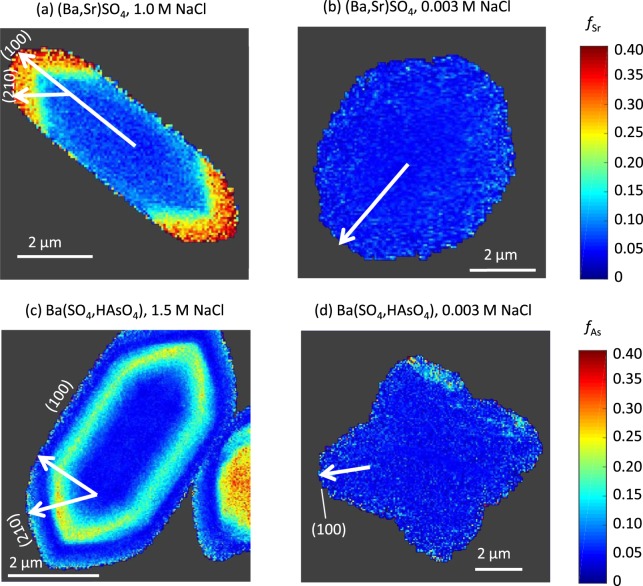
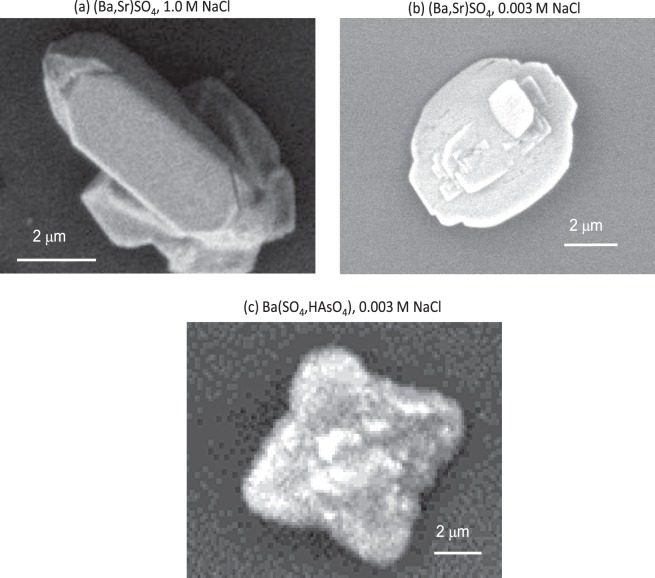
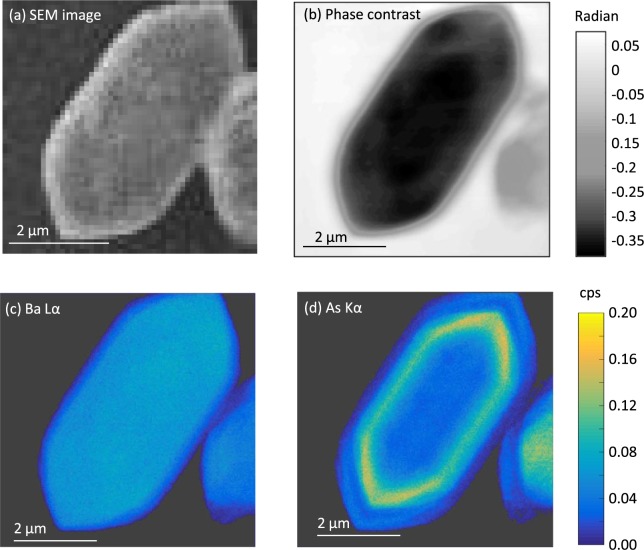
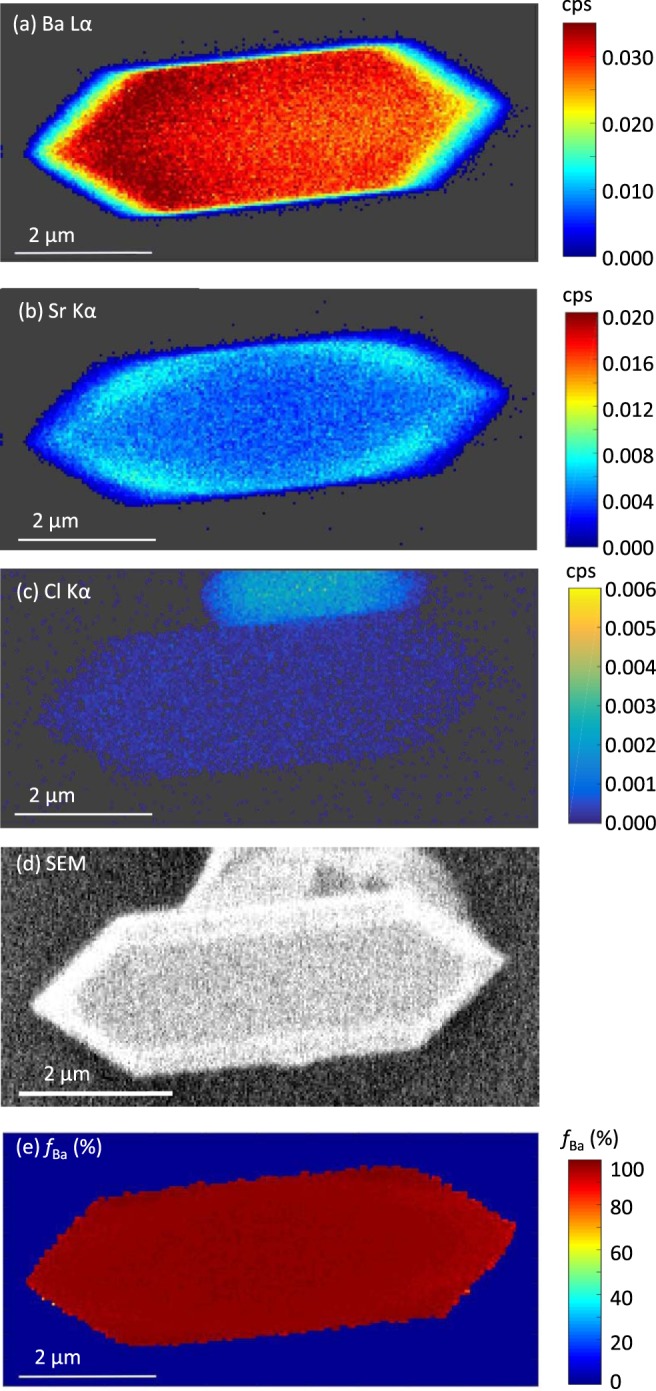
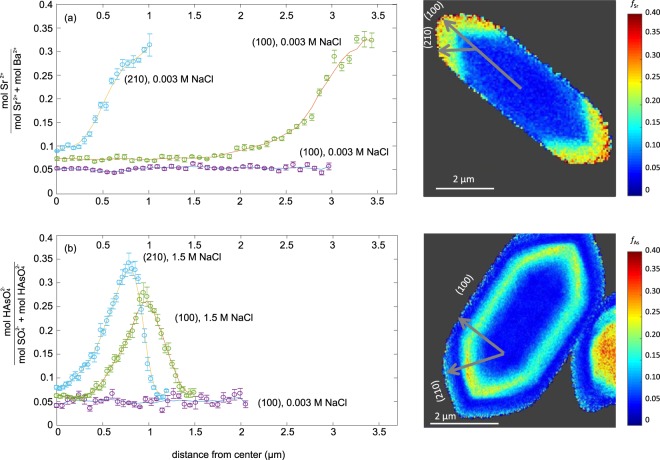
Scientists have long suspected that compositionally zoned particles can form under far-from equilibrium precipitation conditions, but their inferences have been based on bulk solid and solution measurements. We are the first to directly observe nanoscale trace element compositional zonation in <10 µm-sized particles using X-ray fluorescence nanospectroscopy at the Hard X-ray Nanoprobe (HXN) Beamline at National Synchrotron Light Source II (NSLS-II). Through high-resolution images, compositional zonation was observed in barite (BaSO4) particles precipitated from aqueous solution, in which Sr2+ cations as well as HAsO42- anions were co-precipitated into (Ba,Sr)SO4 or Ba(SO4,HAsO4) solid solutions. Under high salinity conditions (NaCl ≥ 1.0 M), bands contained ~3.5 to ~5 times more trace element compared to the center of the particle formed in early stages of particle growth. Quantitative analysis of Sr and As fractional substitution allowed us to determine that different crystallographic growth directions incorporated trace elements to different extents. These findings provide supporting evidence that barite solid solutions have great potential for trace element incorporation; this has significant implications for environmental and engineered systems that remove hazardous substances from water.
Conflict of interest statement
The authors declare no competing interests.
Figures
References
-
- Doerner HA, Hoskins WM. Co-Precipitation of Radium and Barium Sulfates. Jounral Am. Chem. Soc. 1925;47:662–675. doi: 10.1021/ja01680a010. - DOI
-
- Gordon L, Reimer CC, Burtt BP. Distribution of Strontium within Barium Sulfate Precipitated from Homogeneous Solution. Anal. Chem. 1954;26:842–846. doi: 10.1021/ac60089a012. - DOI
-
- Plummer LN, Busenberg E. Thermodynamics of aragonite-strontianite solid-solutions: Results from stoichiometric solubility at 25 and 76 °C. Geochim. Cosmochim. Acta. 1987;51:1393–1411. doi: 10.1016/0016-7037(87)90324-3. - DOI
-
- Glynn, P. D. Modeling Solid-Solution Reactions in Low-Temperature Aqueous Systems. Chem. Model. Aqueous Syst. II 74–86, 10.1021/bk-1990-0416.ch006 (1990).
-
- Myneni SCB, Traina SJ, Logan TJ, Waychunas GA. Oxyanion Behavior in Alkaline Environments: Sorption and Desorption of Srsenate in Ettringite. Environ. Sci. Technol. 1997;31:1761–1768. doi: 10.1021/es9607594. - DOI
Grants and funding
LinkOut - more resources
Full Text Sources
Other Literature Sources
Research Materials
