


Cancer genetics, precision prevention and a call to action
- PMID: 30158684
- PMCID: PMC6420140
- DOI: 10.1038/s41588-018-0202-0
Cancer genetics, precision prevention and a call to action
Erratum in
-
Publisher Correction: Cancer genetics, precision prevention and a call to action.Nat Genet. 2019 Jan;51(1):196. doi: 10.1038/s41588-018-0326-2. Nat Genet. 2019. PMID: 30542102
Abstract
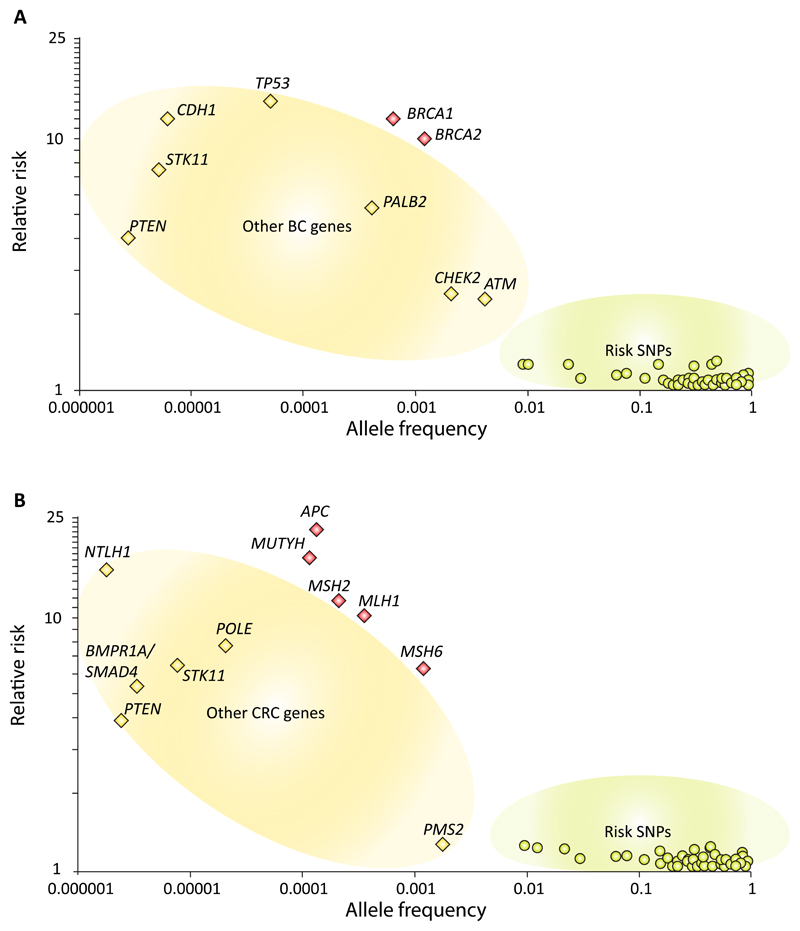
More than 15 years have passed since the identification, through linkage, of 'first-wave' susceptibility genes for common cancers (BRCA1, BRCA2, MLH1 and MSH2). These genes have strong frequency-penetrance profiles, such that the associated clinical utility probably remains relevant regardless of the context of ascertainment. 'Second-wave' genes, not tractable by linkage, were subsequently identified by mutation screening of candidate genes (PALB2, ATM, CHEK2, BRIP1, RAD51C and RAD51D). Their innately weaker frequency-penetrance profiles have rendered delineation of cancer associations, risks and variant pathogenicity challenging, thereby compromising their clinical application. Early germline exome-sequencing endeavors for common cancers did not yield the long-anticipated slew of 'next-wave' genes but instead implied a highly polygenic genomic architecture requiring much larger experiments to make any substantive inroads into gene discovery. As such, the 'genetic economics' of frequency penetrance clearly indicates that focused identification of carriers of first-wave-gene mutations is most impactful for cancer control. With screening, prevention and early detection at the forefront of the cancer management agenda, we propose that the time is nigh for the initiation of national population-testing programs to identify carriers of first-wave gene mutation carriers. To fully deliver a precision prevention program, long-term, large-scale mutation studies that capture longitudinal clinical data and serial biosamples are required.
Conflict of interest statement
The authors declare no competing financial or non-financial interests as defined by Nature Research.
Figures
References
-
- Yurgelun MB, Chenevix-Trench G, Lippman SM. Translating Germline Cancer Risk into Precision Prevention. Cell. 2017;168:566–570. - PubMed
-
- Nolan E, et al. RANK ligand as a potential target for breast cancer prevention in BRCA1-mutation carriers. Nat Med. 2016;22:933–9. - PubMed
-
- Cancer incidence statistics. Cancer Research UK; 2017.
Publication types
Grants and funding
LinkOut - more resources
Full Text Sources
Other Literature Sources
Research Materials
Miscellaneous
