


Hydroxyurea Associated Cutaneous Lesions: A Case Report
- PMID: 30159077
- PMCID: PMC6108816
- DOI: 10.3889/oamjms.2018.320
Hydroxyurea Associated Cutaneous Lesions: A Case Report
Abstract
Background: Hydroxyurea (HU) is an antimetabolite agent that interferes with the S-phase of cellular replication and inhibits DNA synthesis, with little or no effect on RNA or protein synthesis. It is used in the treatment of many myeloproliferative disorders (MD) and is particularly a first line treatment drug for intermediate to high-risk essential thrombocythemia. Although safe and very well tolerated by the patients suffering from MD, there have been numerous reports of a broad palette of cutaneous side effects associated with prolonged intake of the medication. These may include classical symptoms such as xerosis, diffuse hyperpigmentation, brown-nail discolouration, stomatitis and scaling of the face, hands, and feet or more serious side effects such as actinic keratosis lesions, leg ulcers and multiple skin carcinomas.
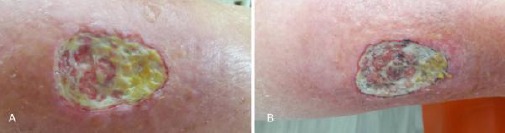
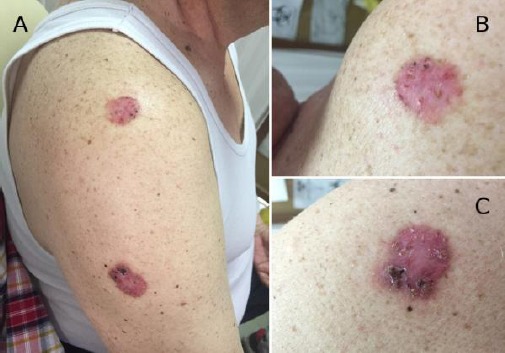
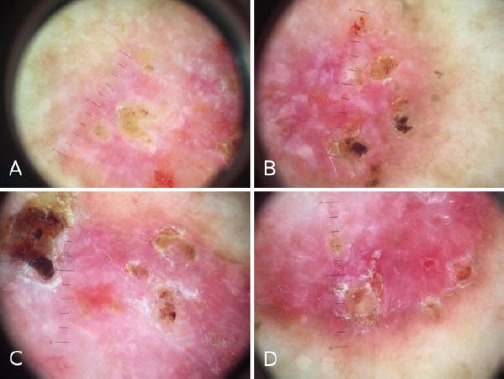
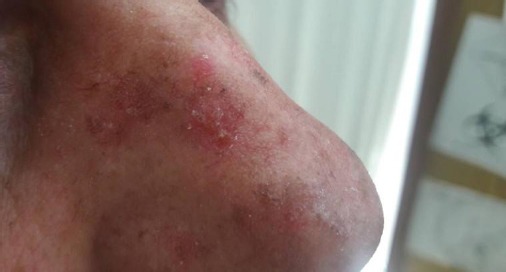
Case report: We report a case of a 52-year-old man, on long-term therapy with HU for essential thrombocytosis, with several concurrent skin lesions. Despite the perennial use of HU, the cutaneous changes were neglected. The local dermatological examination revealed oval perimalleolar ulcer on the right leg, with dimensions 6 x 4 cm, clearly demarcated from the surroundings with regular margins, periulcerous erythema, with very deep and highly fibrinous bed of the ulcer, positive for bacterial infection. The ulcer was treated with topical wound therapy with alginate and parenteral antibiotics. The extended dermatological screening also showed two nummular lesions in the right brachial region, presenting as erythematous papules with sharp margins from the surrounding skin, gritty desquamation and dotted hyperpigmentations inside the lesion. Further dermoscopy and biopsy investigations confirmed a diagnosis of basal cell carcinoma. Nasal actinic keratosis was also noted. The patient was advised for discontinuing or substituting the HU therapy.
Conclusion: We present this case to draw attention to the various cutaneous side effects that occur with perennial HU use and suggest an obligatory reference to a dermatological consult.
Keywords: Basal cell carcinoma; Cutaneous side effects; Hydroxyurea therapy; Leg ulcer.
Figures
References
-
- Best PJ, Petitt RM. Multiple skin cancers associated with hydroxyurea therapy. Mayo Clin Proc. 1998;73(10):961–3. https://doi.org/10.4065/73.10.961 PMid:97≆6. - PubMed
-
- Sirieix ME, Debure C, Baudot N, et al. Leg ulcers and hydroxyurea:forty-one cases. Arch Dermatol. 1999;135(7):818–820. https://doi.org/10.1001/archderm.135.7.818 PMid:10411157. - PubMed
-
- Tefferi A, Barbui T. Polycythemia vera and essential thrombocythemia:2015 update on diagnosis, risk?stratification and management. Am J Hematol. 90:162–173. - PubMed
-
- Tefferi A, Vannucchi AM, Barbui T. Polycythemia vera treatment algorithm 2018. Blood Cancer Journal. 2018;8(1):3. https://doi.org/10.1038/s41408-017-0042-7 PMid:29321547 PMCid:PMC5802495. - PMC - PubMed
-
- Randi ML, Ruzzon E, Tezza F, et al. Toxicity and side effects of hydroxyurea used for primary thrombocythemia. Platelets. 2005;16(3-4):181–4. https://doi.org/10.1080/09537100400020179 PMid:16011962. - PubMed
Publication types
LinkOut - more resources
Full Text Sources
Other Literature Sources