


Impact of Pore Size and Surface Chemistry of Porous Silicon Particles and Structure of Phospholipids on Their Interactions
- PMID: 30159385
- PMCID: PMC6108535
- DOI: 10.1021/acsbiomaterials.8b00343
Impact of Pore Size and Surface Chemistry of Porous Silicon Particles and Structure of Phospholipids on Their Interactions
Abstract
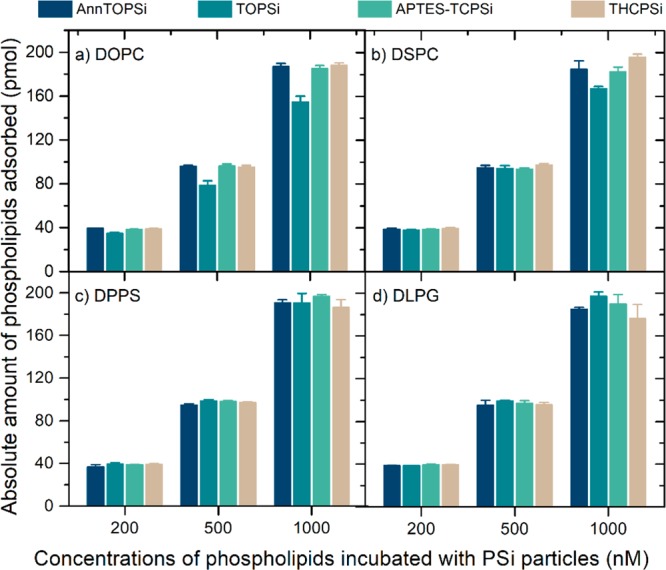
By exploiting its porous structure and high loading capacity, porous silicon (PSi) is a promising biomaterial to fabricate protocells and biomimetic reactors. Here, we have evaluated the impact of physicochemical properties of PSi particles [thermally oxidized PSi, TOPSi; annealed TOPSi, AnnTOPSi; (3-aminopropyl) triethoxysilane functionalized thermally carbonized PSi, APTES-TCPSi; and thermally hydrocarbonized PSi, THCPSi] on their surface interactions with different phospholipids. All of the four phospholipids were similarly adsorbed by the surface of PSi particles, except for TOPSi. Among four PSi particles, TOPSi with hydrophilic surface and smaller pore size showed the weakest adsorption toward phosphatidylcholines. By increasing the pore size from roughly 12.5 to 18.0 nm (TOPSi vs AnnTOPSi), the quantity of phosphatidylcholines adsorbed by TOPSi was enhanced to the same level of hydrophilic APTES-TCPSi and hydrophobic THCPSi. The 1,2-dioleoyl-sn-glycero-3-phosphocholine (DOPC) exhibited the highest release ratio of phospholipids from all four PSi particles, and phosphatidylserine (DPPS) showed the lowest release ratio of phospholipids from PSi particles, except for TOPSi, which adsorbed less phospholipids due to the small pore size. There is consistency in the release extent of phospholipids from PSi particles and the isosteric heat of adsorption. Overall, our study demonstrates the importance of pore size and surface chemistry of PSi particles as well as the structure of phospholipids on their interactions. The obtained information can be employed to guide the selection of PSi particles and phospholipids to fabricate highly ordered structures, for example, protocells, or biomimetic reactors.
Conflict of interest statement
The authors declare no competing financial interest.
Figures




References
-
- Ashley C. E.; Carnes E. C.; Phillips G. K.; Padilla D.; Durfee P. N.; Brown P. A.; Hanna T. N.; Liu J.; Phillips B.; Carter M. B.; Carroll N. J.; Jiang X.; Dunphy D. R.; Willman C. L.; Petsev D. N.; Evans D. G.; Parikh A. N.; Chackerian B.; Wharton W.; Peabody D. S.; Brinker C. J. The Targeted Delivery of Multicomponent Cargos to Cancer Cells by Nanoporous Particle-Supported Lipid Bilayers. Nat. Mater. 2011, 10 (5), 389–97. 10.1038/nmat2992. - DOI - PMC - PubMed
-
- Herino R.; Bomchil G.; Barla K.; Bertrand C.; Ginoux J. L. Porosity and Pore Size Distributions of Porous Silicon Layers. J. Electrochem. Soc. 1987, 134 (8), 1994–2000. 10.1149/1.2100805. - DOI
-
- Björkqvist M.; Salonen J.; Paski J.; Laine E. Characterization of Thermally Carbonized Porous Silicon Humidity Sensor. Sens. Actuators, A 2004, 112 (2–3), 244–247. 10.1016/j.sna.2004.01.002. - DOI
LinkOut - more resources
Full Text Sources
Other Literature Sources
