Review
. 2018 May 14;3(2):75-98.
doi: 10.1016/j.ncrna.2018.05.002. eCollection 2018 Jun.

Molecular functions and specific roles of circRNAs in the cardiovascular system

Affiliations
Review

Molecular functions and specific roles of circRNAs in the cardiovascular system

Lesca M Holdt et al. Noncoding RNA Res. .

Erratum in

Abstract

As part of the superfamily of long noncoding RNAs, circular RNAs (circRNAs) are emerging as a new type of regulatory molecules that partake in gene expression control. Here, we review the current knowledge about circRNAs in cardiovascular disease. CircRNAs are not only associated with different types of cardiovascular disease, but they have also been identified as intracellular effector molecules for pathophysiological changes in cardiovascular tissues, and as cardiovascular biomarkers. This evidence is put in the context of the current understanding of general circRNA biogenesis and of known interactions of circRNAs with DNA, RNA, and proteins.

Keywords: Cardiovascular disease; Circular RNA; Non-coding RNA; Splicing; Transcription; circRNA.


Figures
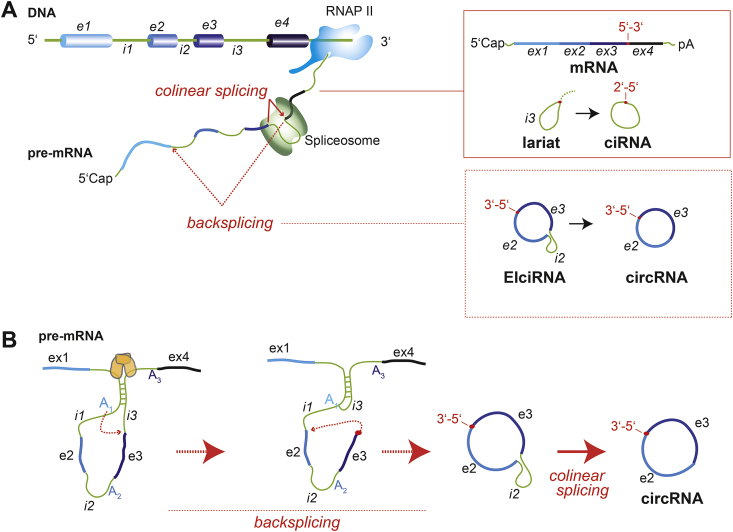
Fig. 1
Fig. 1
Biogenesis of spliceosome-dependent circular RNAs. Overview of the three classes of spliceosome-dependent circular RNAs treated in this review: ciRNAs, EIciRNAs and circRNAs (A). Shown is the arrangement of exons (e1-4) and introns (i1-3) in 5′-3′ order in a gene in the genome, and the transcription into an exon- and intron-containing pre-mRNA, which is either collinearly spliced (top) or backspliced (bottom). Colinear splicing results in a major product (the exon-containing mRNA, where exons are arranged in the same 5′-3′ order as in encoded in the genome), and the byproducts (introns in the form of 2′-5′ branched lariats, of which only one case is shown). Lariats are usually rapidly degraded in the nucleus, but can become processed and parental molecules for ciRNAs. Backsplicing (bottom) results in a major product (3′-5′-linked EIciRNAs and circRNAs), and the byproduct (2′-5′ branched mRNA, not shown). Details of backsplicing are depicted in detail in (B). (B) Backsplicing resulting in 3′-5′-linked circRNA formation: Intramolecular backfolding between inverted intronic repeats in the pre-mRNA, assisted by dimerization of RNA-binding proteins with binding motifs on the pre-mRNA, brings canonical splice junction in such a three-dimensional context, that a downstream end of an exon (red dot) is spliced to the begin of an upstream exon. The two transesterification reactions are shown with small red dotted arrows (indicating the direction of the underlying nucleophilic attack). The result is a 3′-5′-linked EIciRNA that displays an intervening intron. This intron is further processed by conventional splicing to an exon-only 3′-5′-linked circRNA. Introns (light green), exons (different shades of blue, indicating more 5′ or more 3′ location in a gene or mRNA), RNA-binding proteins serving as circRNA biogenesis regulators like Quaking or Muscleblind (orange), RNA polymerase III holocomplex (RNAP II), Spliceosome (dark green).
Fig. 2
Fig. 2
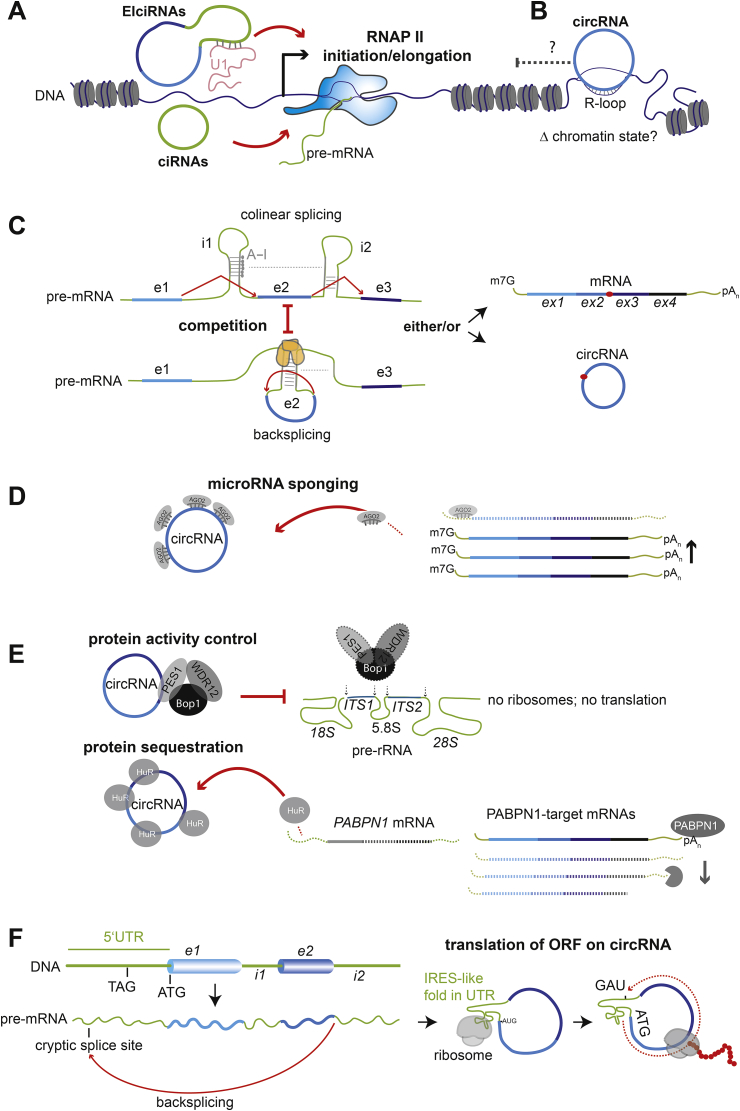
General molecular functions of circular RNAs. Proposed functions of circular RNAs in the cell nucleus (A–C) and the cytoplasm (D–F). Functions are not arranged by the prominence where circular RNAs are expected to be most important but instead are ordered by how gene expression proceeds, starting from transcription and ranging over co-/post-transcriptional processing to cytoplasmic regulation and finally to translation. (A) EiciRNAs and ciRNAs binding to host locus and stimulating RNAP II initiation and/or elongation. (B) circRNA binding to DNA sequence encoding the circRNA-generating exon in the host locus and forming and R-loop at this site. This is proposed to impair RNAP II progression, a function so far not studied as a transcription-regulating process, but rather as a splicing regulating process. (C) Model for competition between colinear splicing (top) and co-transcriptional backsplicing (bottom): competition is due to backfolding between different intronic repeat motifs (grey segments). Selective adenosine deamination to inosine by ADAR enzymes within double-stranded RNA patches in the backfolded regions can promote linear splicing (top). RNA-binding protein like Quaking or Muscleblind (orange) bind and homodimerize, and thereby can promote backsplicing by favoring backfolding of introns flanking the circularization event (bottom). (D) Sequestration of Argonaute 2-bound microRNAs on the circRNA (left) reduces the cellular pool of active microRNAs and, thereby, increases the abundance of mRNAs that would otherwise be degraded by these microRNAs (right). (E) Known examples of circRNA:protein interactions: circANRIL binding PES1 protein of the PeBoW complex. This interaction blocks PeBoW activity in ribosomal RNA (rRNA) maturation (Top). The second example (bottom): Sequestration of HuR proteins by circPABPN reduces the free levels of the PABPN mRNA-stabilizing HuR and leads to reduced levels of PABPN1 protein, leading to destabilization of PABPN1-dependent mRNAs. (F) An exceptional case of protein translation from an open reading frame (ORFs) encoded on a circRNA: Sequences in the genes 5′UTR that serve as unconventional internal ribosome entry site (IRES) for translation beginning with the ATG start codon. Translation proceeds until an in-frame stop codon (UAG) located, for example, in the 5′ UTR.
Fig. 3
Fig. 3
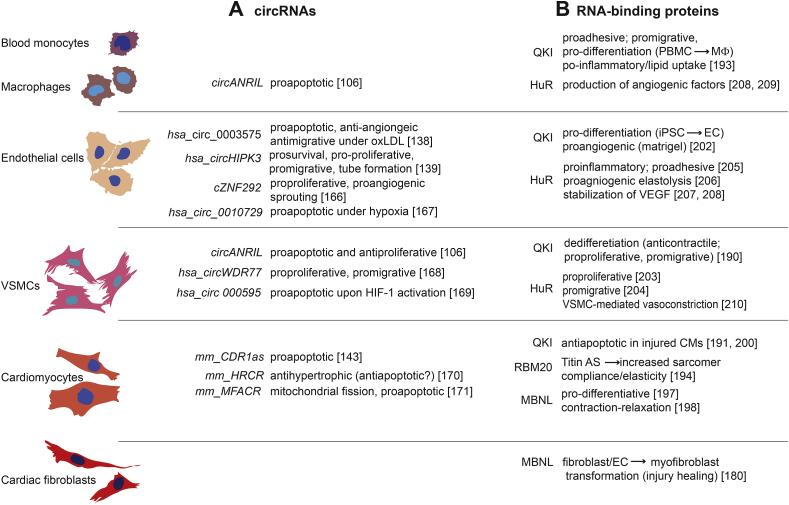
Cellular roles of circRNAs in cardiovascular cell types in vitro. Blood cells and cells of the cardiovascular system that are known to contribute to cardiovascular diseases are depicted on the left. Evidence for cellular roles of (A) circRNAs and of (B) RNA-binding proteins that have recently also been identified as circRNA biogenesis regulators. Evidence stems from in vitro experiments in cultured cells. Note that it is unknown whether the cardiovascular roles of the indicated RNA-binding proteins are related in any way to their function as circRNA biogenesis regulators.

References

    1. Ulitsky I. Evolution to the rescue: using comparative genomics to understand long non-coding RNAs. Nat. Rev. Genet. 2016;17:601–614. - PubMed
    1. Rizki G., Boyer L.A. Lncing epigenetic control of transcription to cardiovascular development and disease. Circ. Res. 2015;117:192–206. - PubMed
    1. Salzman J., Gawad C., Wang P.L., Lacayo N., Brown P.O. Circular RNAs are the predominant transcript isoform from hundreds of human genes in diverse cell types. PLoS One. 2012;7 - PMC - PubMed
    1. Szabo L., Salzman J. Detecting circular RNAs: bioinformatic and experimental challenges. Nat. Rev. Genet. 2016;17:679–692. - PMC - PubMed
    1. Suzuki H., Zuo Y., Wang J., Zhang M.Q., Malhotra A., Mayeda A. Characterization of RNase R-digested cellular RNA source that consists of lariat and circular RNAs from pre-mRNA splicing. Nucleic Acids Res. 2006;34:e63. - PMC - PubMed

LinkOut - more resources